How to Deepen Your Trataka Practice
Miha Cacic · April 8, 2026 · 8 min read
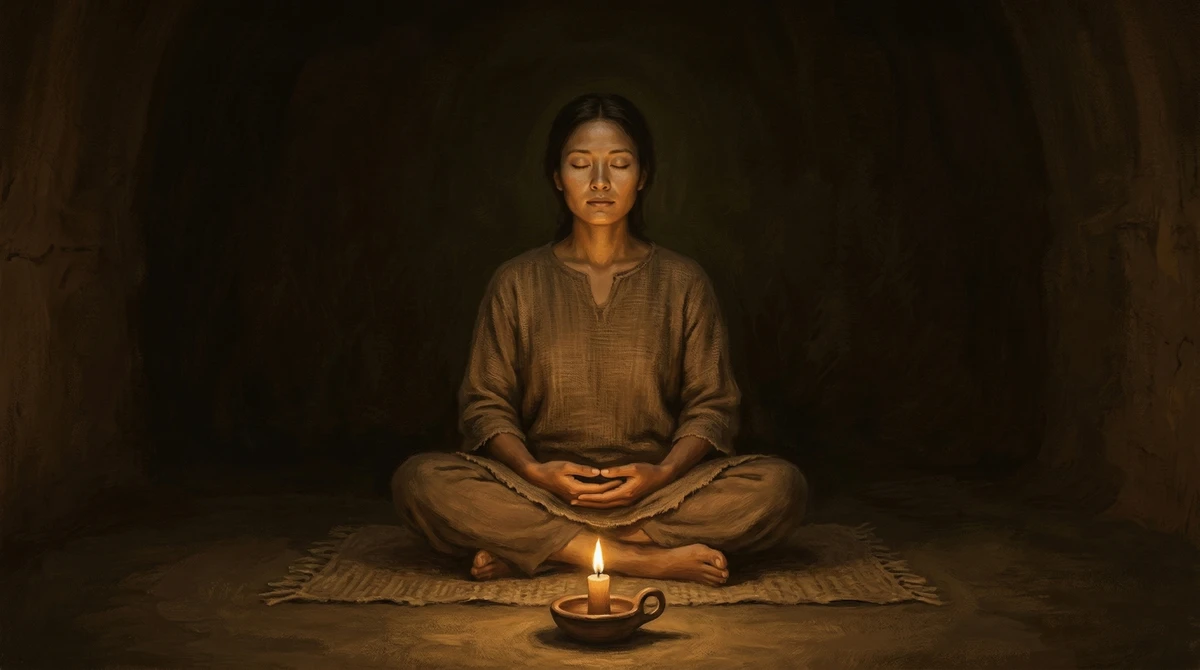
You can gaze at a candle flame for ten minutes without blinking. The afterimage appears when you close your eyes, floats for a few seconds, then dissolves into nothing. You open your eyes and start over. That’s where most practitioners get stuck, and adding more minutes of staring won’t fix it.
Deepening trataka is not about extending your gaze. It’s about what happens after you close your eyes. The retinal afterimage is physiology. What you do when it fades (whether you can hold a purely mental image and eventually rest in the luminous space behind it) is the actual practice. Most guides skip this entirely because most guides are written for beginners.
Why your practice has plateaued
Trataka has three distinct stages, and they require different skills. The Hatha Yoga Pradipika lists trataka among the six shatkarmas (cleansing practices), but it’s the only one that bridges into meditation. The three stages, as described in Swami Niranjanananda Saraswati’s Dharana Darshan (Bihar School of Yoga, 2003), are:
- Bahiranga trataka (external): gazing at the flame. This settles the mind and trains the eyes.
- Antaranga trataka (internal): working with the afterimage and mental visualization after closing the eyes.
- Chidakasha dharana (void): resting in the dark field of awareness itself, once even the mental image dissolves.
These are not levels of the same exercise. They are qualitatively different practices. External gazing is dharana (concentration on an object). The internal phase corresponds to dhyana (effortless, receptive attention). Patanjali’s Yoga Sutras make this distinction explicit: dharana is “fixing the mind on one place” (III:1), dhyana is “the uninterrupted flow of the mind toward the chosen object” (III:2). Different mental operations, different modes of attention.
A 2014 study by Talwadkar, Jagannathan, and Raghuram tested this with 60 elderly participants (48 completed the study) who practiced trataka for 30 minutes daily over 26 days. The trataka group showed significant improvements in working memory, selective attention, and executive function compared to controls. The critical finding: a single session produced no measurable difference between groups. The cognitive benefits required sustained daily practice across the full protocol, which included external gazing, defocusing, breathwork, and chanting. If you’re doing the same ten-minute candle gaze every day and wondering why nothing changes, this study suggests a reason: the benefits come from the complete practice, including the internal phases, sustained over weeks.
The afterimage is not the goal, it’s the doorway
When you stare at a candle flame and close your eyes, the bright image you see is a retinal afterimage. It’s caused by photoreceptor fatigue: the cells that fired continuously while you gazed at the flame temporarily produce a complementary signal when the stimulus is removed. This is pure physiology. It happens to everyone, regardless of skill, and it fades on its own within 10 to 60 seconds. 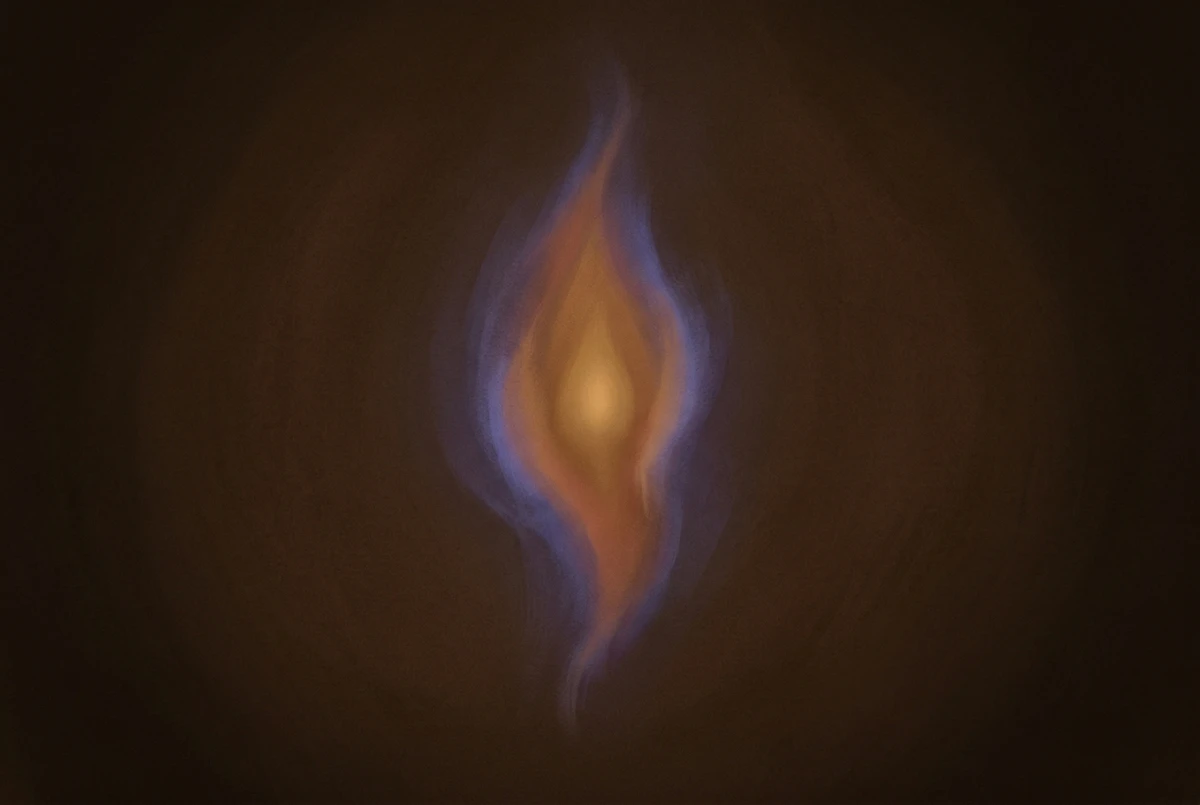
Most practitioners treat this fading as the end of their inner practice. It’s actually the beginning.
The moment the retinal afterimage dissolves is the transition point from bahiranga to antaranga trataka. Can you reconstruct the image mentally, without retinal support? That’s a fundamentally different cognitive process. One is passive sensory persistence. The other is active mental image construction.
A 2010 study published in PNAS by van Boxtel, Tsuchiya, and Koch found that how you gaze at the flame determines how long the afterimage lasts. Forced attention to the stimulus decreased afterimage duration, while relaxed awareness increased it. The researchers concluded that attention and consciousness operate through distinct neural mechanisms with opposing effects on afterimages. For trataka, the implication is direct: a tense, straining gaze at the candle produces a weaker starting point for inner practice than a steady, relaxed one.
This finding aligns with what practitioners discover through experience. One practitioner on Quora reported a breakthrough: “After closing your eyes, don’t try to look at the afterimage with the physical eyes. I found that I could break myself of the habit by forcing my eyes to move around inside my lids and noticing that the eye movement does not affect the positioning of the afterimage.” The afterimage is not where your eyes point. It’s in the visual cortex. When you relax the eye muscles entirely and stop trying to “look at” it, the image stabilizes and lasts longer.
Signs that you’re making the transition from retinal afterimage to mental visualization:
- The image reappears after fading completely
- It begins changing color or shape (often cycling through complementary colors)
- You can gently move it to the space between your eyebrows (the ajna center, where traditional texts instruct you to hold it)
- The image feels less like something you’re seeing and more like something you’re generating
How to strengthen your inner trataka
The internal visualization phase is a trainable skill, not a talent you either have or don’t. Here are specific techniques that develop it.
Use pulsed refixation instead of one long attempt. Open your eyes and gaze at the flame for 5 to 10 seconds, then close them and hold the afterimage for as long as you can. When it fades, open and gaze again briefly, then close. Multiple short cycles of gazing and visualizing outperform a single long gaze followed by one attempt to hold the image. Each cycle refreshes the retinal impression and gives you another chance to practice the transition into mental visualization.
Practice in a completely dark room. Ambient light competes with the afterimage and shortens its duration. A dark room with only the candle flame produces maximum contrast and the strongest possible starting image to work with. Shield the candle from drafts; a flickering flame creates an unstable retinal impression that’s harder to hold mentally.
Optimize your candle setup. A larger, steady flame at roughly arm’s length (50 to 75 centimeters), against a dark background, produces a stronger afterimage. Traditional texts don’t specify a precise distance (the Hatha Yoga Pradipika says only “a small point”), while the Bihar School recommends arm’s length and Dr. Giridhar ‘Yogeshwar’ (1983) suggests “between one and three yards.” Experiment within this range to find what works for your eyes.
When the afterimage fades, trace it. Don’t let your attention scatter. Mentally redraw the outline of the flame, starting from its brightest center point and expanding outward. You’re shifting from passive observation to active reconstruction. This is the core skill of antaranga trataka.
Guide the image to the ajna center. Don’t force it. Let the image drift gently upward to the space between your eyebrows. The Gheranda Samhita (1.54) connects trataka to Shambhavi Mudra (the eyebrow center gaze), and this upward settling is where that connection begins. Trying to move the image with muscular effort will collapse it. Think of it as allowing the image to settle into its natural resting place.
Expect the image to change. As your practice develops, the mental image won’t look like a faithful reproduction of the candle flame. Colors shift. The flame shape may simplify into a point of light, expand into a disc, or pulse with color. These transformations are normal progression, not failure. The Bihar School of Yoga describes this as the mind abstracting the visual impression through successive stages of internalization. Don’t chase a specific image. Stay with whatever form appears.
Progressive benchmarks. Holding the mental image (not just the retinal afterimage) for 5 to 10 seconds is a beginner’s starting point. Thirty to 60 seconds indicates genuine progress. Two to four minutes of sustained mental visualization, where you can maintain and manipulate the image without retinal support, is advanced. These timelines come from modern teachers rather than traditional texts (the Hatha Yoga Pradipika simply says to gaze “till eyes are filled with tears”), but they give you something concrete to work toward.
Working with the void: what comes after the image
When both the retinal afterimage and your mental reconstruction of it dissolve, you arrive at what the Bihar School of Yoga calls chidakasha, the “space of consciousness.” This is the third stage of trataka, and it’s where the practice merges with meditation proper.
Chidakasha is not blankness or drowsiness. It is alert awareness directed at the dark field itself, sometimes described as luminous darkness. The object of concentration has dissolved, and what remains is awareness without an object. As the Bihar School’s Yoga Magazine (1991) explains, when awareness is restricted to a single unchanging stimulus, the mind is “turned off” to external input. Alpha wave production increases, indicating that specific brain areas have ceased processing external sensory data. This is the neurological signature of pratyahara (sense withdrawal).
Focusing on the eyebrow center when the image fades is not a fallback. It is the doorway to this third stage. When you hold attention at the ajna point without any visual content, you’re practicing chidakasha dharana.
Related void-gazing practices appear across traditions. The Siva Samhita (5.15-21) describes gazing at one’s own shadow projected in the sky until the practitioner contemplates “the great Void.” In Tibetan Buddhism, Dzogchen practitioners use sky gazing as a form of shamatha (calm abiding). The A-khrid and Zhang Zhung Manual of the Bön tradition include unblinking gazing instructions strikingly similar to trataka. As one Dzogchen practitioner described on the Dharma Wheel forum: “Using the gaze in particular ways is a central thing in Dzogchen.”
Don’t rush to get here. The internal visualization stage builds the concentration stability that makes void practice productive rather than sleepy. Skipping from external gazing straight to formless awareness usually produces nothing more than a pleasant drowse.
Combining trataka with breathwork
Every trataka guide mentions that you can “combine with pranayama.” Almost none say which techniques, when, or why.
Before trataka: nadi shodhana (alternate nostril breathing). Five to ten minutes of nadi shodhana settles the nervous system and improves focused attention. Studies with healthy volunteers and army personnel have found it improves performance on attention tasks and decreases state anxiety. A calm, settled nervous system produces a more stable gaze.
During external gazing: synchronized breathing. Some practitioners use a slow, even rhythm (four-count inhale, four-count exhale) to anchor attention. The breath becomes a secondary concentration object that supports the gaze rather than competing with it. This is optional. If you find it distracting, let the breath be natural.
During the afterimage phase: let the breath become subtle. Forced breathing patterns during inner trataka disrupt the delicate mental image. Simply observe the breath without controlling it. As Swami Niranjanananda writes in Yoga Magazine, in antaranga trataka, “manas, buddhi and chitta, the three faculties, are centred in the object of concentration.” Adding a vigorous breathing pattern fractures that focus.
Bhramari pranayama (humming bee breath) at the transition. Some practitioners find that bhramari done immediately after closing the eyes has a stabilizing effect on the mental image. The internal vibration of the humming sound gives the mind an anchor during the vulnerable moment when the retinal afterimage is fading and the mental image hasn’t yet formed. The vibration also draws attention naturally to the space between the eyebrows.
After trataka: extended exhalation. Anuloma viloma with a prolonged exhalation ratio (such as 4:8, inhale to exhale) deepens the parasympathetic state before transitioning to silent meditation.
The key principle: as the practice deepens, the breath should become more subtle, not more controlled.
Combining trataka with other practices
Trataka works best when it has a context. The yoga tradition positions it as a bridge between physical practices (asana, pranayama) and mental practices (dharana, dhyana). Three positioning options:
At the start of a session. The concentration you build carries into everything that follows. If you meditate after trataka, the mind settles faster.
After pranayama, before yoga nidra. Trataka’s concentrative effect deepens the quality of conscious relaxation. You enter yoga nidra with a more focused mind, which reduces the drift into sleep.
As the final practice of a session. When asana and pranayama precede it, the gaze is dramatically more stable because the body is relaxed and the breath is already calm. Many practitioners find this produces their deepest sessions.
Mantra integration. Silently repeating a mantra during the gazing phase adds an auditory anchor to the visual one. This is especially effective during inner trataka, when the visual image is fading and the mantra maintains one-pointed focus. The Satkarmasangraha, an older text on yogic purification practices, specifically advises repetition of bija mantras during trataka.
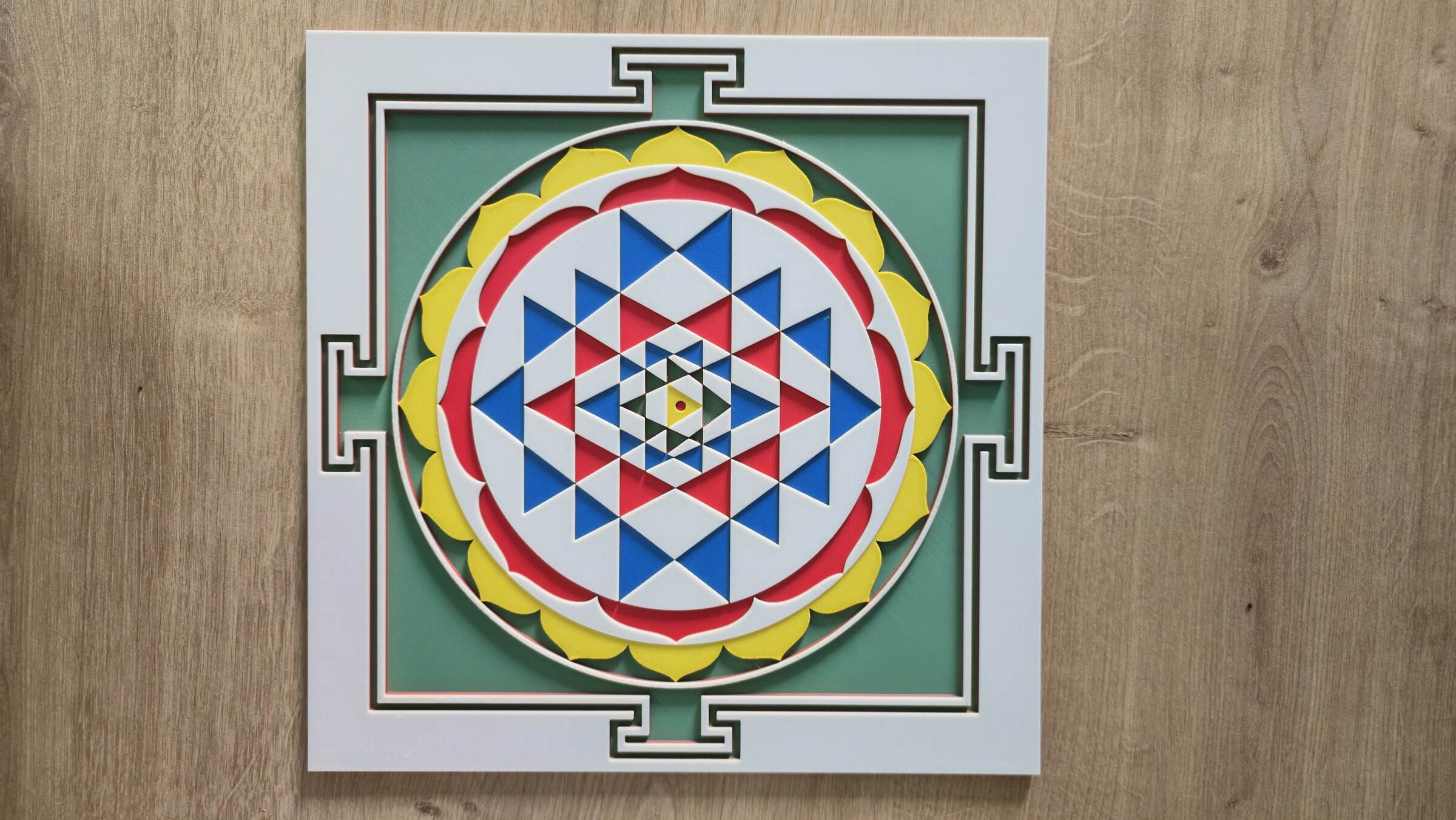
Progressing from flame to yantra. Once candle trataka is established, practicing with a geometric form like the Sri Yantra develops stronger visualization capacity. The yantra’s concentric structure (triangles surrounding a central point, the bindu) provides a natural progression: gaze at the bindu, then take in the surrounding geometry with peripheral awareness. The afterimage of a complex geometric form is harder to hold than a simple flame, which builds more refined visualization skill.
Shambhavi mudra. The Gheranda Samhita (1.54) says trataka practice leads to the attainment of Shambhavi Mudra (the eyebrow center gaze) and “divya drishti” (inner vision). Shambhavi mudra, practiced on its own by gazing at the eyebrow center with half-closed eyes, develops the same internal attention pathways as inner trataka. Alternating between candle trataka and shambhavi mudra across sessions keeps the practice from becoming mechanical.
Journaling post-practice. Briefly note what you experienced: how long the afterimage lasted, what colors appeared, how stable the mental image was, what your mental state felt like. This creates the feedback loop that most practitioners lack. Trataka progress is slow and subtle enough that without records, you won’t notice it over weeks and months.
Common mistakes that prevent deepening
Straining the eyes. Squinting or forcing the eyes wide open creates tension that collapses both the gaze and the afterimage. The Hatha Yoga Pradipika says to gaze “with an unwavering gaze” (nirīkṣet), not a forced one. The gaze should be intent but relaxed, like looking at something you find genuinely interesting.
Treating it as an endurance test. “I gazed for fifteen minutes without blinking” is not progress. The quality of the internal phase matters more than the duration of the external phase. A five-minute gaze followed by two minutes of strong mental visualization is deeper practice than fifteen minutes of staring followed by nothing.
Physically looking at the afterimage. Your closed eyes still try to “see” the afterimage by moving toward it. This is a reflex, and learning to release it is a breakthrough moment. The van Boxtel et al. (2010) research showed that forced attention shortens afterimage duration; practitioners consistently report that relaxing the eyes completely behind closed lids lets the image stabilize and last longer.
Skipping the preparation. Jumping straight to gazing without settling the body and breath creates a scattered, superficial practice. Even five minutes of pranayama or simple body awareness makes a noticeable difference.
Giving up when the afterimage fades. The fading is the signal to shift techniques, from passive observation to active visualization. It is not the signal to open your eyes and restart. Stay with the dark field. Trace the image mentally. Wait. Often it reappears.
Never varying the practice object. Staying with a candle flame indefinitely limits your development. Progressing to other trataka objects like a black dot, a yantra, or a mirror develops different aspects of concentration and visualization. Dr. Giridhar ‘Yogeshwar’, writing in Yoga Magazine (1983), surveys multiple traditional texts that describe trataka on the nose tip, the eyebrow center, a shadow, and open space, each producing different effects.
An experienced Dzogchen practitioner on the Dharma Wheel forum described the deepening mechanism as “alternating between intense, forceful concentration and relaxation where you allow the field of awareness to open back up.” This oscillation, not sustained brute-force concentration, is how trataka matures from an eye exercise into meditation.
Sources
- Talwadkar S, Jagannathan A, Raghuram N. (2014). “Effect of trataka on cognitive functions in the elderly.” International Journal of Yoga, 7(2):96–103. doi: 10.4103/0973-6131.133872. PMID: 25035618.
- van Boxtel JJA, Tsuchiya N, Koch C. (2010). “Opposing effects of attention and consciousness on afterimages.” Proceedings of the National Academy of Sciences. PMC2889341.
- Matiz A, Crescentini C, Fabbro A, Budai R, Bergamasco M, Fabbro F. (2019). “Spontaneous eye movements during focused-attention mindfulness meditation.” PLoS ONE 14(1): e0210862. doi: 10.1371/journal.pone.0210862.
- “Microsaccades reflect attention shifts: a mini review of 20 years of microsaccade research.” (2024). Frontiers in Psychology. doi: 10.3389/fpsyg.2024.1364939.
- Landin-Romero R, Moreno-Alcazar A, et al. (2018). “How Does Eye Movement Desensitization and Reprocessing Therapy Work? A Systematic Review on Suggested Mechanisms of Action.” Frontiers in Psychology. PMC6106867.
- Sur M. (1996). “Brain Processing of Visual Information.” MIT News Office. https://news.mit.edu/1996/visualprocessing.
- Rajpoot PL, Vaishnav P. “Effect of Trataka on Anxiety among Adolescents.” World Academy of Science, Engineering and Technology, International Journal of Health and Medical Engineering. doi: 10.5281/zenodo.1099920.
- Svatmarama. Hatha Yoga Pradipika (15th century). Verses 2:31–32.
- Gheranda Samhita. Verses 1.53–1.54. Commentary by Swami Niranjanananda Saraswati, Yoga Publications Trust, 2012.
- Swami Niranjanananda Saraswati. Dharana Darshan: Yogic, Tantric and Upanishadic Practices of Concentration and Visualization. Yoga Publications Trust, 2nd edition, 2003.
- Swami Satyananda Saraswati. Asana Pranayama Mudra Bandha. Yoga Publications Trust, Bihar.
- Dr. Giridhar ‘Yogeshwar’. (1983). “Trataka or Yogic Gazing.” Yoga Magazine, Bihar School of Yoga.
- “Trataka — Concentrated Gazing.” (1991). Yoga Magazine, Bihar School of Yoga.
- Siva Samhita. Verses 5.15–21.
- Kinsbourne M. (1972). “Eye and head turning indicate cerebral lateralization.”