How to Meditate Without an App
Miha Cacic · April 11, 2026 · 6 min read
You need three things: something to focus on, a place to sit, and a timer. That’s it. The guided voice, the session library, the streak counter are scaffolding that meditation apps built for engagement, not for the practice itself. A 2015 review by Queensland University of Technology searched 700 meditation apps and found that only about 4% provided mindfulness training and education (Mani et al., 2015). Most of the rest offered guided audio tracks, ambient sounds, or reminders — when they were meditation-related at all.
But knowing this doesn’t make the transition easy. If you’ve been meditating with an app and you try sitting in silence for the first time, it will probably feel terrible. Your mind will race. The quiet will feel aggressive. You’ll want to open the app again. That reaction is normal, and it’s the first sign that you’re meditating on your own, because for the first time, nothing is filling the space except your attention.
Why the silence feels so hard at first
The guided voice in your app was doing two jobs at once. First, it anchored your attention by telling you where to focus (“notice your breath,” “feel your feet on the floor”). Second, it filled the silence so you never had to sit with just your own mind. When you remove the voice, you lose both supports simultaneously.
What rushes in is not new noise. It’s your own mental chatter, which the voice was talking over. The silence isn’t empty; it’s full of thoughts you weren’t hearing before.
This matters because of how attention develops during meditation. Neuroscientist Antoine Lutz and colleagues distinguish two core meditation styles: focused attention (FA), where you direct your mind to a single object like the breath, and open monitoring, where you observe whatever arises (Lutz, Slagter, Dunne, & Davidson, 2008). In focused attention practice, the training mechanism is a specific cycle: you focus, your mind wanders, you notice it wandered, and you bring it back. That noticing-and-returning is the rep. Not the sustained focus. The return.
When a guided voice says “if your mind has wandered, gently bring it back,” it’s doing the noticing for you. You still return your attention, but you didn’t catch the drift yourself. Remove the voice, and you’re responsible for the entire cycle. That’s why unguided practice feels harder. It is harder. And it’s the thing that builds actual attentional skill.
Harvard Health put it directly: “The self-directed, silent form of mindfulness practice is more effective than externally guided exercises. Being talked through a breathing exercise is actually a form of relaxation training, which also has value, but is different from mindfulness training” (Cartreine, 2018). Both are useful. They train different things.
What you actually need (and what you don’t)
A quiet-enough spot. It doesn’t need to be silent. It needs to be free from interruptions. The Satipatthana Sutta, one of the oldest meditation instructions we have, tells practitioners to go “into the forest, or to the foot of a tree, or to an empty building.” Your living room with the door closed works fine.
A seated position. A chair is fine. The floor is fine. The bed is risky because your body associates it with sleep, and you’ll drift off. Sit with your back reasonably straight, not rigid, just upright enough that you won’t slouch into drowsiness.
A timer. Your phone’s built-in timer works. But put it face-down, on airplane mode, and ideally in another part of the room. A 2017 study from the University of Texas at Austin found that the mere presence of a smartphone on your desk reduces working memory and fluid intelligence, even when it’s silent and screen-down (Ward, Duke, Gneezy, & Bos, 2017). The cognitive pull of a nearby phone is exactly what you’re trying to set aside. A kitchen timer or a clock with an alarm removes this problem entirely. 
One point of focus. Breath, a visual object, or a mantra. Pick one per session. Not three.
What you don’t need: Music, ambient sounds, a special cushion, incense, a particular time of day, or any of the “perfect setup” that apps train you to expect. These aren’t harmful, but they’re not required. Every additional condition you add is one more thing that has to be in place before you can practice, which makes practice more fragile.
Three ways to meditate without a voice
They’re ordered from the simplest starting point to the most visually engaging. Pick one and try it tonight. 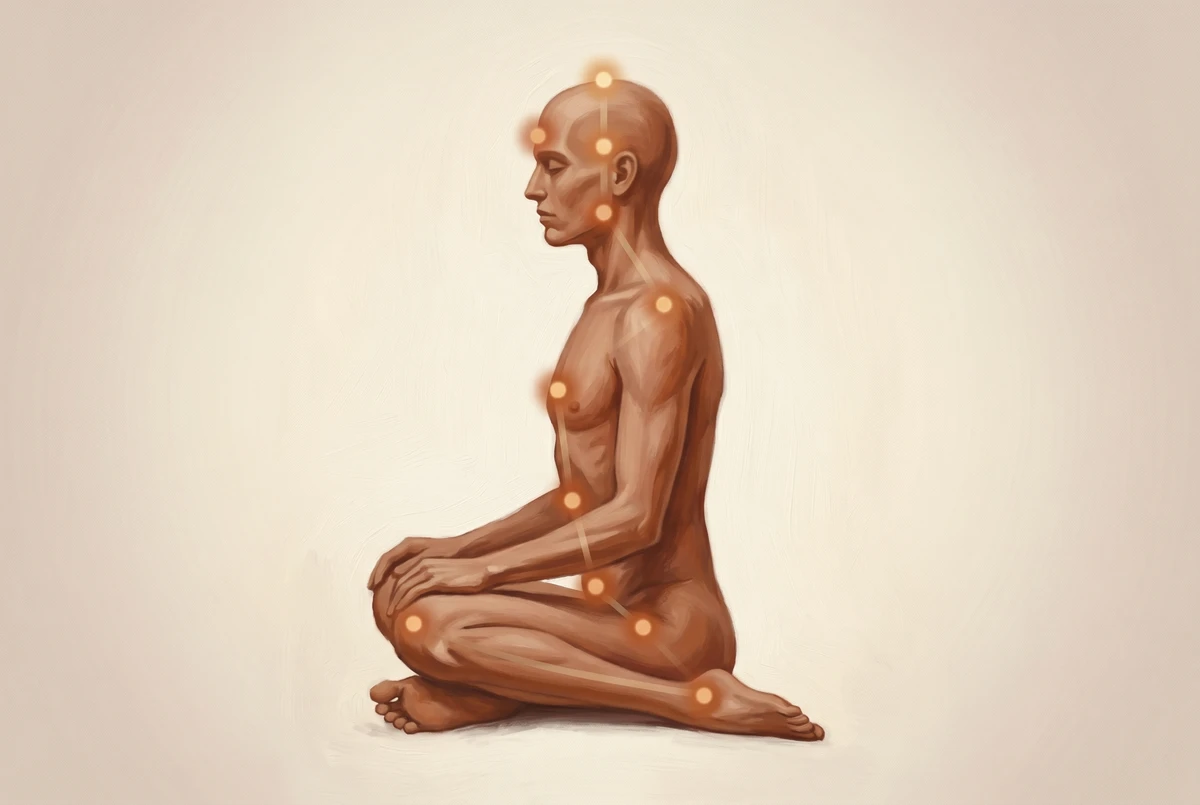
Breath counting
Sit down. Close your eyes. Breathe normally (don’t control the rhythm).
Count each exhale: 1, 2, 3, up to 10. When you reach 10, start over at 1. When you lose count (and you will, probably within the first minute), start over at 1. No frustration, no judgment, just restart.
The restart is the practice. That moment where you realize you’ve been thinking about dinner or replaying a conversation, and you notice you’ve drifted, that’s the attentional rep Lutz’s research describes. You aren’t failing when you lose count. You’re doing the thing. 
Start with five minutes. When you can regularly reach 10 without losing count, extend to ten minutes. The counting gives your mind a task simple enough to reveal when attention has wandered, but structured enough to give you somewhere to return.
Body scan
Close your eyes. Start at the top of your head.
Move your attention slowly downward: forehead, eyes, jaw, neck, shoulders, arms, hands, chest, belly, hips, thighs, knees, calves, feet. At each point, notice what’s there. Tension, warmth, tingling, numbness, nothing at all. Don’t try to change anything. Just observe, and move on.
The same attentional cycle is at work here: you focus on one region, your mind drifts, you notice, you return to where you left off. But the body gives your attention a structured path through physical space. You don’t need to remember where you are in a sequence of abstract instructions because the map is your own body. A full scan takes five to fifteen minutes depending on how slowly you move.
Candle gazing (trataka)
This one is for people who struggle with eyes-closed meditation, which is a lot of people, especially after years of screen use.
Light a candle and place it at eye level, about arm’s length away. Sit comfortably. Gaze steadily at the flame without straining. Blink when you need to.
When your mind wanders, you’ll know immediately, because the flame is still there and you’re no longer looking at it. The feedback is built into the practice. After three to five minutes of gazing, close your eyes and watch the afterimage of the flame on your eyelids. Hold your attention on that image as it shifts and fades.
Trataka (the Sanskrit name for this practice) is one of the six classical purification techniques in the Hatha Yoga Pradipika, a 15th-century yoga text, defined as “gazing steadily at a small point until tears flow.” A 2021 review by Biswas and Sharma reported that trataka practitioners showed improvements in selective attention, cognitive flexibility, and response inhibition on the Stroop color-word test compared to controls, though the evidence base remains small. 
Why this works as a bridge from apps: the flame gives your attention somewhere to go without doing the attentional work for you. You still have to notice when you’ve drifted. You still have to bring yourself back. But the anchor is external and continuous, which makes the silence less disorienting than starting with eyes closed and nothing to look at.
How to handle the first two weeks
Days 1 to 3: Your mind will feel louder and more chaotic than it ever did with the app. This isn’t because you’re meditating wrong. The noise was always there; the guided voice was talking over it.
Days 4 to 7: You’ll have one session that feels genuinely calm, and the next one will be terrible. This oscillation is normal. Attention is a fluctuating capacity, not a line that goes up.
Week 2: You’ll start to notice when your mind wanders before it’s been gone for minutes. This is the actual skill developing. It won’t feel dramatic. It’s subtle: you’ll catch yourself mid-thought and come back, and at some point you’ll realize you used to lose five minutes before noticing, and now it’s thirty seconds.
Start at five minutes, not twenty. Apps default to ten-to-fifteen-minute sessions, but your capacity for unguided attention may be shorter right now. Five minutes of genuine unguided attention is more valuable than fifteen minutes of wishing you had the voice back. Add time only when five minutes starts feeling short.
Anchor to something you already do. A 2023 study by Huberty et al. tracked 3,275 Calm app users and found that meditating after an existing daily routine reduced the risk of abandoning the practice by 39 to 57% (Huberty et al., 2023). After coffee, after brushing your teeth, before bed. Pick a trigger that already happens every day. “Whenever I feel like it” is how practices die.
Should you go back to the app sometimes? Yes, especially early on. The goal is independence, not purity. If you have a rough unguided session and want guidance the next day, use it. Just notice the difference in what your mind does when the voice is there versus when it isn’t. Over time, reduce the guided sessions.
When you’re ready for more
Extend gradually. Move from five minutes to ten, then to twenty. Experienced meditators report that sessions around the twenty-minute mark feel qualitatively different, not just longer. The first ten minutes are often settling; the second ten are where something shifts. This is practitioner knowledge, not a claim from a controlled study, but it’s consistent enough across traditions to be worth noting.
Drop the count. Once breath counting feels stable, try watching the breath without numbering it. Then try watching whatever arises without selecting a focus object at all. This is what Lutz et al. call open monitoring, and it’s the natural next step from focused attention practice.
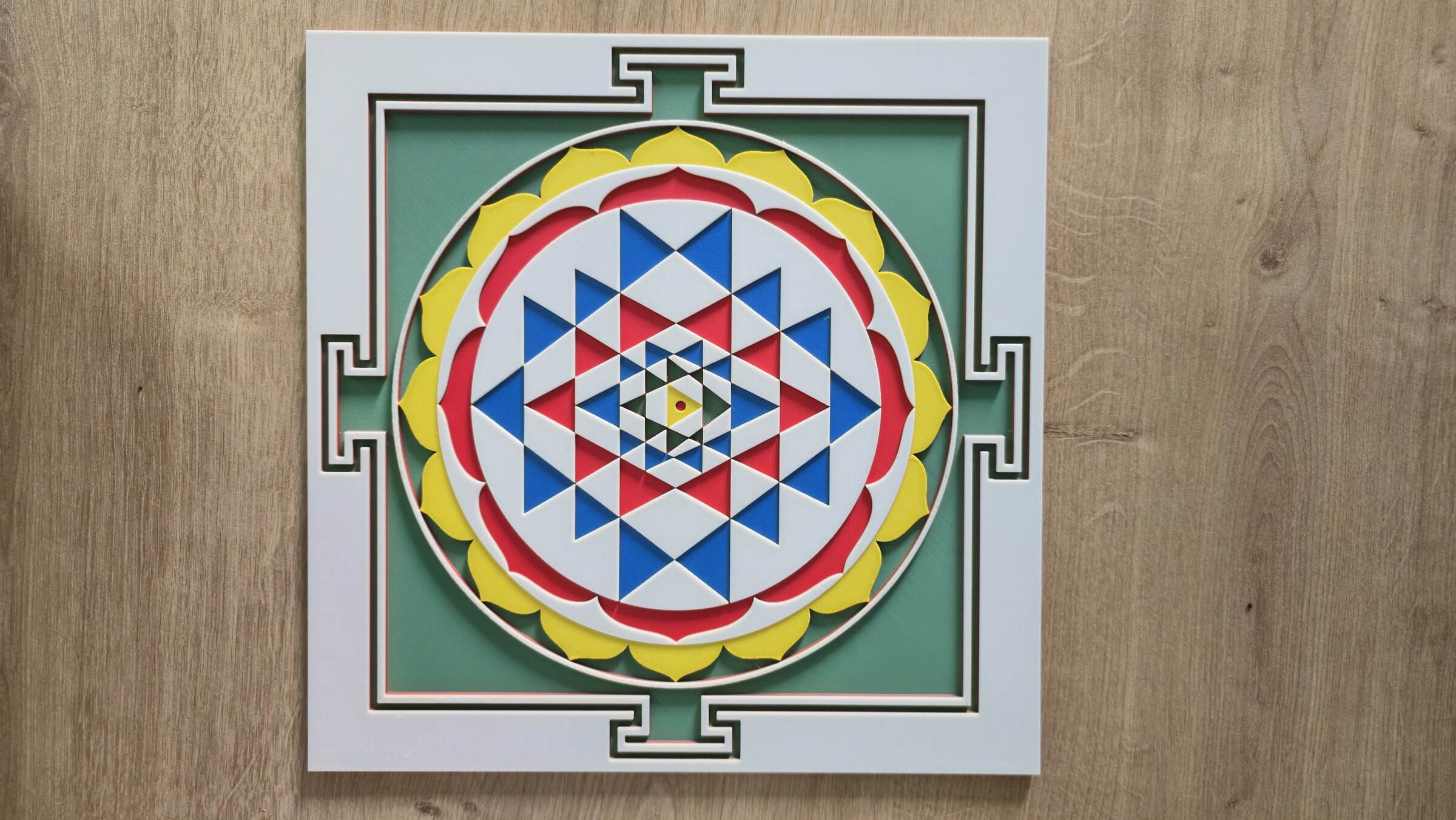
Progress the visual practice. If you started with candle gazing, the traditional progression moves from the external flame to the afterimage (watching it with eyes closed) to purely internal visualization. Geometric patterns like yantras offer more visual complexity for the developing attention to work with as concentration deepens.
Read real instruction. Two books stand above the rest for self-directed meditators. Mindfulness in Plain English by Bhante Gunaratana is practical, accessible, and available free online. It doesn’t require Buddhist belief. The Mind Illuminated by Culadasa (John Yates, PhD) integrates neuroscience with traditional meditation stages and is for readers who want deep technical structure.
Find a timer, not an app. Insight Timer offers a free meditation timer with interval bells and no guided content required. It’s one of only three apps the Lancaster University researchers identified as emphasizing self-directed, silent practice.
Notice how you measure progress. The sign that you’re getting better is not that your mind stops wandering. It’s that you notice the wandering sooner. As Matthew Sockolov of One Mind Dharma puts it: “The difficulty of staying on track and beginning again actually serves us if it is an appropriate amount. Every time we bring the mind back, we strengthen that mental muscle and ability to return to the object of meditation.”
Sources
- Cartreine, J. (2018). “Mindfulness apps: How well do they work?” Harvard Health Blog, November 6, 2018. https://www.health.harvard.edu/blog/mindfulness-apps-how-well-do-they-work-2018110615306
- Mani, M., Kavanagh, D.J., Hides, L., & Stoyanov, S.R. (2015). “Review and Evaluation of Mindfulness-Based iPhone Apps.” JMIR mHealth and uHealth, 3(3), e82. doi: 10.2196/mhealth.4328. PMCID: PMC4705029.
- Huberty, J., et al. (2023). “Mindfulness Meditation App Abandonment During the COVID-19 Pandemic: An Observational Study.” PMCID: PMC10158687.
- Lutz, A., Slagter, H.A., Dunne, J.D., & Davidson, R.J. (2008). “Attention regulation and monitoring in meditation.” Trends in Cognitive Sciences, 12(4), 163-169. doi: 10.1016/j.tics.2008.01.005. PMID: 18329323.
- Ward, A.F., Duke, K., Gneezy, A., & Bos, M.W. (2017). “Brain Drain: The Mere Presence of One’s Own Smartphone Reduces Available Cognitive Capacity.” Journal of the Association for Consumer Research, 2(2), 140-154. doi: 10.1086/691462.
- Biswas, S., & Sharma, P. (2021). “Trataka-Benefits of Candle Gazing Techniques.” Scholarly Journal of Psychology and Behavioral Sciences, 5(5). doi: 10.32474/SJPBS.2021.05.000225.
- Swatmarama. (15th century). Hatha Yoga Pradipika. Yoga Publications Trust edition by Muktibodhananda.
- Gunaratana, B. Mindfulness in Plain English. Wisdom Publications.
- Yates, J. (Culadasa). The Mind Illuminated. Hay House.