Meditation for Focus at Work
Miha Cacic · April 11, 2026 · 7 min read

Meditation can improve your ability to focus at work, but the type matters more than most advice lets on. The breathing exercises and body scans recommended by wellness apps train broad awareness and stress reduction. The skill you actually need at your desk (locking attention onto one task and holding it there) is trained by a different kind of practice: concentration meditation.
Why most meditation advice doesn’t help you focus at work
If you’ve tried 10 minutes of app-guided mindfulness in the morning and still can’t concentrate two hours later, you’re not doing it wrong. You’re doing the wrong kind.
Most workplace meditation advice prescribes open-monitoring mindfulness: notice your thoughts without judging them, observe sensations, return to your breath. This genuinely helps with stress and emotional regulation. Economides et al. (2018) showed that 10 sessions of Headspace’s breath-awareness and body-scanning program reduced stress and irritability compared to an audiobook control. But the protocol they tested trains awareness of inner experience, not the ability to hold attention on an external task.
The skill you need at work is selective sustained attention: holding one thing in mind while filtering out everything else. That’s closer to a muscle that needs targeted exercise than a mood that needs cultivating. Practicing open awareness and expecting laser focus is like doing yoga for flexibility and wondering why you can’t run a 5K. Both are fitness. They train different things.
This isn’t an argument against mindfulness. It’s an argument for matching the practice to the problem.
Two kinds of meditation, two kinds of attention
In 2008, neuroscientists Lutz, Slagter, Dunne, and Davidson published a framework that divided meditation into two broad families: 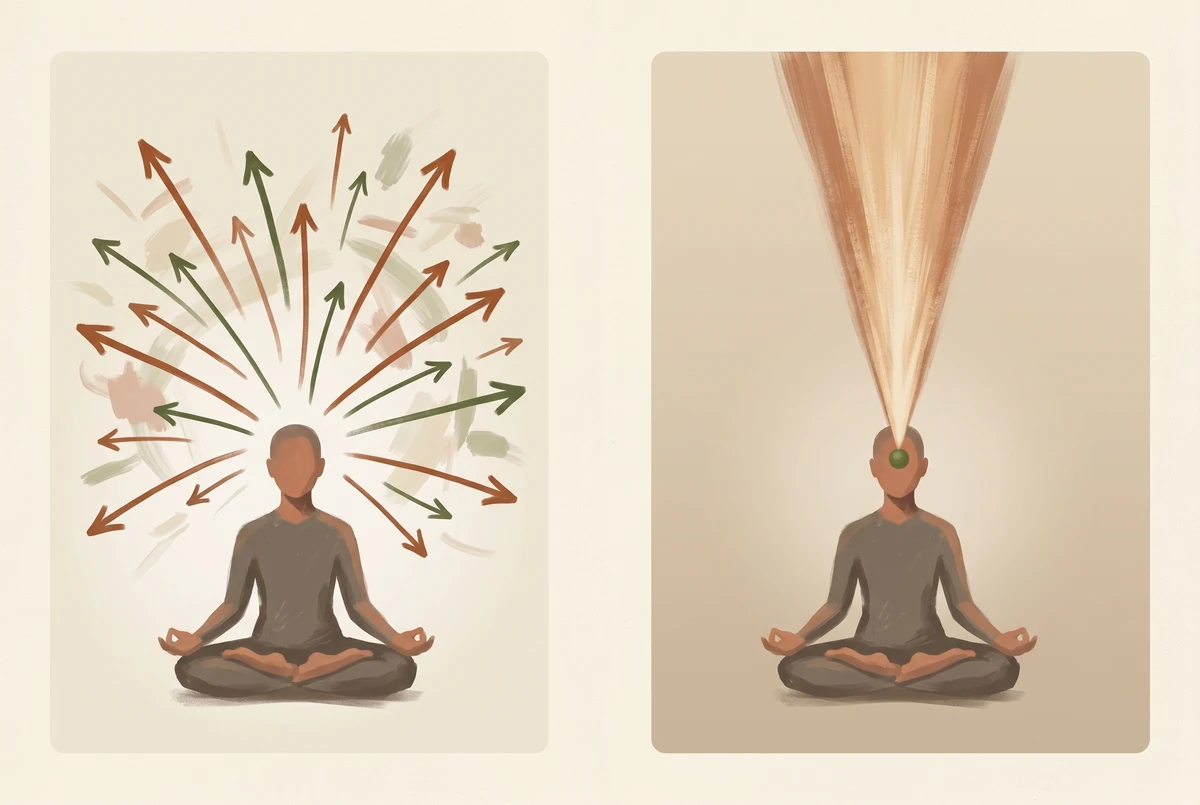
Open-monitoring (OM) meditation means observing whatever arises (thoughts, sensations, sounds) without attachment. It trains meta-awareness, the ability to notice what your mind is doing. Most app-based meditation, Vipassana body scanning, and mindfulness practices fall here.
Focused-attention (FA) meditation means fixing your attention on a single object: a flame, a point, a sound, a mantra. When the mind wanders, you bring it back. It trains sustained, selective attention. Examples include candle gazing (trataka), mantra repetition, and breath counting.
Both are valuable. But Lutz et al. made a specific observation about FA practice: it trains three cognitive skills that map directly onto workplace concentration. In their words, the meditator must exercise “(1) the monitoring faculty that remains vigilant to distractions without destabilizing the intended focus; (2) the ability to disengage from a distracting object without further involvement; and (3) the ability to redirect focus promptly to the chosen object.”
That’s a description of what you do every time you catch yourself reaching for your phone during a report and pull your attention back.
The yogic tradition has its own name for this: dharana. Patanjali’s Yoga Sutras (Sutra 3.1) define it as “the binding of the mind to one place.” It’s the sixth of Patanjali’s eight limbs, positioned as a prerequisite to deeper meditation (dhyana), not a lesser version of it. The quality of attention it cultivates is described in the commentarial tradition as ekagrata: one-pointed concentration.
How concentration meditation trains your brain to focus
Every time you notice your mind has wandered and redirect it back to the object, you complete one repetition of attention training. The training is in the noticing and returning, not in the sustained focus itself. Distractions aren’t failures. They’re the weight you’re lifting.
This strengthens three specific cognitive functions:
- Sustained attention (holding focus longer before drifting)
- Attention monitoring (detecting distraction faster)
- Attention switching (returning to the task with less friction)
The neuroscience aligns with this model. In their review of existing neuroimaging research, Lutz et al. (2008) found that FA meditation activates the dorsolateral prefrontal cortex (involved in monitoring), the intraparietal sulcus, and the frontal eye fields (involved in directing attention). Expert FA meditators showed an inverted U-shaped activation curve: the most advanced practitioners needed less neural effort to maintain focus, suggesting the skill becomes more automatic with practice.
Separately, Brewer et al. (2011) found that experienced meditators showed significantly reduced activity in the Default Mode Network (the brain’s “wandering” network, active roughly 50% of waking life) and stronger connectivity between self-monitoring and cognitive control regions. One caveat: this study found DMN suppression across multiple meditation types, not just FA. Meditation experience in general seems to quiet the wandering mind. 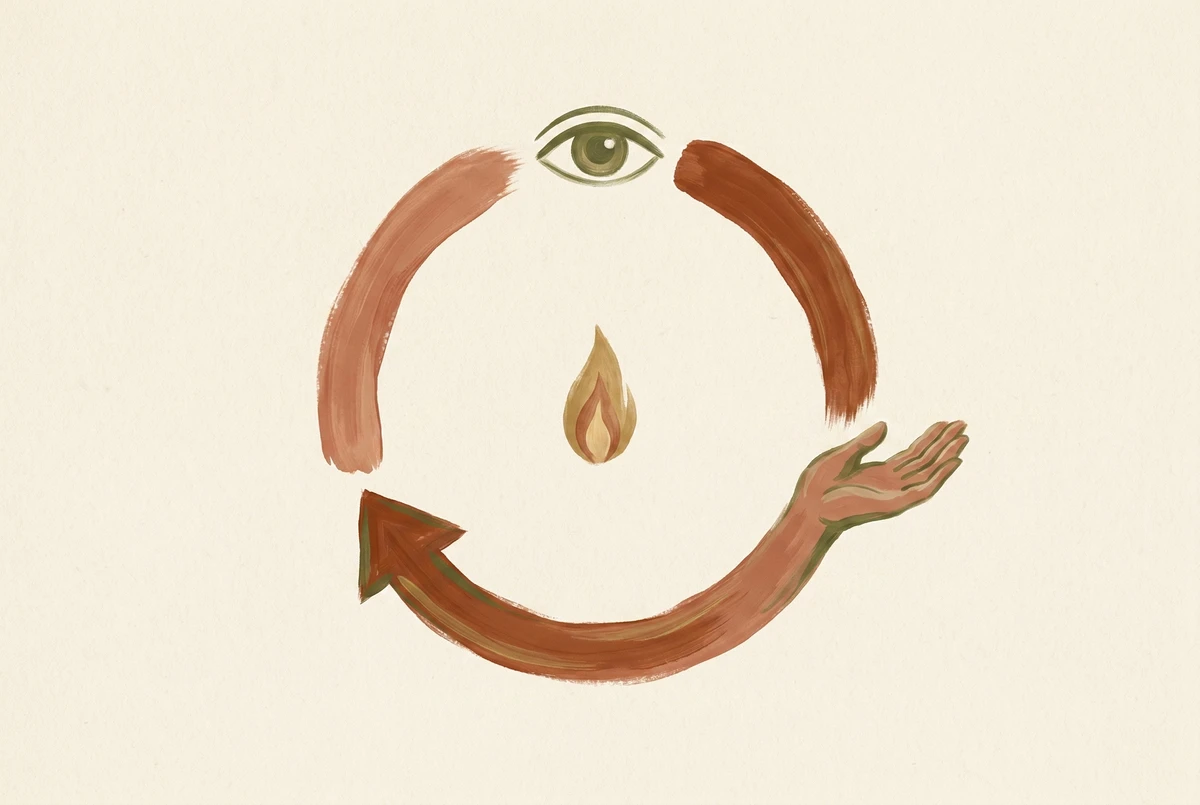
These effects also appear quickly. Zeidan et al. (2010) showed measurable improvements in sustained attention, working memory, and executive functioning after just four days of 20-minute meditation sessions in novices. Tang et al. (2020) found structural gray matter changes in a key brain hub within 2 to 4 weeks. And Malinowski (2013) demonstrated that 10 minutes of daily practice progressively improved electrophysiological markers of attentional control over 16 weeks. These three studies used mindfulness-based protocols rather than strict FA meditation, so they demonstrate that meditation broadly reshapes the brain’s attention systems in days to weeks. The case for FA specifically is mechanistic: the Lutz framework predicts that a practice targeting monitoring, disengaging, and redirecting attention should train the specific skills that workplace focus demands.
This maps directly to your workday: you’re writing a report, your mind drifts to your inbox, you catch it sooner, you return with less frustration. Over time, the drift happens less often and the catch happens faster.
Trataka: a concentration practice built for focus training
If you’ve tried breath meditation and found your mind wandering for minutes before you noticed, trataka solves that problem with a built-in feedback mechanism.
Trataka is candle-gazing meditation, one of the oldest concentration practices in the yoga tradition. The Hatha Yoga Pradipika (c. 15th century) classifies it among the six Shatkarmas (purification techniques), described in verse 2:31 as gazing steadily at a small mark “till eyes are filled with tears.” Although traditionally classified as a cleansing practice (the text says it “destroys eye diseases and removes sloth”), modern practitioners and researchers treat it as a focused-attention meditation technique. 
The practice is simple: you gaze steadily at a candle flame without blinking for 2 to 3 minutes, then close your eyes and hold the afterimage at the point between your eyebrows. The whole session takes 5 to 15 minutes. 
What makes trataka particularly effective for focus training is the visual anchor. In breath meditation, your mind can drift for minutes before you notice. In trataka, when your mind drifts, your gaze drifts, and you feel the physical shift immediately. The distraction becomes detectable, not just endurable.
The research, while still early, is consistent. Swathi, Bhat, and Saoji (2021) found that trataka significantly improved visuospatial working memory in 41 volunteers compared to both baseline and an active eye-exercise control (Cohen’s d = 0.74 for forward total score, p < 0.001). Raghavendra and Singh (2016) showed that a single trataka session significantly improved performance on the Stroop color-word test (a measure of selective attention and cognitive flexibility) in 30 participants (p < 0.001 vs. sitting control). And Talwadkar, Jagannathan, and Raghuram (2014) found that 26 days of a trataka-based program (combining candle gazing with preparatory eye exercises and breathing techniques) improved working memory, selective attention, and executive function in elderly subjects aged 60 to 80.
A 2025 systematic review by Roj et al. in the Journal of Neurosciences in Rural Practice proposed a neurophysiological mechanism: sustained gaze fixation activates the frontal eye fields, suppresses involuntary eye movements, and cascades through thalamic filtering to enhance top-down attentional control. The mechanism is still hypothetical (not yet tested with neuroimaging during trataka), but it’s neurophysiologically coherent and explains why fixing your gaze fixes your attention.
None of this is exotic. It’s 5 to 10 minutes of staring at a candle before work.
How to use meditation to focus better at work
Here’s a practical protocol. The priority is consistency, not duration. A 5-minute trataka session every morning will do more for your work focus than a 30-minute mindfulness session on weekends.
Before work (5 to 10 minutes): trataka session
Sit in front of a candle at eye level, about arm’s length away. Gaze steadily at the flame tip for 2 to 3 minutes without blinking (or blinking minimally). Close your eyes and hold the afterimage for 2 to 3 minutes. That’s one round. Do 1 to 2 rounds. Over weeks, gradually extend the gazing phase.
If you can’t use a candle, trataka works with any fixed point: a small dot on the wall, a specific point on a screen, or a printed geometric pattern. The candle is traditional and optimal (the flame provides a natural focal point and the afterimage is vivid), but the practice adapts.
During work (60 to 90 second resets): focused breathing
When you notice focus slipping, don’t switch to a full meditation. Do 6 to 10 slow breaths with your eyes fixed on a single point on your screen or desk. Same principle of gaze fixation and attention anchoring, compressed into a minute. 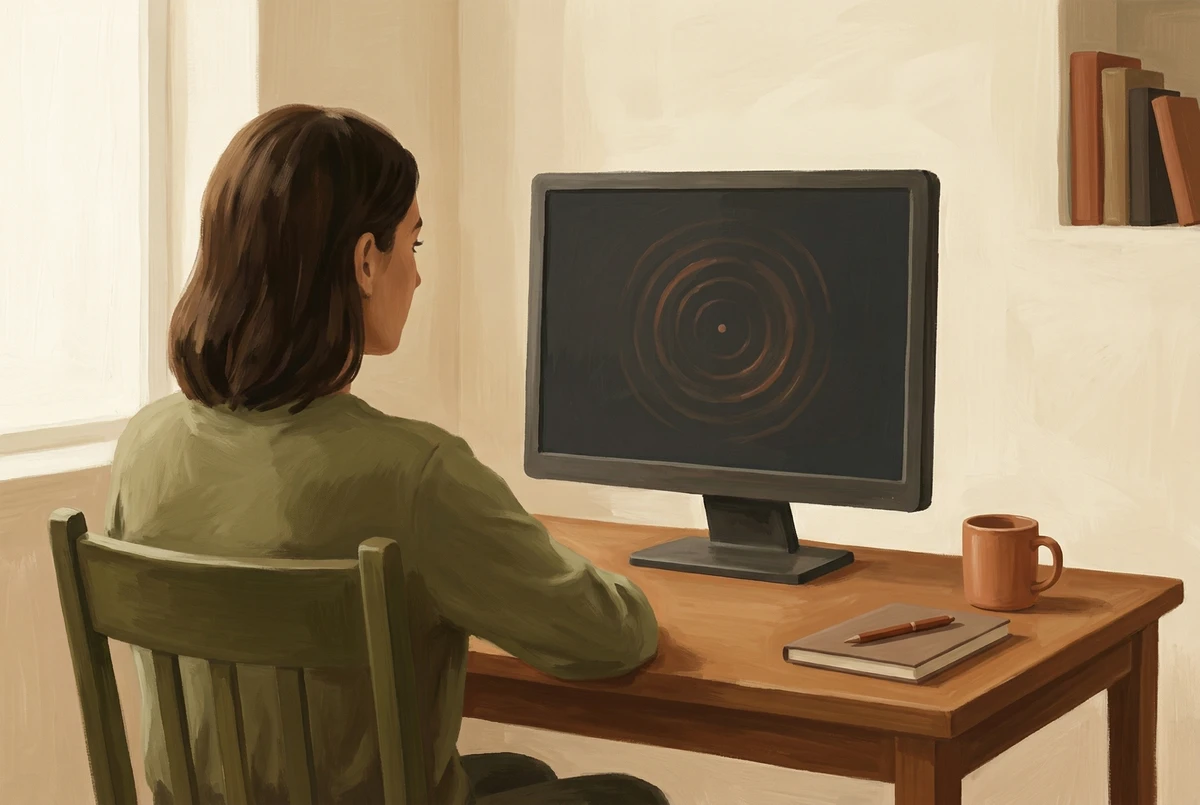
What to expect
Don’t expect instant focus. Expect to notice your mind wandering sooner. Weeks 1 to 2 are about building the habit. By weeks 3 to 4, you’ll start catching distractions faster at work. By weeks 6 to 8, the effect becomes more obvious: longer stretches of unbroken attention, less compulsive task-switching. This timeline is conservative. Zeidan et al. (2010) found cognitive improvements after just four days of brief meditation training, and Tang et al. (2020) observed structural brain changes within 2 to 4 weeks.
What research actually says about meditation and work performance
The evidence isn’t monolithic, and the popular reporting oversimplifies it.
Well-supported: FA meditation improves sustained attention and reduces mind-wandering. The theoretical framework (Lutz et al., 2008) predicting that FA trains specific attentional skills is well-supported by mechanism, but direct head-to-head comparisons of FA vs. OM for sustained attention remain sparse. The argument is strong on theory and individual evidence; it is not yet settled by a single definitive experiment. Trataka specifically has been shown to improve working memory (Swathi et al., 2021) and selective attention (Raghavendra & Singh, 2016) in controlled studies.
Supported but often overstated: Mindfulness meditation reduces workplace stress. This is true (the Economides et al. (2018) Headspace study showed meaningful reductions in stress and irritability), but stress reduction doesn’t automatically translate to better focus. A calm mind and a focused mind aren’t the same thing.
Commonly cited but poorly sourced: You’ll see figures like “22% reduction in mind-wandering” and “14% increase in focus” attributed to meditation apps. These specific numbers couldn’t be traced to peer-reviewed publications during research for this article. They appear to originate from proprietary app research, not independent studies. This doesn’t mean meditation apps don’t work, but the most-cited statistics aren’t as solid as they seem.
Undersold: The actual neuroscience of attention-network training through FA meditation, and trataka’s specific evidence base, are barely mentioned in popular content. Most articles default to generic “meditation helps focus” claims without distinguishing which type of meditation or which type of focus.
One important nuance: Rahl et al. (2017) found that attention monitoring alone (without a non-judgmental, accepting attitude) did not significantly reduce mind-wandering. Only when monitoring was combined with acceptance did mind-wandering decrease. This suggests that even in concentration practice, a relaxed, non-strained attitude matters. White-knuckling your attention onto a candle flame won’t work as well as holding it there with ease.
Why breath meditation isn’t enough (and when it is)
Breath meditation is genuinely excellent for emotional regulation, stress reduction, and developing awareness of your own thought patterns. If your work-focus problem is primarily anxiety-driven (you can’t focus because you’re stressed or overwhelmed), breath meditation may be exactly what you need.
Where breath meditation falls short is training the raw ability to sustain attention on a boring task when you’re not stressed, just distracted. Breath meditation asks you to observe sensations as they arise; it doesn’t ask you to lock onto one point and hold. For that, you need a practice that exercises the “holding attention” muscle specifically, with a feedback mechanism that tells you when you’ve drifted.
The practical answer is to use both. Trataka or another FA practice in the morning to train sustained attention. Brief breath-awareness resets during the workday to manage stress and reactivity. Match the practice to the problem: if you’re anxious and unfocused, start with breath meditation. If you’re calm but scattered, go straight to concentration practice. Most people will benefit from both at different times.
Sources
- Lutz A, Slagter HA, Dunne JD, Davidson RJ. (2008). “Attention regulation and monitoring in meditation.” Trends in Cognitive Sciences, 12(4):163–169. doi: 10.1016/j.tics.2008.01.005. PMID: 18329323.
- Brewer JA, Worhunsky PD, Gray JR, Tang YY, Weber J, Kober H. (2011). “Meditation experience is associated with differences in default mode network activity and connectivity.” PNAS, 108(50):20254–20259. doi: 10.1073/pnas.1112029108. PMID: 22114193.
- Swathi PS, Bhat R, Saoji AA. (2021). “Effect of Trataka (Yogic Visual Concentration) on the Performance in the Corsi-Block Tapping Task: A Repeated Measures Study.” Frontiers in Psychology, 12:773049. doi: 10.3389/fpsyg.2021.773049. PMID: 34975664.
- Raghavendra BR, Singh P. (2016). “Immediate effect of yogic visual concentration on cognitive performance.” Journal of Traditional and Complementary Medicine, 6(1):34–36. doi: 10.1016/j.jtcme.2014.11.030. PMID: 26870720.
- Roj AR, Sharma H, Pal P, Pundir M, Patra S. (2025). “Trataka and cognition: A systematic review with a proposed neurophysiological mechanism.” Journal of Neurosciences in Rural Practice, 16:493–500. doi: 10.25259/JNRP_157_2025.
- Talwadkar S, Jagannathan A, Raghuram N. (2014). “Effect of trataka on cognitive functions in the elderly.” International Journal of Yoga, 7(2):96–103. doi: 10.4103/0973-6131.133872. PMID: 25035618.
- Economides M, Martman J, Bell MJ, Sanderson B. (2018). “Improvements in Stress, Affect, and Irritability Following Brief Use of a Mindfulness-based Smartphone App: A Randomized Controlled Trial.” Mindfulness, 9(6):1584–1593. doi: 10.1007/s12671-018-0905-4. PMID: 30386437.
- Rahl HA, Lindsay EK, Pacilio LE, Brown KW, Creswell JD. (2017). “Brief Mindfulness Meditation Training Reduces Mind-Wandering: The Critical Role of Acceptance.” Emotion, 17(2):224–230. doi: 10.1037/emo0000250. PMID: 27819476.
- Zeidan F, Johnson SK, Diamond BJ, David Z, Goolkasian P. (2010). “Mindfulness meditation improves cognition: evidence of brief mental training.” Consciousness and Cognition, 19(2):597–605. doi: 10.1016/j.concog.2010.03.014. PMID: 20363650.
- Tang YY et al. (2020). “Brief Mindfulness Meditation Induces Gray Matter Changes in a Brain Hub.” NeuroImage, 48:102473. PMID: 33276097.
- Malinowski P. (2013). “Neural mechanisms of attentional control in mindfulness meditation.” Frontiers in Neuroscience, 7:8. PMC3277272.
- Hatha Yoga Pradipika (c. 15th century CE). Chapter 2, verses 31–32. Pancham Sinh translation (1914).
- Yoga Sutras of Patanjali (c. 400 CE). Sutra 3.1. Bryant translation.