Meditation for Students: What Actually Works
Miha Cacic · April 11, 2026 · 8 min read

Meditation works for students. The research is strong and getting stronger. But the standard advice, download an app and breathe for five minutes, describes relaxation, not meditation. The difference matters. Relaxation calms your nervous system. Concentration training, which also falls under the word “meditation,” builds the capacity to hold attention on one thing for an extended period. That capacity is what studying, reading, and test-taking demand. Students who understand this distinction can pick the right practice for what they need, instead of trying a generic exercise, feeling nothing, and quitting.
Why the standard advice doesn’t work for most students
The typical meditation article tells you to find a quiet space, sit comfortably, and focus on your breath for five minutes. This advice is not wrong. It is incomplete in ways that guarantee failure for most students. 
Your attention is already fragmented. College students average roughly seven hours of daily screen time, with nearly two hours after 10 PM. Social media, notifications, short-form video, and rapid tab-switching train your attentional system for 15-second bursts. Asking that system to sustain focus on your breath for five minutes is like asking someone who hasn’t run in years to do a mile at pace. The gap between instruction and capacity is the problem, and no top-ranking article on this topic addresses it.
The phone is the worst meditation tool. Most “meditation for students” articles point you toward meditation apps. But the phone is the single largest source of attentional fragmentation in your life. Meditating on the same device that holds your notifications, social feeds, and group chats means the device itself cues distraction, even when the meditation app is open.
“Doing nothing” feels irresponsible. Student culture treats every minute as a resource to optimize. Sitting still with your eyes closed looks, from the outside, like wasting time. This triggers productivity guilt, especially during exam periods when the pressure to study is highest. Until you understand meditation as a skill-building exercise (not a break), this guilt works against you.
You were told it would feel different. App marketing promises you’ll “feel calmer in 10 minutes.” When you try it once and don’t feel dramatically different, the rational conclusion is that it doesn’t work. Meditation produces subtle internal shifts that untrained self-awareness can’t detect at first. Sullivan and Huberty (2023) found that subscribers under 25 had a 2.5 times higher abandonment risk than those over 65. Students are the demographic most likely to quit, and inflated expectations are a major reason why.
Calming down vs. training concentration: the distinction that changes everything
Everything labeled “meditation” falls into two fundamentally different categories, and almost nobody explains this to students.
Relaxation practices (guided body scans, progressive muscle relaxation, soothing-voice guided sessions, deep breathing exercises) downregulate your sympathetic nervous system. They are genuinely useful for exam anxiety, sleep problems, and acute stress. They calm you down. They do not build the capacity to sustain attention.
Concentration practices (focused attention on a single object: breath counting, a mantra, a visual point, a candle flame) train the attentional system itself. They strengthen the prefrontal cortex’s ability to maintain voluntary attention against the pull of distraction. This is what improves study capacity, reading comprehension, lecture retention, and working memory.
The distinction is not academic. A student who can’t focus during lectures doesn’t primarily need relaxation. They need concentration training. A student who can’t sleep before exams doesn’t primarily need concentration training. They need a calming practice. Most advice conflates these two, so students get the wrong tool for their specific problem.
A meta-analysis by Sedlmeier et al. (2012) of 163 meditation studies found that generic meditation produces stronger emotional benefits than cognitive ones. This is why students who need cognitive improvement (better focus, stronger working memory) should seek out targeted concentration training, not just any meditation. However, when mindfulness programs target cognitive skills specifically, the effects can be large. A meta-analysis of school-based mindfulness programs (Zenner et al., 2014) found that cognitive performance showed the strongest effect size (Hedge’s g = 0.80), well above stress (g = 0.39) or resilience (g = 0.36). Targeted practice produces targeted results. 
Practitioners have recognized this distinction for thousands of years. The Yoga Sutras of Patanjali (~200 CE) treat concentration (dharana), sustained absorption (dhyana), and sensory withdrawal (pratyahara) as separate practices with different functions. Modern “meditation for students” advice lumps them together.
The research supports making this distinction:
- Zeidan et al. (2010) found that just four days of focused meditation training (four 20-minute sessions) significantly improved working memory, executive functioning, and sustained attention in university students with no prior experience.
- Mrazek et al. (2013) showed that two weeks of mindfulness training produced a 16 percentile-point boost on GRE verbal reasoning scores and improved working memory capacity. The gains were mediated specifically by reduced mind-wandering.
- Ramsburg and Youmans (2014) found that students who received brief meditation training before a lecture performed significantly better on post-lecture quizzes, replicated across three separate experiments.
These gains came from concentration training, not relaxation exercises.
How meditation actually changes a student’s brain
Skeptical students (reasonably) want to know the mechanism. Here is why sitting still and focusing on one thing changes cognitive performance.
Attention is a trainable system, not a fixed trait. Your ability to sustain focus operates through neural circuits that strengthen with deliberate practice. Davidson and Lutz (2008) studied meditators ranging from novices to Tibetan Buddhist monks with over 10,000 hours of practice. Focused attention meditation activated the dorsolateral prefrontal cortex (which monitors attention), the visual cortex, and the intraparietal sulcus (which orients attention). The researchers concluded that “attention is a trainable skill that can be enhanced through the mental practice of focused attention meditation.”
Mind-wandering is the default, and it is expensive. Killingsworth and Gilbert (2010) sampled 250,000 data points from 2,250 adults and found that people spend 46.9% of waking hours thinking about something other than what they’re currently doing. Nearly half your day. When you’re reading a textbook and suddenly realize you’ve “read” two pages without absorbing anything, that’s the default mode network running unchecked. 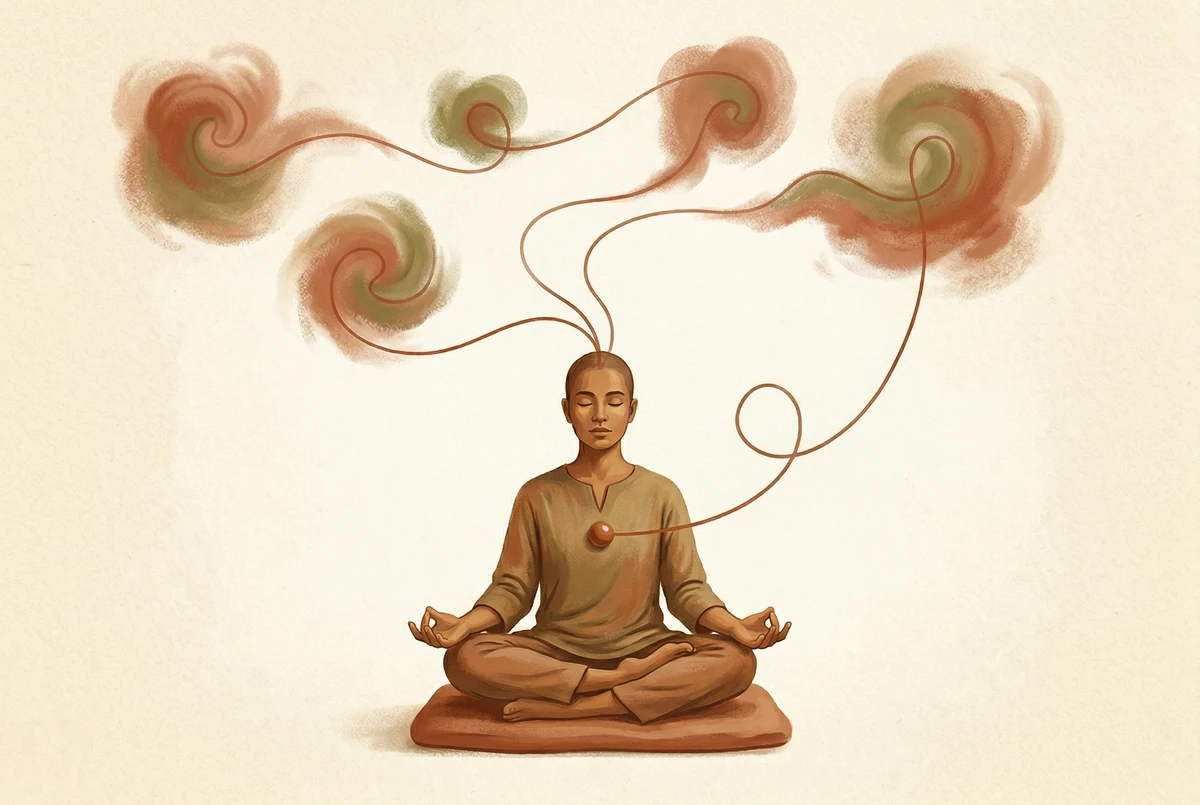
Concentration training directly targets this. When you hold attention on a single point (breath, object, mantra) and notice when it wanders, you’re training two systems: the prefrontal cortex, which maintains voluntary attention, and the anterior cingulate cortex, which detects when you’ve drifted. Each time you catch the drift and return, you’ve completed one repetition. This is why Mrazek et al. (2013) found that mindfulness training improved GRE scores specifically through reduced mind-wandering: less task-unrelated thought means a cleaner working memory buffer, which means better reading comprehension and problem-solving.
Your brain physically changes with practice. Hölzel et al. (2011) used MRI scans to compare brains before and after an eight-week meditation program. The meditation group showed increased grey matter density in the left hippocampus (learning and memory), the posterior cingulate cortex (self-awareness), and the temporo-parietal junction (perspective-taking). Participants who reported reduced stress also showed decreased grey-matter density in the amygdala. The reduction correlated with subjective stress levels: the more participants felt their stress had dropped, the more the amygdala density decreased.
The timeline is faster than most students expect. Cognitive benefits (attention, working memory) appear within four days to two weeks of consistent daily practice, based on the Zeidan and Mrazek studies. Stress and emotional regulation benefits show up within four to eight weeks (Lemay, Hoolahan, and Buchanan, 2019 documented significant anxiety reduction in college students after six weeks). Structural brain changes require eight or more weeks. The answer to “how long until it works?” depends on what “works” means to you, but the cognitive gains begin fast.
Choosing the right practice for what you actually need
Instead of picking a type of meditation at random, match the practice to your specific problem.
If you can’t focus during study sessions, you need concentration training. Start with breath counting: count each exhale from 1 to 10, then restart. When you lose count (and you will, constantly), that moment of noticing is the training. You now know exactly when your attention wandered. Progress to single-point focus: a dot on paper, a spot on the wall, or a candle flame. A visual anchor is often easier than breath for students with active visual minds because it gives the eyes somewhere to stay.
If exam anxiety is your main problem, you need nervous system regulation. A body scan (systematically relaxing muscle groups from head to toe) or slow diaphragmatic breathing with an extended exhale directly calms the sympathetic nervous system. This is the right tool the night before an exam or during a stress spiral. In a small pilot study, Lemay et al. (2019) found that once-weekly yoga and meditation sessions reduced Beck Anxiety Inventory scores by 9.6 points on average (n = 17) among college students in the six weeks before finals.
If your mind races and you “can’t quiet your thoughts,” you need an external anchor. Eyes-closed, breath-only meditation is hardest for students whose attention is already overstimulated by hours of screen use. A visual focus point (something to look at rather than something to listen to) gives the visual cortex a task, which leaves less bandwidth for the default mode network’s chatter. The visual focus section below explains the mechanism and how to try it.
If you can’t sleep, you need a calming transition practice. Yoga nidra (a body-awareness guided relaxation done lying down) or a simple body scan in bed works well. This is one area where a guided audio meditation is genuinely appropriate, since the voice provides a track to follow as you drift off.
If you’re emotionally overwhelmed or burned out, consider a self-compassion practice. Loving-kindness meditation (silently directing phrases of goodwill toward yourself and others) has evidence for reducing self-criticism and building emotional resilience. Schonert-Reichl and Lawlor (2010) found improvements in optimism and social-emotional competence among pre-adolescent students (grades 4 through 7) practicing daily mindful attention with loving-kindness elements. Research on college-aged populations is thinner, but the practice is widely used in university counseling settings.
How to actually start (without an app, in under 10 minutes)
You don’t need an app. You don’t need a cushion. You don’t need a quiet room. Here is the minimum viable practice.
Step 1: Remove the phone from the room. Use a watch or kitchen timer. The phone leaves. This single step eliminates the distraction problem that undermines most student meditation attempts.
Step 2: Sit in any position where your spine is upright and you won’t fall asleep. A chair works. The floor works. Your bed does not work (you’ll sleep).
Step 3: Pick one anchor. Breath counting if you want concentration training. Body scan if you need to calm down. A spot on the wall or a candle flame if you want visual focus. One anchor. Not two, not alternating. One.
That’s the protocol. No guided voice, no background music, no special equipment.
How long: Start with five minutes, once a day, at the same time. Five minutes is not optimal, but the habit matters more than the duration in the first two weeks. After two weeks of daily practice, extend to 10 to 15 minutes.
When to do it: Anchor to something you already do every day. “Right after I sit down at my desk” or “right after I wake up, before I check my phone.” Sullivan and Huberty (2023) tracked 3,275 meditation app users and found that those who meditated after an existing routine had 39 to 57% lower abandonment risk. Habit-anchoring was a stronger predictor of sustained practice than other behavioral factors in the study.
What to expect: Your mind will wander constantly. This is not failure. Noticing that your mind wandered is the practice. Each time you catch the drift and return attention to your anchor, you’ve completed one repetition. A session where your mind wanders and returns 50 times is a better workout than a session where you zone out for five minutes without noticing. Rahl et al. (2017) found that acceptance (a non-judgmental attitude when noticing distraction) was more effective at reducing mind-wandering than attention monitoring alone. So when you notice you’ve drifted, the response is not “I’m bad at this.” The response is just to return.
The “I don’t have time” reframe: Five minutes of concentration training makes the next hour of studying measurably more effective. Mrazek et al. (2013) showed this directly: reduced mind-wandering freed up working memory, which improved comprehension and test performance. Meditation is not a subtraction from study time. It is a multiplier.
When eyes-closed meditation doesn’t work: the case for visual focus
Some students try breath meditation, find their mind gets louder with eyes closed, and conclude they’re “bad at meditation.” They’re not bad at it. They’re using the wrong tool.
Students spend most of their waking hours processing visual information: screens, textbooks, slides, lecture halls. When they close their eyes, the visual processing centers that were occupied all day suddenly have nothing to do. The default mode network floods in with thoughts, worries, and mental replays. For these students, closing their eyes makes their mind louder, not quieter.
Visual focus meditation works differently. Fixing the gaze on a single point (a candle flame, a dot, a geometric pattern) gives the visual cortex a task. Roughly 30% of the cerebral cortex processes visual information; engaging it with a simple, stable stimulus leaves less bandwidth for mind-wandering. The mind settles not through effort but through occupation.
This practice has a name: trataka, or gazing meditation. The Hatha Yoga Pradipika (verse 2:31) describes it: “Being calm, one should gaze steadily at a small mark until tears flow.” Modern research validates its cognitive benefits. A 2021 narrative review by Swathi, Raghavendra, and Saoji analyzed multiple studies and found that trataka significantly improved selective attention, cognitive flexibility, and response inhibition. Studies within the same review also documented increased vagal tone (a marker of nervous system calm), meaning trataka can deliver concentration training and relaxation simultaneously. 
This suits students well: their attentional system is already oriented toward visual processing. Visual anchoring works with that orientation rather than against it. The external visual object also provides immediate feedback: when your gaze drifts, you know your attention drifted. No ambiguity about whether you were “really” meditating.
How to try it: Place a candle at eye level, an arm’s length away, in a dimmed room. Gaze at the tip of the flame steadily for one to three minutes. When your eyes water or feel strained, close them and observe the afterimage behind the closed lids. Hold attention on the afterimage until it fades. Open eyes and repeat. Start with five minutes total. This is a complete concentration training session.
Visual focus meditation is not for everyone. Students who do well with breath-based practices don’t need to switch. The point is having the right tool for the problem, not replacing one universal prescription with another. If eyes-closed meditation works for you, keep doing it. If it doesn’t, visual focus is worth trying before you conclude that meditation “isn’t for you.”
Sources
- Davidson, R. J., & Lutz, A. (2008). “Buddha’s brain: Neuroplasticity and meditation.” IEEE Signal Processing Magazine, 25(1), 176–174. PMC2944261.
- Hölzel, B. K., Carmody, J., Vangel, M., Congleton, C., Yerramsetti, S. M., Gard, T., & Lazar, S. W. (2011). “Mindfulness practice leads to increases in regional brain gray matter density.” Psychiatry Research: Neuroimaging, 191(1), 36–43. PubMed: 21071182.
- Killingsworth, M. A., & Gilbert, D. T. (2010). “A wandering mind is an unhappy mind.” Science, 330(6006), 932. PubMed: 21071660.
- Lemay, V., Hoolahan, J., & Buchanan, A. (2019). “Impact of a yoga and meditation intervention on students’ stress and anxiety levels.” American Journal of Pharmaceutical Education, 83(5), 7001. PMC6630857.
- Mrazek, M. D., Franklin, M. S., Phillips, D. T., Baird, B., & Schooler, J. W. (2013). “Mindfulness training improves working memory capacity and GRE performance while reducing mind wandering.” Psychological Science, 24(5), 776–781. PubMed: 23538911.
- Rahl, H. A., Lindsay, E. K., Pacilio, L. E., Brown, K. W., & Creswell, J. D. (2017). “Brief mindfulness meditation training reduces mind-wandering: The critical role of acceptance.” Emotion, 17(2), 224–230. PMC5329004.
- Ramsburg, J. T., & Youmans, R. J. (2014). “Meditation in the higher-education classroom: Meditation training improves student knowledge retention during lectures.” Mindfulness, 5(4), 431–441.
- Schonert-Reichl, K. A., & Lawlor, M. S. (2010). “The effects of a mindfulness-based education program on pre- and early adolescents’ well-being and social and emotional competence.” Mindfulness, 1(3), 137–151.
- Sedlmeier, P., Eberth, J., Schwarz, M., Zimmermann, D., Haarig, F., Jaeger, S., & Kunze, S. (2012). “The psychological effects of meditation: A meta-analysis.” Psychological Bulletin, 138(6), 1139–1171. PubMed: 22582738.
- Sullivan, M., Huberty, J., Chung, Y., & Stecher, C. (2023). “Mindfulness meditation app abandonment during the COVID-19 pandemic: An observational study.” Mindfulness, online ahead of print. PMC10158687.
- Swathi, P. S., Raghavendra, B. R., & Saoji, A. A. (2021). “Health and therapeutic benefits of Shatkarma: A narrative review of scientific studies.” Journal of Ayurveda and Integrative Medicine, 12(1), 206–212. PMC8039332.
- Zenner, C., Herrnleben-Kurz, S., & Walach, H. (2014). “Mindfulness-based interventions in schools: A systematic review and meta-analysis.” Frontiers in Psychology, 5, 603. PMC4075476.