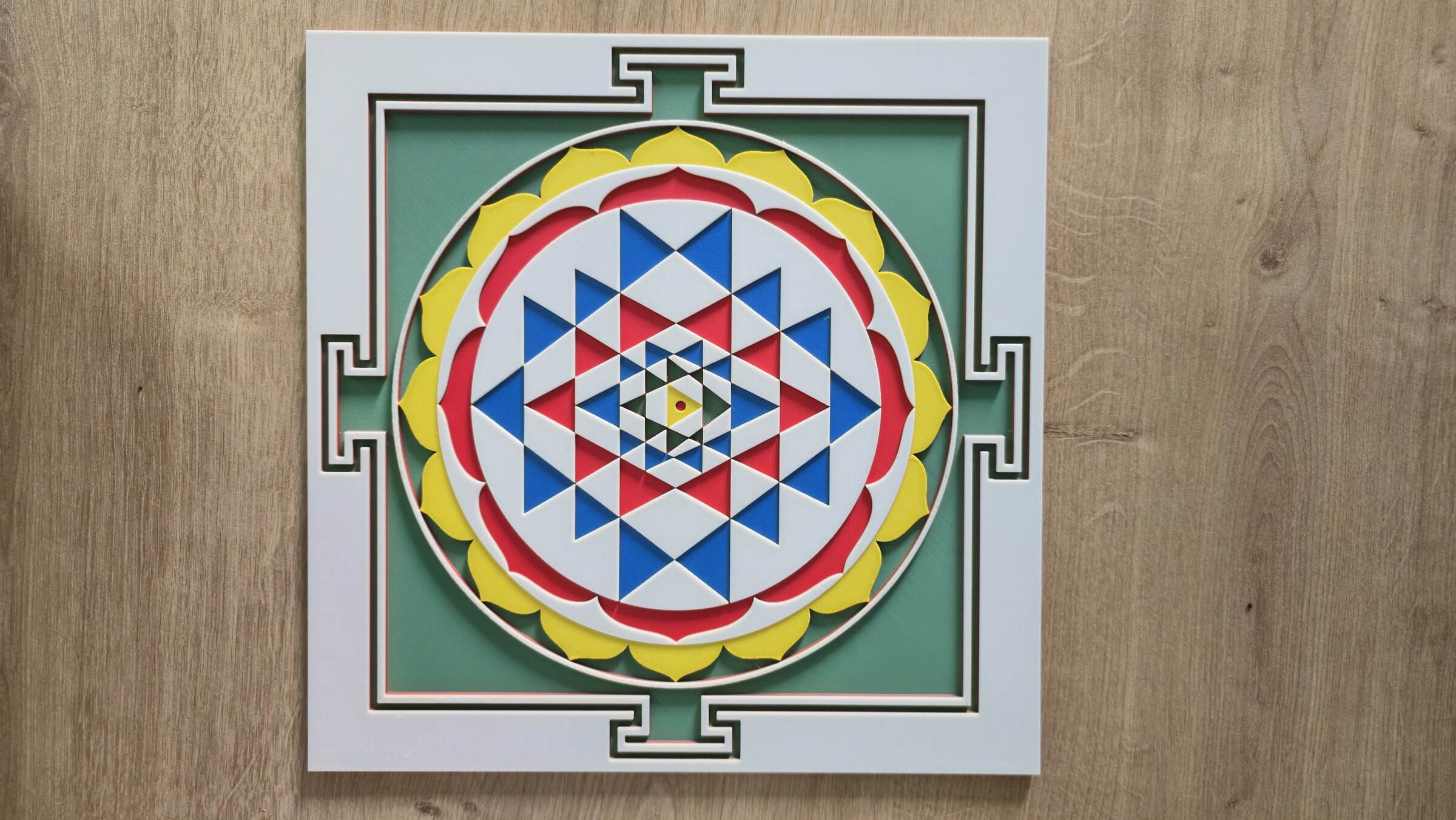
Meditation in the Yoga Sutras of Patanjali
Miha Cacic · April 11, 2026 · 7 min read

The Yoga Sutras of Patanjali are not a philosophy book with a meditation chapter. They are a meditation manual, cover to cover. The very first technical statement Patanjali makes (Sutra 1.2) defines yoga as yogaś citta-vṛtti-nirodhaḥ, “the stilling of the fluctuations of the mind.” Everything that follows, across 195 sutras and four chapters, serves that single aim. Yet most treatments of “meditation in the Yoga Sutras” skip straight to three verses in Chapter 3 (the definitions of dharana, dhyana, and samadhi) and ignore the rest. That leaves out the bulk of what Patanjali actually teaches: what the mind does when you sit, what drives its restlessness, what to give it as an anchor, and what happens when concentration deepens into absorption.
What Patanjali means by meditation (and what he doesn’t)
Patanjali’s dhyana is not sitting quietly. It is not guided visualization, body scanning, or mindfulness in the modern sense. It is a specific stage in a specific process: the point where concentration on a single object becomes an unbroken, effortless flow. But the Yoga Sutras as a whole are a systematic training of attention toward stillness. That broader project is what we’d colloquially call “meditation.”
The starting point is Sutra 1.2’s definition. Chitta is the mind-stuff (consciousness, memory, and ego bundled together). Vrittis are its fluctuations. Patanjali identifies five types (Sutras 1.5-1.11): valid cognition (pramana), error (viparyaya), imagination (vikalpa), sleep (nidra), and memory (smriti). These are not enemies to destroy. They are the raw material meditation works with. Any of them can be afflicted or non-afflicted. The goal is not to eliminate mental activity but to still its agitation.
This distinction matters. Patanjali never says “empty your mind.” He says give the mind a single object and hold it there until the holding becomes effortless. The content of consciousness reduces not because you force thoughts out, but because single-pointed attention starves other vrittis of energy.
The obstacles: why meditation is hard, according to Patanjali
Before offering a single technique, Patanjali names exactly what will get in the way. Sutras 1.30-1.31 list nine obstacles (antarayas): disease (vyadhi), dullness (styana), doubt (samshaya), carelessness (pramada), laziness (alasya), sensuality (avirati), false perception (bhranti-darshana), inability to maintain ground gained (alabdha-bhumikatva), and instability or regression (anavasthitatva).
These obstacles produce four symptoms: pain, frustration, trembling of the limbs, and disturbed breathing.
Chapter 2 digs deeper. Sutra 2.3 identifies the five kleshas (afflictions) as the roots beneath the surface obstacles: ignorance (avidya), ego (asmita), attachment (raga), aversion (dvesha), and clinging to life (abhinivesha). Ignorance is the root klesha; the other four grow from it. Chapter 2’s entire purpose is to weaken these afflictions as preparation for meditation. 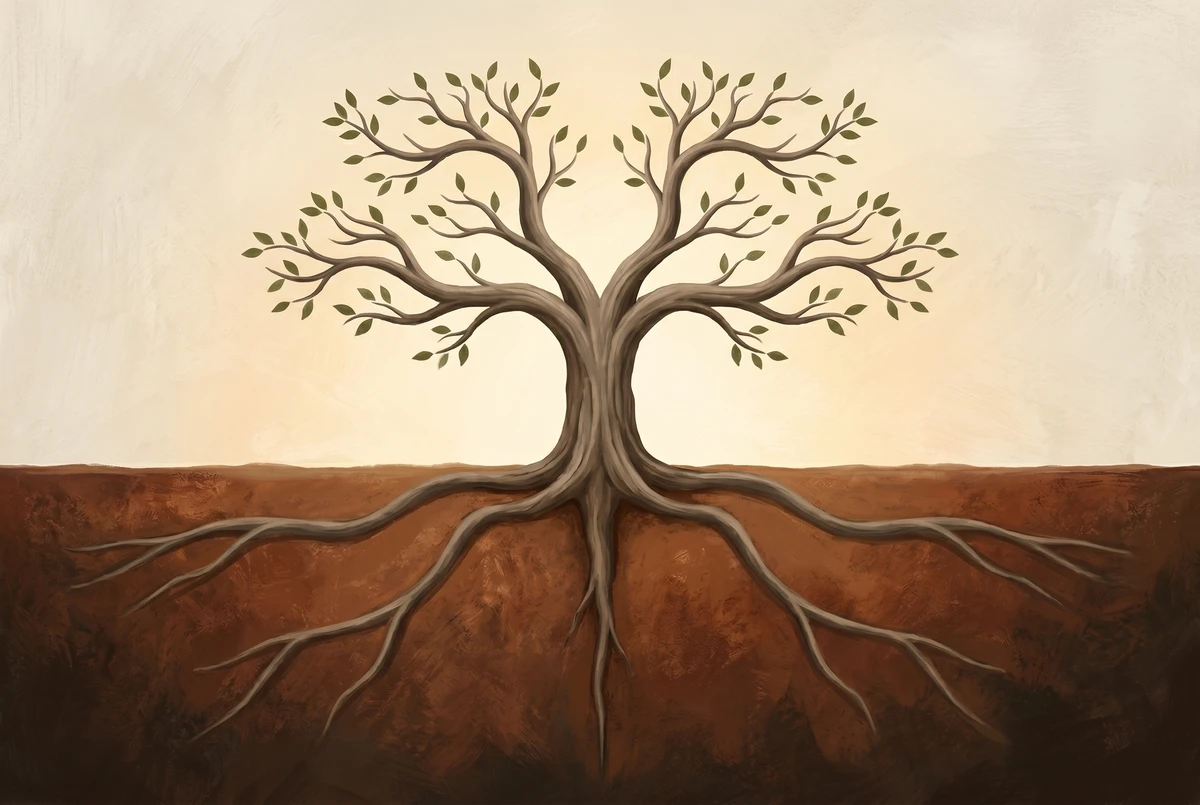
What makes this valuable to a practitioner is the recognition it offers. If you sit down to meditate and encounter doubt, laziness, or a feeling of losing ground you’d gained, those are not signs of personal failure. Patanjali listed them roughly two millennia ago as inherent features of the process. Recognizing your specific obstacle is itself part of the practice.
Seven ways to steady the mind: Patanjali’s meditation objects (Sutras 1.33-1.39)
This is the section most articles skip or reduce to a sentence. Patanjali offers seven specific approaches to stabilize the mind (chitta prasadanam), and they form a deliberate gradient from relational to increasingly subtle and internal.
1. Four attitudes (Sutra 1.33). Cultivate friendliness (maitri) toward the happy, compassion (karuna) toward the suffering, delight (mudita) in the virtuous, and equanimity (upeksha) toward the non-virtuous. This is a relational practice. It works by removing the emotional reactivity that keeps the mind churning after encounters with other people.
2. Breath regulation (Sutra 1.34). Pracchardana-vidharana-bhyam va pranasya: through exhalation and retention of breath. Extended exhalation calms the autonomic nervous system, making this both a concentration anchor and a physiological settling technique. This is Patanjali placing pranayama not only among the eight limbs but as a standalone meditation method.
3. Sensory absorption (Sutra 1.35). Fixing attention on a subtle sensory experience, such as an inner sound, a sensation at the tip of the tongue, or a fine point of tactile awareness. The mind stabilizes because it has something concrete and immediate to rest on.
4. Inner luminosity (Sutra 1.36). Vishoka va jyotishmati: “the sorrowless inner light.” This is the Patanjalian basis for light-based meditation practices, including trataka (steady gazing on a candle flame, codified later in the Hatha Yoga Pradipika) and visualization of inner radiance.
5. A desireless mind (Sutra 1.37). Contemplating a sage or realized being whose mind is free from attachment. The meditator takes the quality of desirelessness itself as the object.
6. Dream and deep sleep knowledge (Sutra 1.38). Using the states of consciousness that arise in dreams or dreamless sleep as meditation objects. Consciousness itself, rather than any object within it, becomes the anchor.
7. Any agreeable object (Sutra 1.39). Yatha-abhimata-dhyanad va: “by meditation on anything one finds agreeable.” This is not a lesser option. As Edwin Bryant notes in his scholarly commentary on this sutra, it is the summation of all preceding methods. The specific object matters less than the quality of sustained, agreeable attention. This is the scriptural basis for mantra meditation, yantra meditation, deity forms, nature objects, and any other anchor that draws the mind inward.
These seven methods are not random. They move from ethical-relational (1.33) through physical (1.34-1.35) to increasingly internal and subtle (1.36-1.38), with 1.39 as the universal principle. Patanjali is acknowledging that different minds need different anchors. Swami Krishnananda’s commentary on this section specifies that the ideal meditation object should be natural, connected to the practitioner’s highest aspiration, and progressively subtle.
The eight limbs and where meditation fits
Sutra 2.29 lays out the eight limbs of ashtanga yoga: yama (ethical restraints), niyama (personal observances), asana (posture), pranayama (breath regulation), pratyahara (sense withdrawal), dharana (concentration), dhyana (meditation), and samadhi (absorption).
The structure is sequential for a reason. Vyasa’s commentary divides them into two categories: the first five are bahiranga (external), the last three are antaranga (internal). Each stage quiets a different source of noise. Ethical conduct reduces the turbulence of guilt and conflict. Physical posture (Sutra 2.46: sthira-sukham asanam, “steady and comfortable”) stills the body. Pranayama stills the breath. Pratyahara turns attention from external stimulation to the inner field. 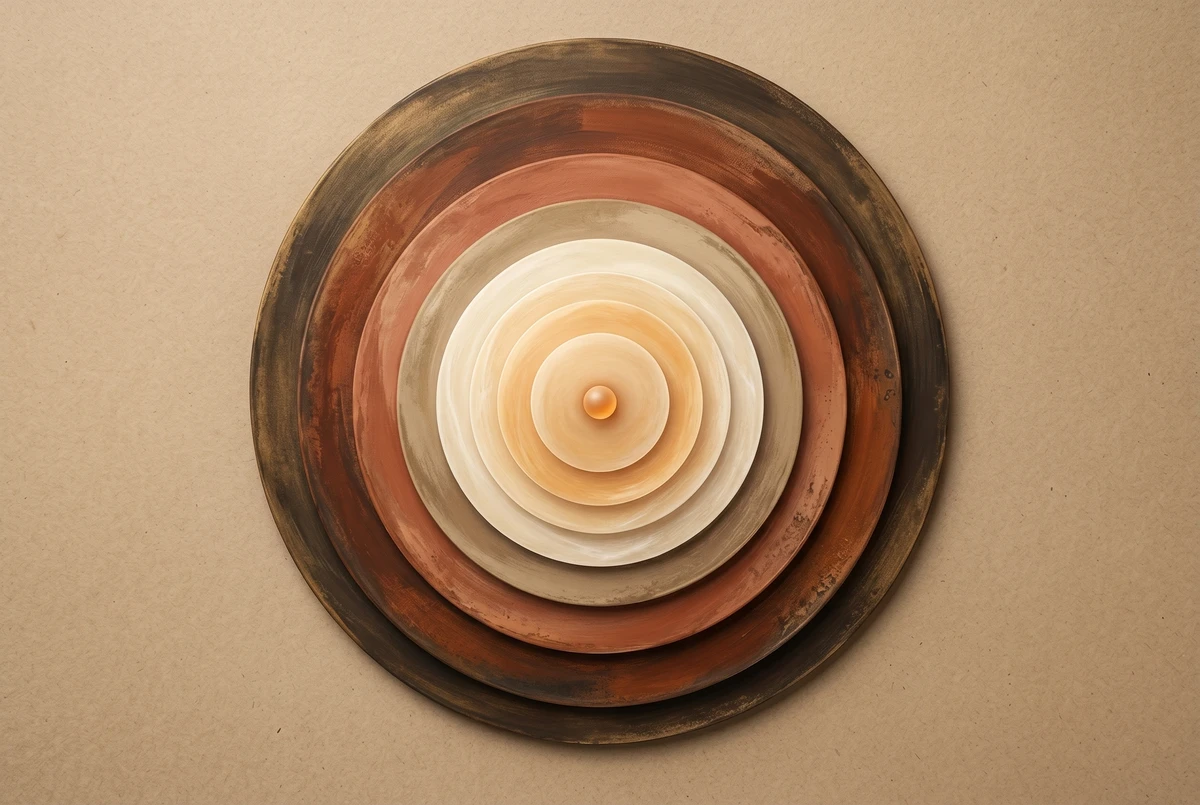
Pratyahara is the stage most modern practitioners skip, and it’s the bridge without which dharana struggles. As Iyengar writes in Light on the Yoga Sutras, “Without pratyahara, dharana is impossible; the senses must turn inward before the mind can be bound.” If you’ve ever tried to meditate in a noisy room after a stressful day and found it impossible, you’ve experienced the absence of the preceding limbs.
Dharana: concentration as the entry point
Sutra 3.1: deśa-bandhaś cittasya dhāraṇā. Dharana is the binding (bandha) of the mind to one place (desha). From the Sanskrit root dhṛ, meaning “to hold.”
That place can be external (a candle flame, a yantra, a point on the wall) or internal (the heart center, the space between the eyebrows, the navel, a mantra syllable). The key word is bandha: binding, tying down. Dharana is effortful. You hold attention on the object, it slips, and you bring it back.
Vyasa’s commentary on this sutra uses the image of water drops falling one by one on a surface. Each moment of attention is discrete, separate from the last. There are gaps. The mind touches the object, drifts, and returns. That returning is not a failure of meditation. It is dharana. It is the practice working.
This is what most people mean when they say “I tried to meditate but my mind kept wandering.” In Patanjali’s framework, they were doing dharana. They were doing it correctly.
A review of 14 studies on dharana and dhyana (Telles et al., 2016) found that dharana shows increased beta wave activity on EEG, consistent with active cognitive effort, and slightly elevated heart rate and galvanic skin response compared to rest. The body and brain are working. The same review found that trataka (steady candle gazing, a classic dharana technique) improved attention span and cognitive flexibility in subsequent tests.
Traditional commentaries on Sutra 3.1 give a precise measurement: one dharana equals 12 seconds of unbroken attention on the object. This number comes from the classical commentary tradition (attributed to Vyasa’s Bhashya), not from Patanjali’s text itself, but it offers a useful benchmark. Twelve seconds of genuinely unbroken focus is harder than it sounds.
Dhyana: when concentration becomes meditation
Sutra 3.2: tatra pratyayaikatānatā dhyānam. Dhyana is the unbroken flow (ekatanata) of awareness toward the object. From the Sanskrit root dhyai, meaning “to contemplate.”
The shift from dharana to dhyana is not a change in what you do. It is a change in what happens. Dharana becomes dhyana when the gaps between moments of attention close and the flow becomes continuous. Vyasa’s commentary captures it precisely: dharana is water dripping; dhyana is oil poured from one vessel to another in an unbroken stream (taila-dhāra-vat). 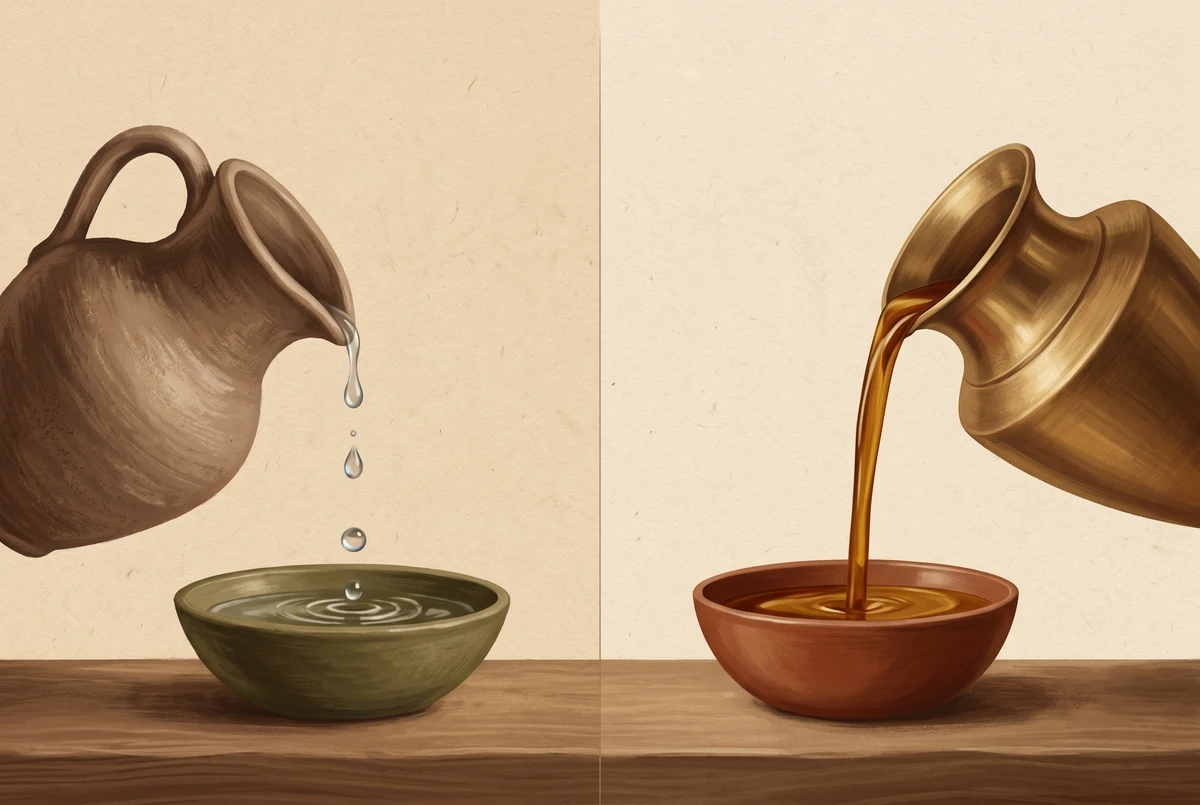
The meditator still knows they are meditating. There is still an object. But the struggle to maintain focus has dissolved.
This maps closely onto what positive psychologist Mihaly Csikszentmihalyi (1990) called ”flow”: complete absorption in an activity, loss of self-consciousness, effortlessness despite high performance, distorted time perception. Both describe a state where the distinction between doer and doing fades. The difference is that Csikszentmihalyi’s flow is typically externally directed (sport, music, coding), while Patanjali’s dhyana is internally directed toward a chosen meditation object.
The EEG data reflects this shift. Where dharana shows increased beta (effort), dhyana shows increased alpha and theta waves, associated with relaxed, internally focused states without effortful control (Telles et al., 2016). The effort-to-effortlessness transition is not just phenomenological. It’s physiologically measurable.
One practical consequence: you cannot force dhyana. The more effort you apply, the further you move from it. Dhyana arises from sustained dharana the way sleep arises from lying still with eyes closed. You create the conditions. You don’t manufacture the result.
The traditional timing system extends the 12-second unit: one dhyana equals 12 dharanas, or 144 seconds (roughly 2.4 minutes) of unbroken flow. One samadhi equals 12 dhyanas, or approximately 28.8 minutes of unbroken absorption.
As Yogapedia notes, “In yoga studios, apps and YouTube videos across the world, the word meditation is in fact used to describe the practice of dharana.” What most people call meditation is concentration training. That is valuable, but in Patanjali’s technical vocabulary, it precedes dhyana by one step.
Samadhi: absorption and beyond
Sutra 3.3: tad evārthamātra-nirbhāsaṃ svarūpa-śūnyam iva samādhiḥ. “When the object alone shines, as if (iva) devoid of the meditator’s own form, that is samadhi.” From sam (together) + ā (toward) + dhā (to place): literally, “to place completely together.” 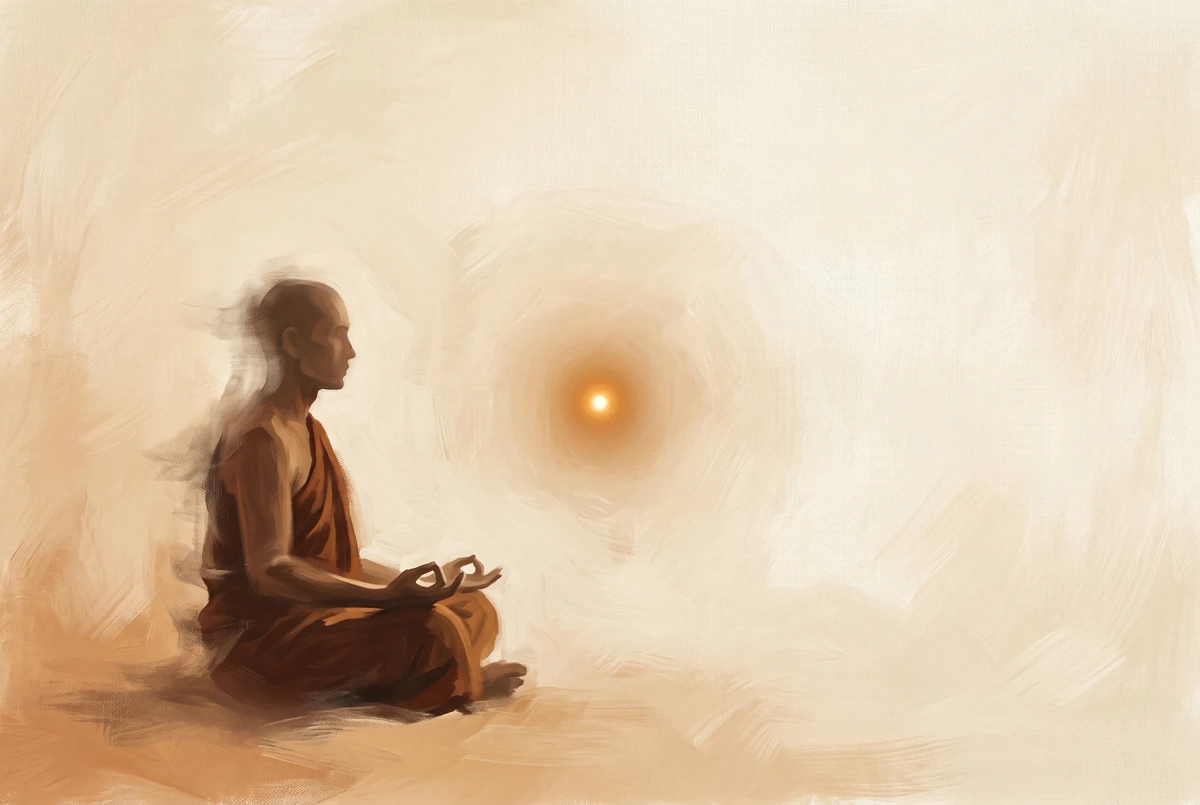
Patanjali’s word choice is precise. He says iva, “as if.” The meditator doesn’t actually disappear. Subjectivity recedes until the object fills awareness completely. The distinction between the one who meditates, the act of meditation, and the object of meditation dissolves.
This is not mystical shorthand. Neuroscience research (Bærentsen et al., 2015) shows that in deep absorption states, the Default Mode Network (the brain regions responsible for self-referential thought, the “I” narrative running in the background) significantly quiets. In advanced meditators during absorption, both the task-positive network and the DMN show unusual stillness. Patanjali’s description of the meditator’s “own form appearing to vanish” has a neural correlate: the self-referencing machinery of the brain reduces its activity.
Samadhi is not a single state. I.K. Taimni, in The Science of Yoga (1961), provides the clearest English treatment of the stages Patanjali describes in Sutras 1.41-1.51:
Sabija samadhi (with seed, meaning with an object):
- Savitarka: absorption where the object is perceived with its name, form, and associated meaning intermingled
- Nirvitarka: name and meaning drop away; only pure form remains
- Savichara: the subtle substrate of the object (its underlying nature) becomes the focus
- Nirvichara: pure essence, without conceptual overlays
- Sananda: even the subtle object recedes; bliss predominates
- Sasmita: the subtlest stage, where pure sense of existence (“I am”) is the object
Nirbija samadhi (without seed, objectless): all vrittis suspended. Pure consciousness resting in itself. This is the direct approach to kaivalya (liberation, Sutra 4.34).
Samadhi is not a permanent enlightenment that either happens or doesn’t. Patanjali describes it as a spectrum. The early stages (brief moments of savitarka, where the object absorbs you for seconds at a time) are accessible to dedicated practitioners. It is a trainable skill, not a gift reserved for saints.
Samyama: the three as one practice
Sutras 3.4-3.6 introduce samyama: dharana, dhyana, and samadhi practiced together on a single object. Bryant’s commentary emphasizes that samyama is not three sequential practices but a unified deepening, “one practice seen from three angles of description.”
When samyama is mastered, prajñālokah: “the light of insight dawns” (Sutra 3.5). Concentrated meditation, in Patanjali’s framework, is not a relaxation technique. It is an epistemological tool, a way of knowing.
Chapter 3 goes on to describe the results of samyama applied to various objects (the siddhis, sometimes translated as “supernatural powers”). And then Patanjali does something unexpected: Sutra 3.38 calls these powers obstacles to samadhi, not goals. Te samādhāv upasargā vyutthāne siddhayaḥ: “These are obstacles to samadhi; they are accomplishments only in the outward-turned state.” The powers that arise from deep meditation are, to Patanjali, distractions from its real purpose.
What modern meditators get wrong about the Yoga Sutras
Three confusions come up repeatedly.
“Meditation means emptying the mind.” Patanjali says the opposite: give the mind one object. Emptiness is not the method. The vrittis quiet because sustained attention on a single anchor starves them of fuel, not because you chase them away.
Skipping the earlier limbs. The eight limbs are sequential for a reason. Pratyahara (sense withdrawal) is the bridge between external practice and internal meditation. Without it, dharana becomes a fight against sensory stimulation. “I can’t meditate” often means “I haven’t built the preceding conditions.”
Treating samadhi as unreachable. Patanjali describes a graduated, trainable process with identifiable stages. The early stages are brief, ordinary-feeling moments of absorption that most dedicated practitioners have already experienced without naming them.
One broader distinction is worth noting. Modern mindfulness (derived from Buddhist sati/vipassana) and Patanjali’s dhyana are different technologies. Neuroscience classifies them under separate categories (Lutz et al., 2008): mindfulness is Open Monitoring (OM), observing whatever arises without selecting an object. Patanjali’s system is Focused Attention (FA) throughout, narrowing to one object until everything else falls away. Both are valid. They work through different mechanisms and produce different neural signatures.
How to begin: a practical framework from the Sutras
Choose your object. Sutra 1.39’s principle: pick whatever naturally draws your attention inward. That might be the breath (Sutra 1.34), a mantra, a candle flame, a yantra, or a visualized form. The object your mind moves toward rather than resisting is the right one. As Swami Krishnananda writes, the ideal meditation object connects to the practitioner’s highest aspiration and meets the mind where it already wants to go.
Establish your seat. Sutra 2.46: sthira-sukham asanam, steady and comfortable. The posture needs to be stable enough that your body stops sending signals, and comfortable enough that you can sustain it. That’s the full requirement.
Regulate the breath. A few minutes of slow, deliberate breathing with extended exhalation (Sutra 1.34) calms the nervous system and bridges external activity to internal focus.
Practice dharana. Hold attention on your chosen object. When it drifts, bring it back. Each return is the practice, not a failure. Can you maintain unbroken attention for 12 full seconds?
Let dhyana arise. Sustained dharana naturally deepens into effortless flow when the conditions are right. Your job is the effort. The effortlessness appears on its own.
Expect resistance. Sutra 1.30 lists nine obstacles, including doubt, laziness, and regression. They are named and expected. Encountering them means you are on the path Patanjali mapped out, not off it.
Sources
- Bryant, E.F. (2009). The Yoga Sutras of Patanjali: A New Edition, Translation, and Commentary. North Point Press.
- Taimni, I.K. (1961). The Science of Yoga. Theosophical Publishing House.
- Iyengar, B.K.S. (1993). Light on the Yoga Sutras of Patanjali. Aquarian/Thorsons.
- Bærentsen, K.B. et al. (2015). “Patanjali and neuroscientific research on meditation.” Frontiers in Psychology. PMC4490208.
- Telles, S. et al. (2016). “A selective review of dharana and dhyana in healthy participants.” International Journal of Yoga. PMC5192286.
- Lutz, A., Slagter, H.A., Dunne, J.D., & Davidson, R.J. (2008). “Attention regulation and monitoring in meditation.” Trends in Cognitive Sciences, 12(4), 163-169.
- Csikszentmihalyi, M. (1990). Flow: The Psychology of Optimal Experience. Harper & Row.