Meditation You Can Do at Your Desk
Miha Cacic · April 11, 2026 · 5 min read
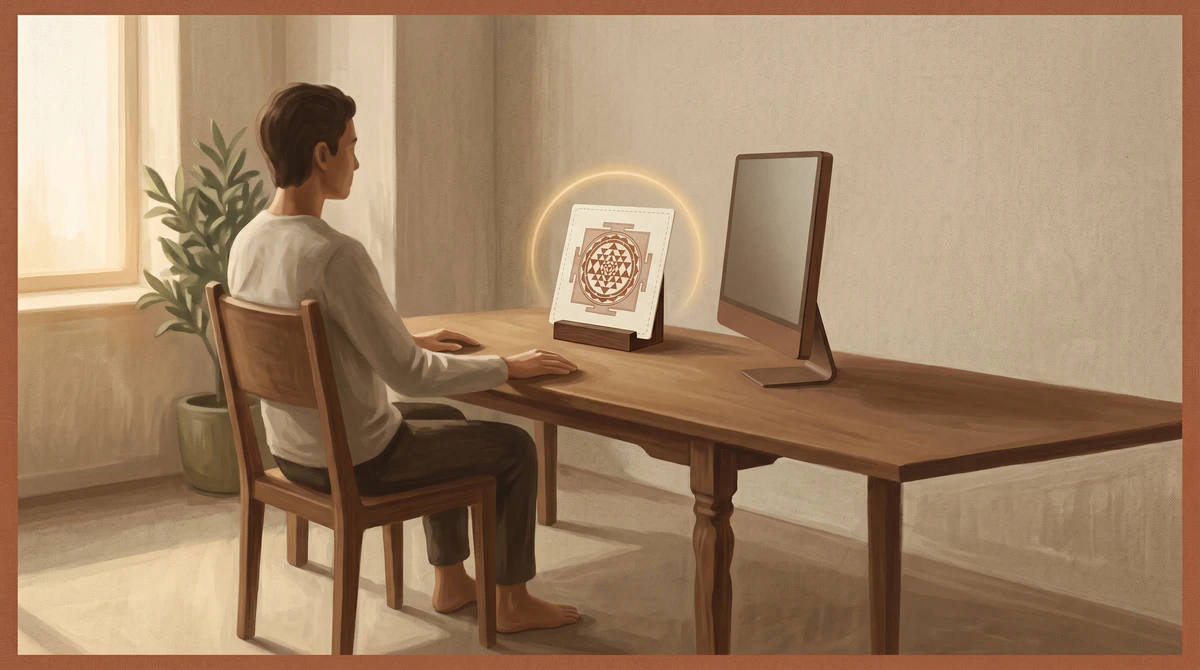
Most desk meditation advice takes practices designed for closed eyes and quiet rooms, then tells you to do them in an office chair. Close your eyes and breathe. Do a body scan. Visualize a beach. The techniques work, but they assume you have privacy, and most desks don’t come with that.
There’s a category of meditation that fits the desk because it was designed for exactly the conditions a desk provides: you’re seated, your eyes are open, and there’s a surface at arm’s length. It’s called gazing meditation, and from the outside, it looks like you’re concentrating on something. Which, in a sense, you are.
Why most desk meditation advice doesn’t quite work
The problem isn’t the techniques. Breath meditation, body scans, and visualization all reduce stress. A 2018 randomized controlled trial found that just ten sessions of guided mindfulness on the Headspace app produced significant reductions in stress and irritability compared to an audiobook control (Economides et al., 2018). Mindfulness-Based Stress Reduction outperforms active stress management education for people with generalized anxiety disorder (Hoge et al., 2013). The evidence for meditation itself is solid.
The problem is the environment. These techniques were built for conditions where you can close your eyes without consequences: a meditation cushion, a quiet room, a parked car. At a desk in an open office, with glass walls, hot-desking, and coworkers walking past, closing your eyes for five minutes looks like napping. Everyone who has tried it knows the self-consciousness that follows.
The common workaround is to keep your eyes open during breath meditation. This works, but it leaves the visual system on the sidelines. You’re meditating despite your eyes being open, not because of them. Nearly half the brain is devoted directly or indirectly to vision (MIT, 1996). Open-eye breath meditation doesn’t harness any of that processing power. 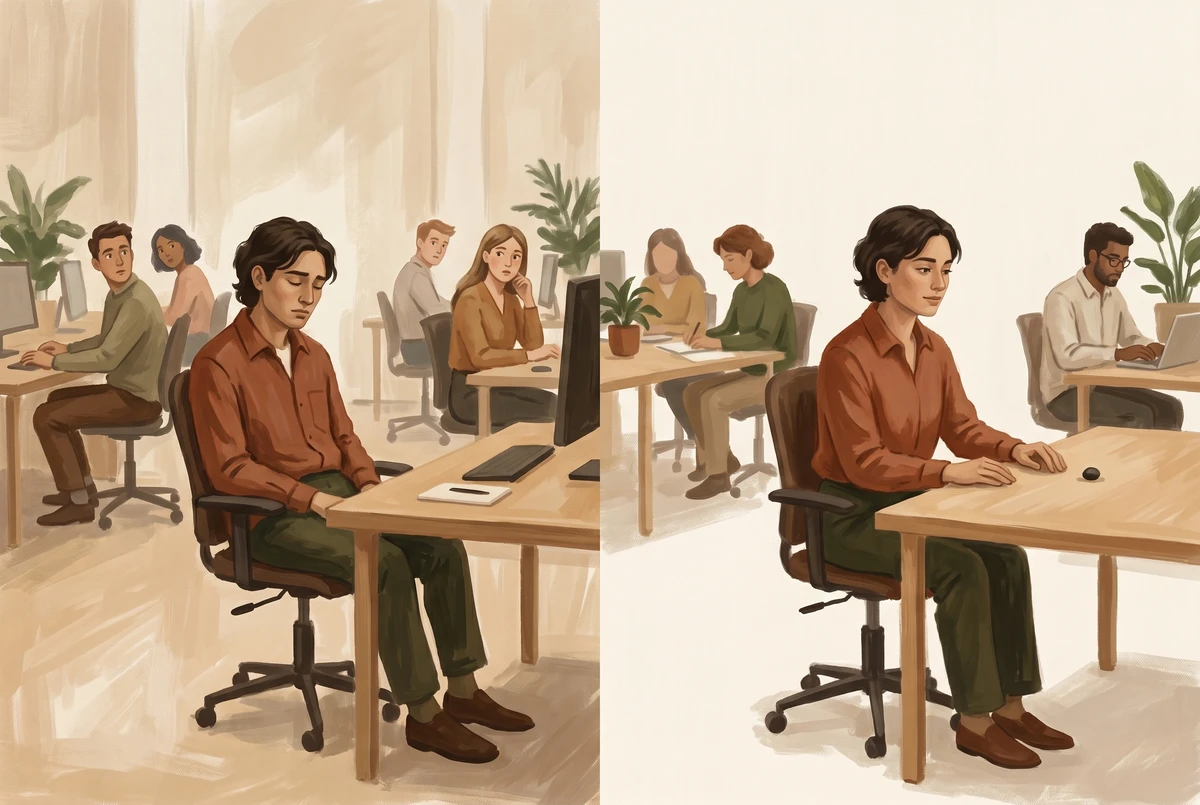
The reader who has tried desk meditation and felt awkward or distracted isn’t failing. The technique is mismatched to the environment.
Open-eye gazing: the meditation built for desks
Gazing meditation is a category of practice where you fix your eyes softly on a single point and hold your attention there. In yoga, it’s called trataka. In broader contemplative traditions, the principle is called drishti (focused gaze). In Zen, sitting practitioners hold a soft downward gaze as a core part of zazen. The practice appears independently across traditions because it works with a basic feature of human neurology: the eyes and the mind are coupled. 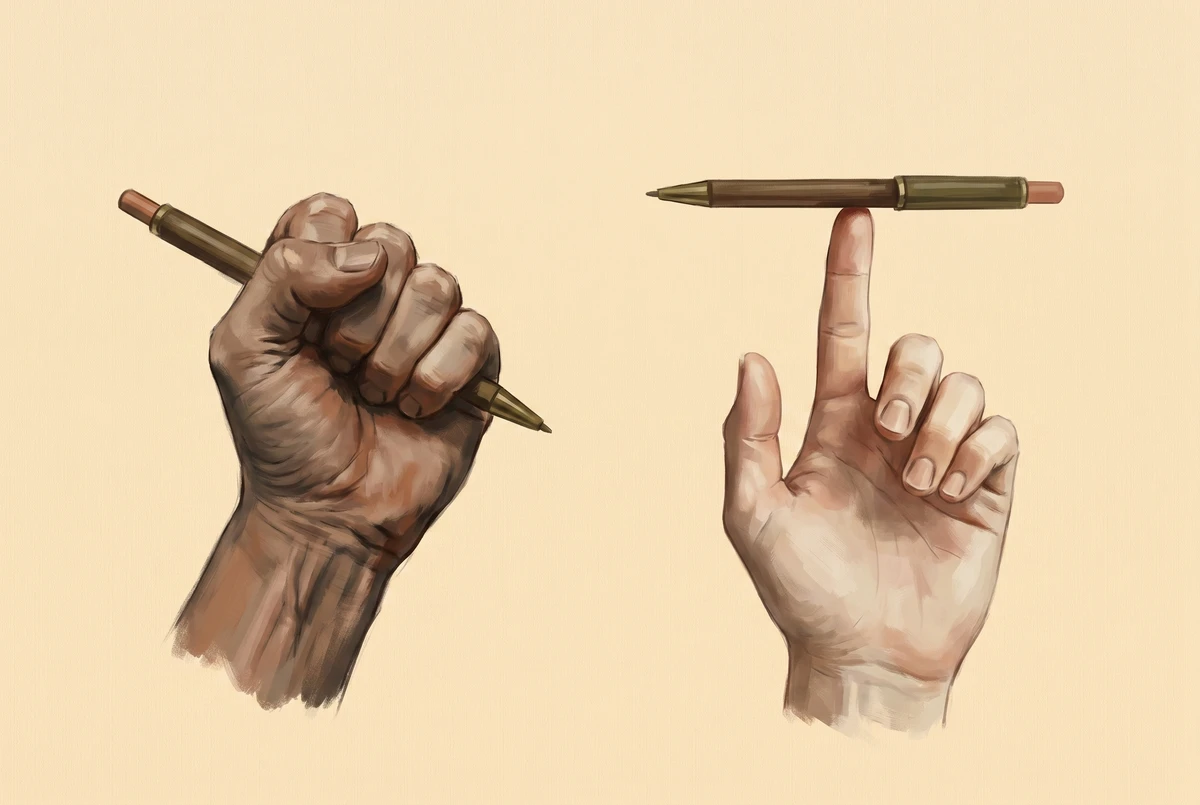
This isn’t metaphor. The retina is, embryologically, a direct outgrowth of the brain, made of the same neural tissue and myelinated by central nervous system cells. What happens in your eyes happens in your brain, literally.
During normal waking life, your eyes make constant involuntary micro-movements called microsaccades, even when you think you’re looking steadily at something. A 2004 review in Nature Reviews Neuroscience by Martinez-Conde, Macknik, and Hubel (the latter a Nobel laureate) established a tight link between these fixational eye movements and attentional state. Mental restlessness shows up as erratic eye movement. The relationship appears to run in both directions: practitioners across contemplative traditions consistently report that deliberately stilling the gaze tends to still the mind. 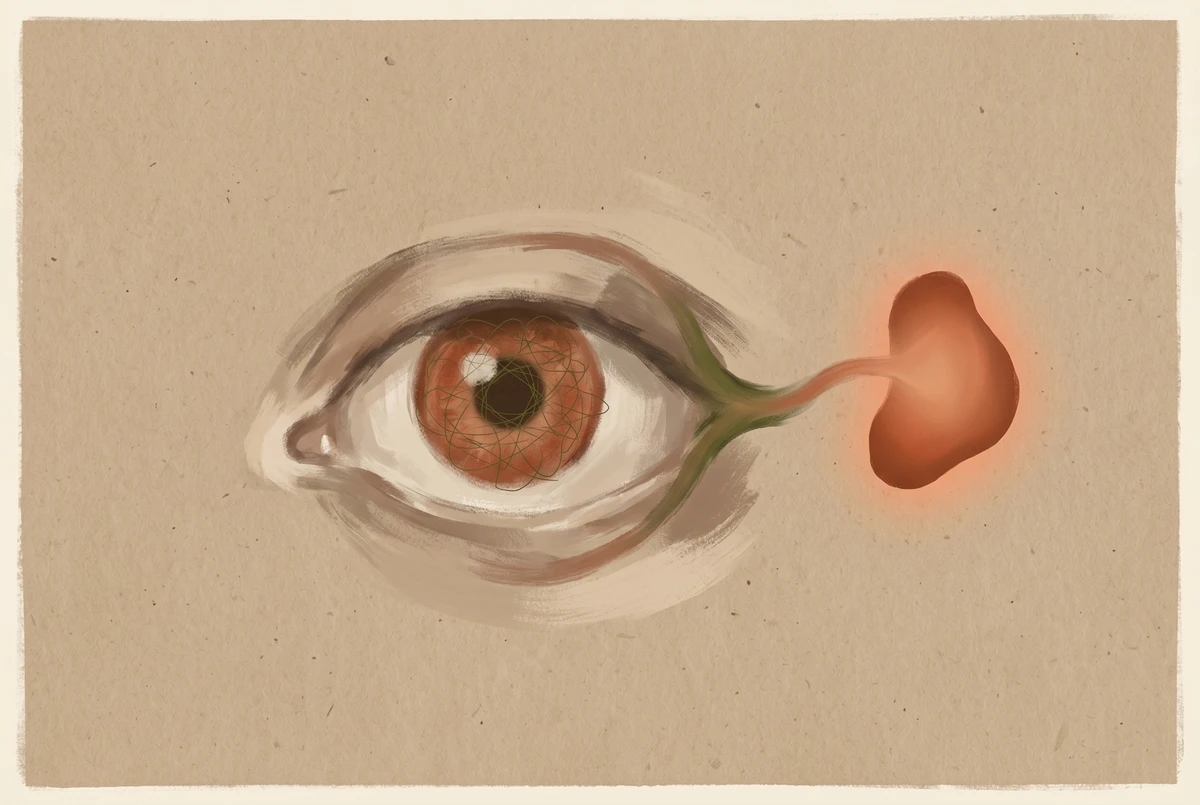
This is the mechanism behind trataka. You pick a point. You soften your gaze onto it. Your eyes gradually settle, the micro-movements reduce, and the mental chatter follows. The Hatha Yoga Pradipika (15th century) describes it simply: “Being calm, one should gaze steadily at a small mark” (Chapter II, Slokas 31-32). The text classifies trataka among the six purification practices (shatkarmas) alongside breathing and cleansing techniques.
The only published randomized controlled trial on trataka (Talwadkar et al., 2014) tested 30-minute daily sessions over 26 days in elderly participants. The trataka group showed significant improvements in attention, working memory, and executive function compared to a waitlist control. The protocol included eye exercises and breathing components alongside the gazing, so the effects can’t be attributed to gazing alone. And the evidence base remains limited: one RCT, elderly subjects, small sample. Still, the results are consistent with the underlying mechanism, and they point in the direction that thousands of years of practice would predict.
What makes this relevant to your desk: the setup is already correct. You’re seated. You’re upright. Your eyes are open. There’s a surface at arm’s length. You don’t need a cushion, a quiet room, or closed eyes. And to anyone walking past, you look like someone concentrating on something on their desk.
One important distinction: gazing is not staring. Staring is tense. The muscles around the eye engage, the brow furrows, and you’re actively grabbing the image. Gazing is relaxed. The eye muscles soften, peripheral vision blurs naturally, and the focal point is held by attention rather than effort. The difference is the same as gripping a pen versus balancing it on your finger.
How to Do Desk Gazing Meditation
The minimal version (no props needed)
Pick a single point already on or near your desk. A period at the end of a sentence on a printed page. The corner of your monitor bezel. A thumbtack on a corkboard. A small mark on the wall. Anything small and stationary.
Sit upright but not rigid. Feet flat on the floor, hands resting on your lap or desk. Soften your gaze onto the point. Don’t squint, don’t stare hard. Let your peripheral vision blur on its own. You’re not trying to see the point more clearly; you’re resting your attention on it.
Breathe normally. When your attention wanders (it will, within seconds), bring it back to the point. No frustration, no commentary. Just return.
Blink whenever you need to. This is not a staring contest. The practice is about where your attention rests, not how long you can keep your eyes open.
Two to three minutes is enough. You’ll feel the difference.
The enhanced version (with a focal point)
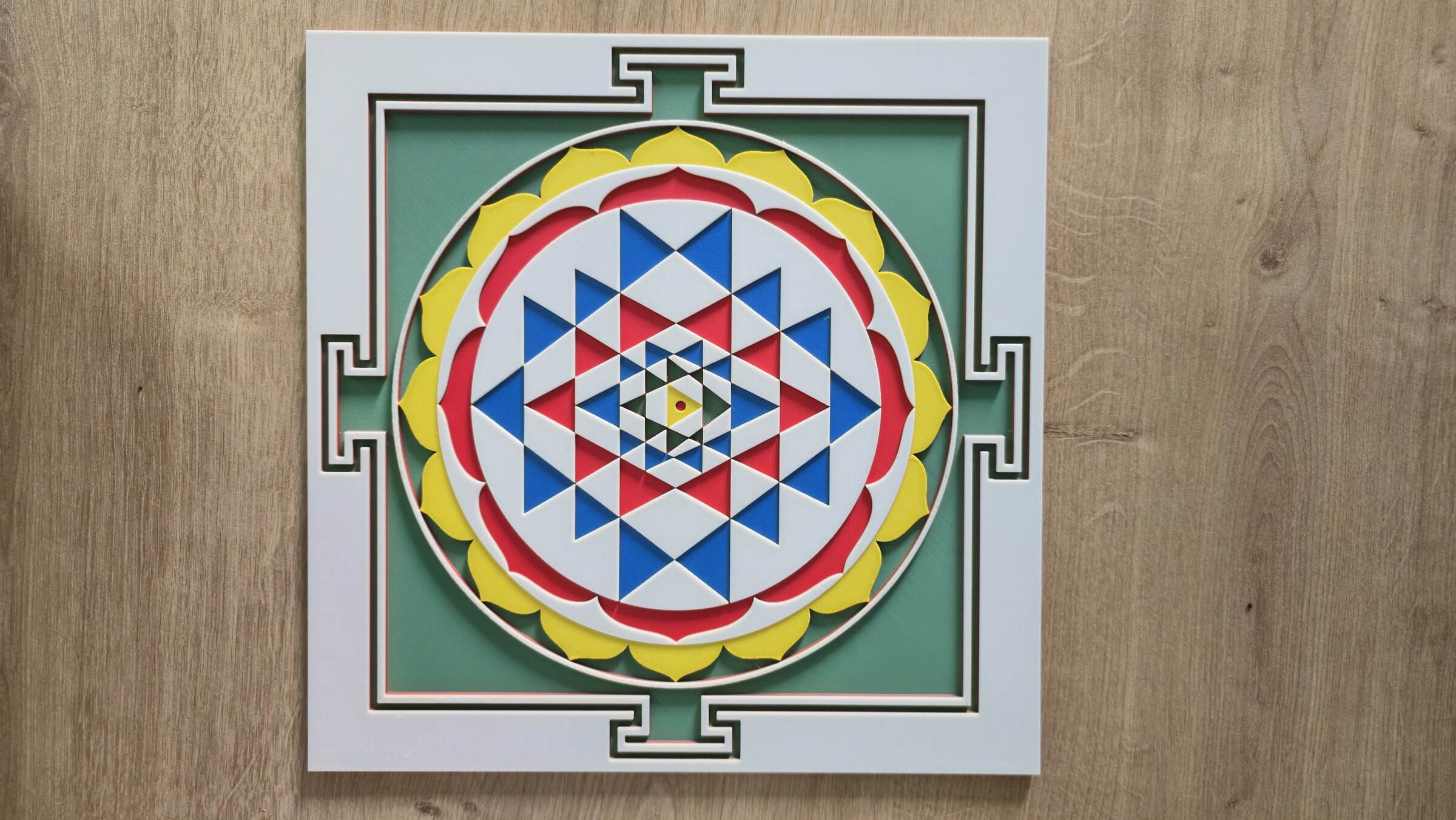
A small card with a geometric design, placed near your monitor, gives your eyes something to settle into. A simple dot on a sticky note works. A mandala or a Sri Yantra (a nested geometric pattern from the Tantric tradition) can work particularly well because the layered shapes create natural visual depth that draws the eye inward toward the center without effort. 
To your coworkers, it looks like a desk ornament or a piece of art. To you, it’s a meditation tool.
What to expect
In the first minute, your eyes will want to wander and your thoughts will intrude. This is normal and not a sign that you’re doing it wrong.
In the second minute, your peripheral vision softens. Your breathing tends to slow on its own, without any deliberate breath control.
By the third minute, there’s a settling quality. The focal point feels less like something you’re looking at and more like something you’re resting in.
When you close your eyes briefly afterward, you may notice a faint afterimage of the point or pattern. This is a normal retinal effect and, in the Bihar School of Yoga tradition (Swami Satyananda Saraswati’s teachings), it marks the transition from external gazing (bahir trataka) to internal gazing (antar trataka), where you hold the afterimage with closed eyes. 
When to Use Desk Meditation During Your Workday
The best triggers aren’t clock-based. They’re situational.
Between meetings or tasks. Transition moments when your mind is still processing the last thing. Two minutes of gazing resets your attention before the next demand on it.
After a stressful email or call. Before you respond, gaze for a minute. Mindfulness training reduces stress reactivity (Hoge et al., 2013), and a brief gazing pause puts a gap between the stimulus and your reaction.
During the mid-afternoon dip. Practitioners consistently report that closed-eye meditation in the early afternoon tips toward drowsiness. Open-eye gazing maintains environmental engagement and tends toward alert, quiet focus.
Before focused or creative work. Brief mindfulness training significantly reduces mind-wandering (Rahl et al., 2017). And Ostafin and Kassman (2012) found that mindfulness improves insight problem solving specifically: the kind of thinking that requires stepping out of habitual patterns and seeing novel connections. A few minutes of gazing meditation before a hard problem primes that state.
None of this dismisses other forms of desk meditation. Breath awareness and body scans work if they work for you. Gazing meditation solves a specific problem: the need for a practice designed for open eyes in a visible workspace.
Building the practice: from desk breaks to deeper meditation
The same focal point you use for two-minute desk resets can support longer sessions at home.
At your desk, you’re doing the first stage: external gazing (bahir trataka). At home, you can extend this to five or ten minutes, then close your eyes and hold the afterimage. This is the second stage (antar trataka), a form of visualization that arrives effortlessly because the image was just physically present on your retina.
If you use a geometric pattern like the Sri Yantra, the complexity supports longer sessions without the gaze becoming dull. In traditional practice, the nested triangles are described as creating a natural path for the eye and attention, drawing focus progressively inward toward the central point (bindu).
There’s no “beginner” phase you need to pass through. The two-minute desk practice and the twenty-minute home session are the same technique at different durations. A habit you build at work during a Thursday afternoon lull is the same practice that yogis have used for centuries.
Sources
- Economides M, Martman J, Bell MJ, Sanderson B. (2018). “Improvements in Stress, Affect, and Irritability Following Brief Use of a Mindfulness-based Smartphone App: A Randomized Controlled Trial.” Mindfulness, 9(5):1584-1593. PMC6153897.
- Hoge EA, Bui E, Marques L, et al. (2013). “Randomized Controlled Trial of Mindfulness Meditation for Generalized Anxiety Disorder: Effects on Anxiety and Stress Reactivity.” Journal of Clinical Psychiatry, 74(8):786-792. PMC3772979.
- Martinez-Conde S, Macknik SL, Hubel DH. (2004). “The role of fixational eye movements in visual perception.” Nature Reviews Neuroscience, 5(3):229-40. PMID 14976522.
- Ostafin BD, Kassman KT. (2012). “Stepping out of history: mindfulness improves insight problem solving.” Consciousness and Cognition, 21(2):1031-6. PMID 22483682.
- Rahl HA, Lindsay EK, Pacilio LE, Brown KW, Creswell JD. (2017). “Brief Mindfulness Meditation Training Reduces Mind-Wandering: The Critical Role of Acceptance.” Emotion, 17(2):224-230. PMC5329004.
- Talwadkar S, Jagannathan A, Raghuram N. (2014). “Effect of trataka on cognitive functions in the elderly.” International Journal of Yoga, 7(2):96-103. PMC4097909.
- Hatha Yoga Pradipika, Chapter II, Slokas 31-32. Translation: Pancham Sinh, 1914.
- MIT News. (1996). “In the blink of an eye.” MIT Department of Brain and Cognitive Sciences.
- Swami Satyananda Saraswati. Dharana Darshan and Asana Pranayama Mudra Bandha. Bihar School of Yoga.