Singing Bowls for Meditation: What They Actually Do
Miha Cacic · April 11, 2026 · 7 min read
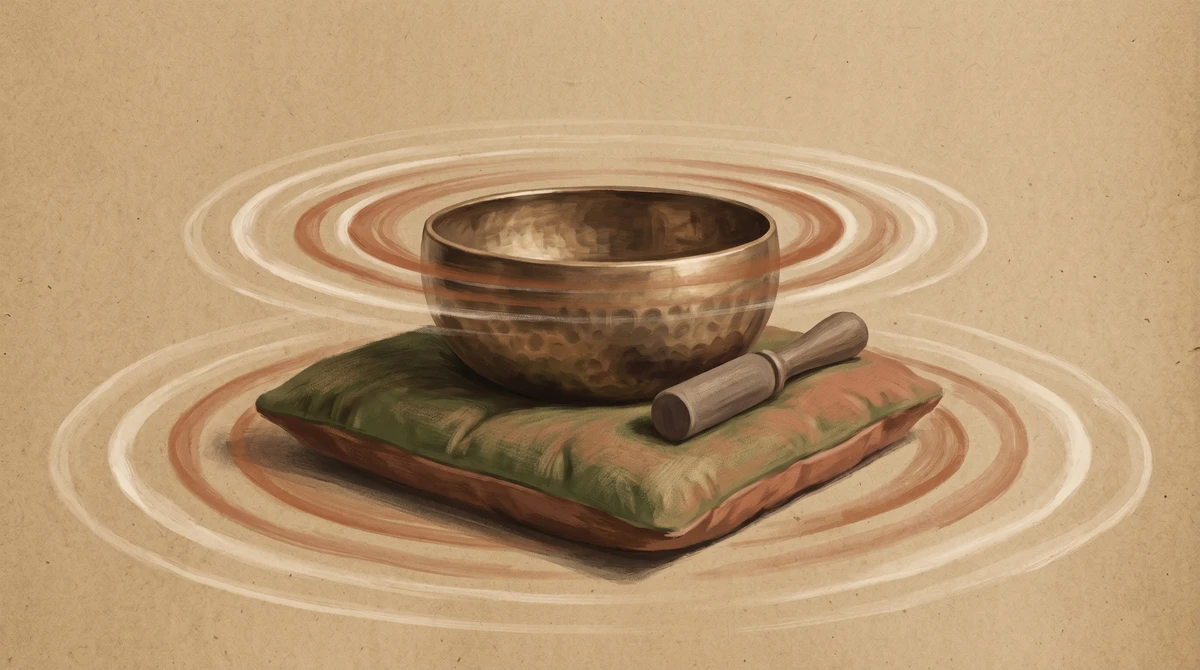
A singing bowl gives you one clear sound to pay attention to, and then takes it away. That cycle of tone and silence is the entire practice: strike the bowl, follow the sound, notice the moment your mind wanders. It’s concentration training with a built-in feedback loop.
What a singing bowl actually does during meditation
A singing bowl is a focal object. It works the same way a candle flame works in trataka (fixed-gaze meditation) or the way a mantra works in japa: it gives your attention somewhere specific to rest. The difference is the medium. Instead of watching a point of light, you’re listening to a tone.
What makes the bowl distinct as a focal object is how that tone behaves. A hand-hammered bronze bowl produces a sound rich with overtones (multiple frequencies layered on top of each other) that decays slowly, often over 30 seconds or more. That layered complexity resists easy habituation: your ear can’t predict it the way it predicts a melody or a repeating drum pattern, so it holds attention longer than a simpler stimulus.
Then the sound fades. This is the part nobody talks about.
When the tone dies and you’re still listening to the space where it was, you’ve completed a rep of sustained attention. When the tone dies and you realize you were planning tomorrow’s schedule, you’ve received immediate feedback that your focus wandered. The bowl’s natural acoustics create the attention check for you.
This makes the strike-listen-decay cycle a miniature concentration meditation all on its own. In classical yoga terminology, this is dharana: the practice of holding attention on a single point. The relaxation that many people associate with singing bowls follows from sustained focus, but in this framework, it’s the focus that constitutes the practice, not the calm. 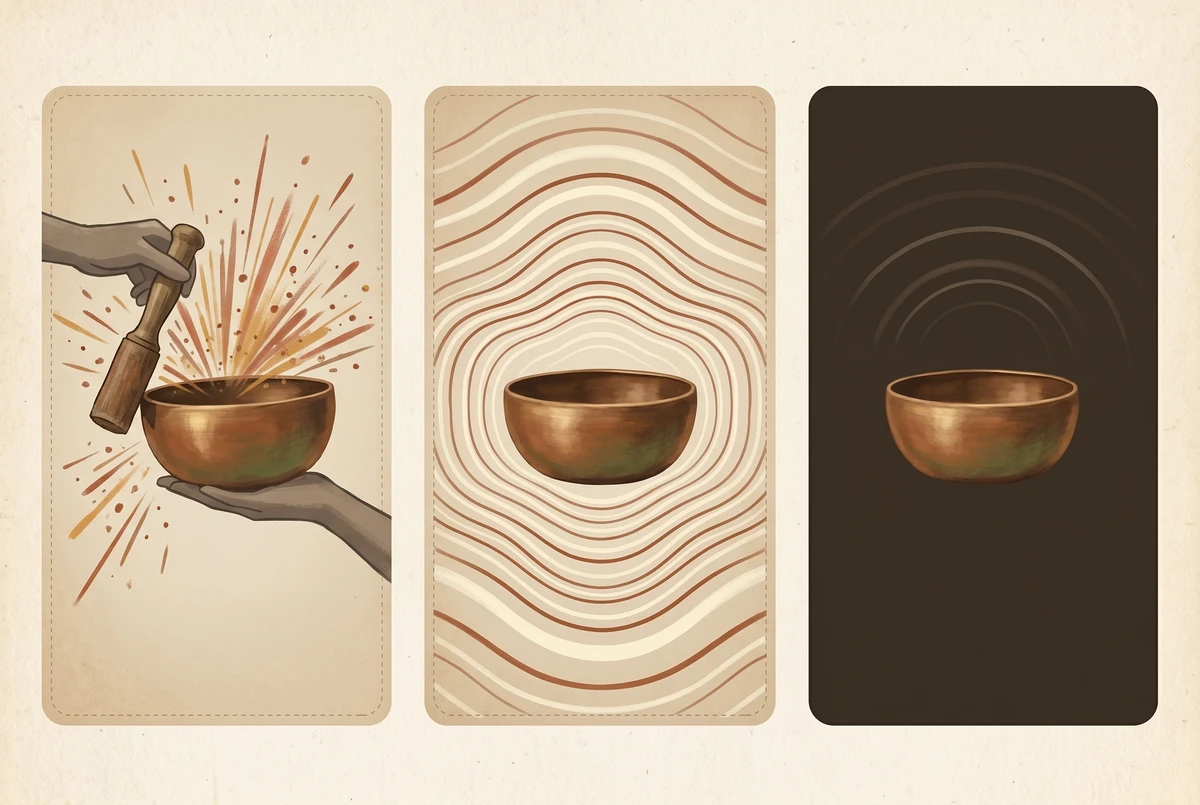
Playing a bowl vs. attending a sound bath
These are two structurally different practices, and few popular articles on singing bowls distinguish between them. That confusion matters, because the most-cited clinical study tested one model while the how-to sections describe the other.
Playing your own bowl is active concentration work. You hold the bowl in one hand, strike it with the other, and manage the entire cycle: when to strike, how hard, when to restrike. You feel the vibration in your palm. You control the pace. You are both the instrument player and the meditator, and the physical engagement anchors your attention in your body.
Attending a sound bath is passive reception. You lie on a mat while a practitioner plays dozens of bowls, gongs, and bells around you. The sound washes over you. This is closer to guided relaxation or yoga nidra than concentration training. The Goldsby et al. (2016) study, which nearly every singing bowl article cites as evidence of health benefits, tested exactly this passive model. Participants lay down for 60 minutes while a musician played 30 to 80 instruments. They were explicitly told they could fall asleep. 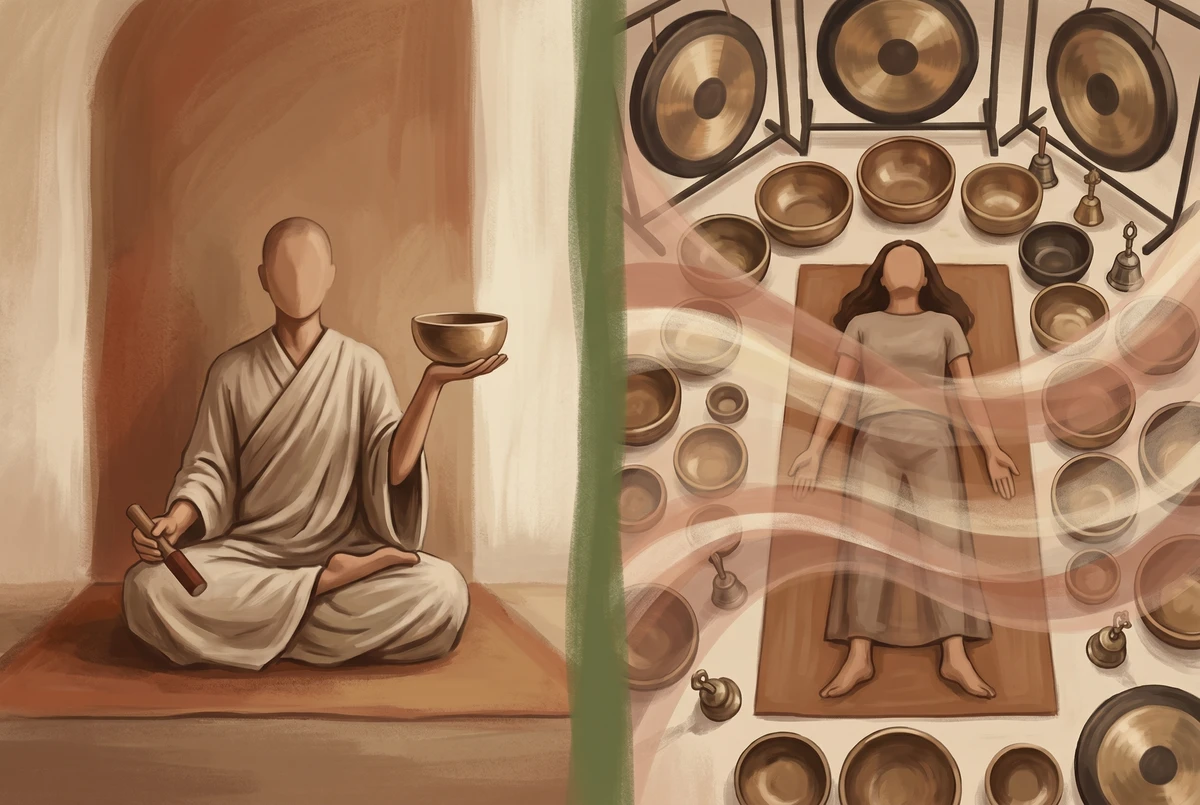
The distinction has practical consequences. If you want to reduce tension and improve mood after a hard week, a sound bath can do that (the Goldsby study showed significant reductions in tension, anger, and fatigue across all participants). If you want to build the capacity to sustain attention, play your own bowl.
And what about listening to a singing bowl recording on headphones? That’s the passive model with the physical vibration removed. It may help you relax. It is not singing bowl meditation.
How to meditate with a singing bowl
This is a guide for solo practice with a single bowl.
Setup. Sit upright on the floor or in a chair. Place the bowl on a small cushion in front of you, or rest it on your non-dominant palm (fingers spread, not gripping, so the bowl can vibrate freely). Hold the mallet in your dominant hand. Don’t lie down. This is concentration practice, and a reclined position invites drowsiness rather than focus. 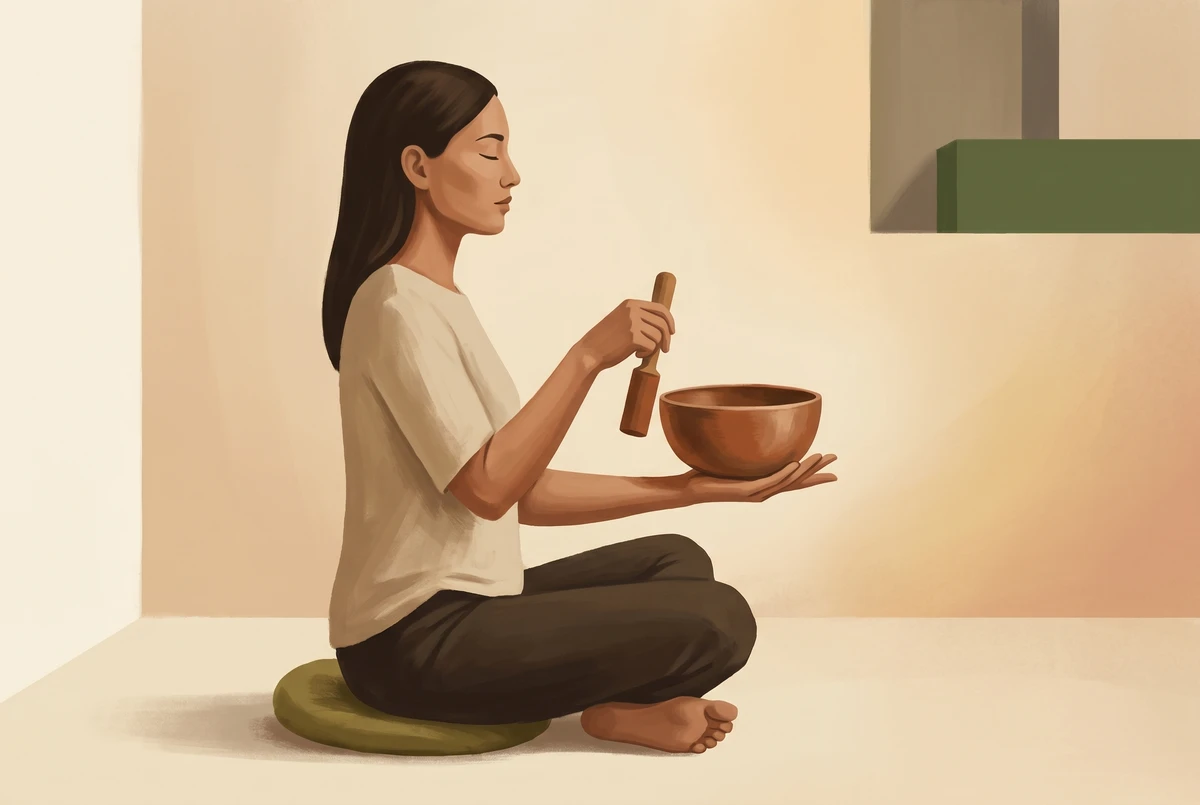
Strike. Tap the outer rim once with the padded end of the mallet. Firmly, not forcefully. A too-hard strike produces a startling volume that disrupts focus rather than directing it. You want a clear, ringing tone, not a crash.
Listen. Close your eyes. Follow the sound with your full attention. Don’t analyze the overtones or try to name the note. Stay with the sound as it evolves and decays. Notice how it changes, thins, recedes.
The silence. When the tone fades completely, stay still. This is the feedback moment. Notice what your mind is doing. If you’re still resting in the quiet space the sound left behind, your concentration held through the cycle. If you’re already composing an email, you now know exactly when your focus broke. Either way, you’ve learned something.
Restrike. After a few seconds of silence, strike again. Each cycle (strike, listen, silence, restrike) is one rep.
Session length. Start with 10 to 15 minutes, roughly 8 to 12 strike cycles depending on how long your bowl’s tone sustains. The practice deepens not by making sessions longer, but by making each cycle’s attention more sustained and the silence more stable.
The rim technique. Running the mallet around the outer rim produces a continuous, sustained tone. This removes the built-in attention check of the decay, replacing it with a steady focal point. Use this once the strike-decay cycle feels easy and you want to practice holding focus over longer unbroken stretches.
Common mistakes. Striking too hard (volume overwhelms rather than focuses). Restriking too quickly (you skip the silence, which is where the real feedback happens). Lying down (you’ll likely drift toward sleep, and EEG data suggests this is what passive singing bowl listening promotes).
What the research actually shows
The clinical evidence on singing bowls is thinner than most articles admit.
The study everyone cites. Goldsby et al. (2016) measured mood and tension in 62 participants before and after a 60-minute sound bath. They found significant reductions in tension (effect size η = .51), anger, fatigue, anxiety, and depressed mood. These are real findings. But the study had no control group, so we don’t know whether lying quietly in a dim room for an hour without any bowls would produce similar results. The sample was 85% female, 87% already had meditation experience, and all participants self-selected because they were interested in singing bowls.
The study’s most overlooked finding: participants who had never experienced singing bowls before showed greater tension reduction than experienced participants. The newcomers started with higher tension (1.61 vs. 1.01 on the scale) and dropped further (to 0.32 vs. 0.15). One interpretation: the novelty of an unfamiliar sound holds attention in a way that a familiar one doesn’t. Another, more mundane explanation: people who start more tense have more room to fall. The study can’t distinguish between these.
The one randomized trial. Landry (2014) ran a randomized crossover study with 51 participants, comparing 12 minutes of singing bowl listening against 12 minutes of silence. The bowl group showed greater reductions in systolic blood pressure (p = .044) and heart rate (p = .003) than the silence group. But mood scores (measured by the PANAS) fell equally in both conditions. The bowl had a measurable physiological effect, but it didn’t improve mood more than sitting quietly.
The brainwave study. Kim and Choi (2023) measured EEG activity in 17 people listening to a singing bowl. They found that theta waves (associated with relaxed, drowsy states) increased to 117% of baseline, and delta waves (associated with sleep) increased to 135%. Meanwhile, alpha waves decreased to 85% of baseline. Many articles claim singing bowls shift your brain into alpha. This small study found the opposite: alpha went down while the sleep-associated frequencies went up. The bowl produced acoustic beats at 6.68 Hz, falling squarely in the theta range, which likely explains the theta entrainment. The bowl’s tone decayed over approximately 50 seconds. But the overall EEG pattern looks more like drowsiness than focused meditation, which makes sense, since the participants were passively listening.
The systematic review. Stanhope and Weinstein (2020) at the University of Adelaide reviewed all peer-reviewed studies on singing bowl health effects. They found exactly four that met inclusion criteria. Their conclusion: “We cannot recommend singing bowl therapies at this stage.” Not because singing bowls don’t do anything, but because the existing evidence is too methodologically limited to draw firm conclusions.
The honest summary. Singing bowls produce measurable physiological effects: in the one controlled study, blood pressure and heart rate dropped more with a bowl than with silence alone. Participants across all studies consistently report feeling calmer and less tense after sessions. But mood improvement appeared equally in bowl and silence conditions, raising the possibility that any quiet, focused pause does similar work. Claims about cellular healing, immune function, or chakra alignment have no supporting evidence.
And here’s the critical caveat for this article: every clinical study tested the passive model (lying down, listening). No study has tested the active concentration practice described in the previous section. The case for singing bowl meditation as attention training rests on the mechanics of concentration practice (dharana) and on common sense, not on clinical trials.
Choosing a bowl for meditation practice
If you’re buying a singing bowl for concentration practice, most of the marketing you’ll encounter is irrelevant or actively misleading. Here’s what matters.
Size. A medium bowl (5 to 7 inches) works best for solo practice. It’s small enough to hold in one hand, large enough to produce a tone with sufficient sustain for the strike-listen-silence cycle. Larger bowls (9 to 12 inches) are designed for sound baths and group sessions.
Material. Hand-hammered bronze (copper-tin alloy) produces a warm, complex sound with layered overtones, giving your ear more to follow during concentration practice. Crystal quartz bowls produce a purer, more sustained tone with fewer harmonics. For the kind of attentional tracking this practice requires, the bronze bowl’s complexity is an advantage. 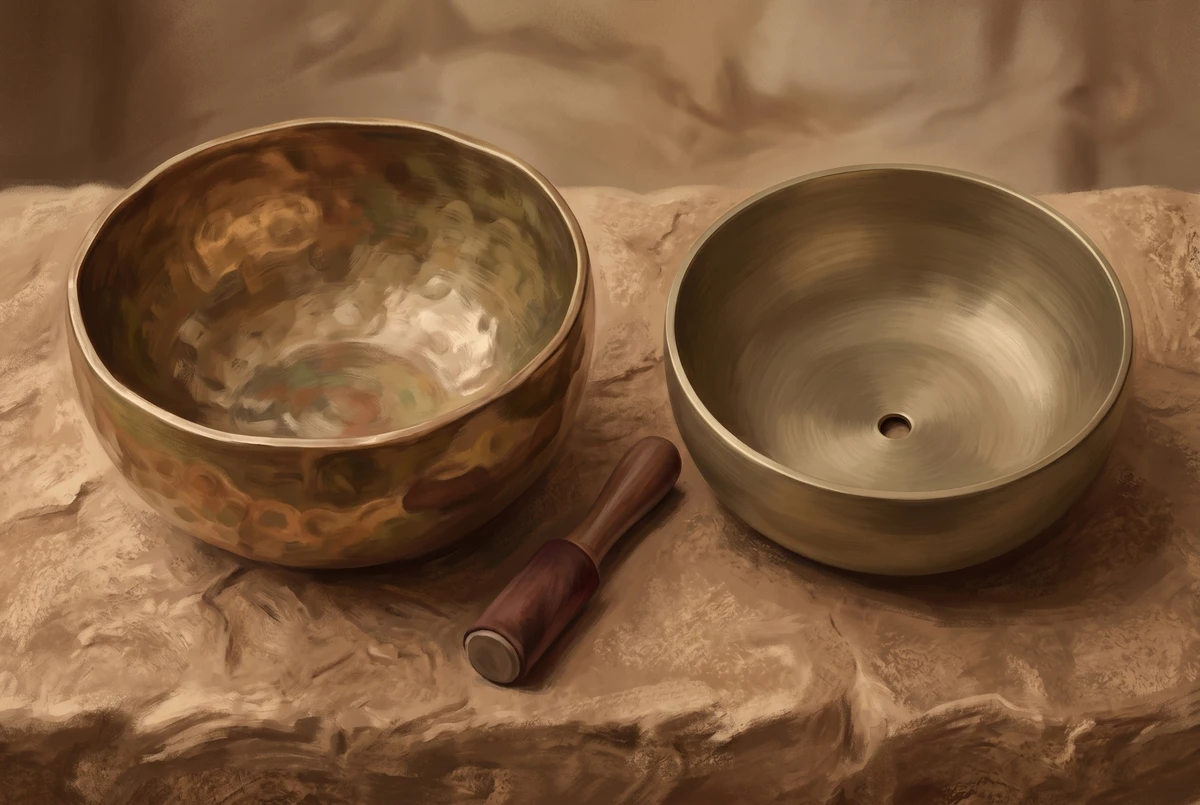
Most inexpensive “Tibetan singing bowls” sold online are machine-made brass (copper-zinc), not hand-hammered bronze. Brass produces shorter sustain and less complex overtones. A $30 machine-made brass bowl and a hand-hammered bronze bowl are acoustically different instruments. You can identify machine-finished bowls by their uniform appearance and a small hole in the center from the lathe.
Ignore the “seven sacred metals” pitch. Bowls marketed as containing gold, silver, and mercury command premium prices for a composition that metallurgical testing doesn’t support. Bells of Bliss tested hundreds of antique singing bowls: all were bell metal bronze (77 to 80% copper, 20 to 23% tin) with trace impurities. No gold, silver, mercury, or lead. As they note, “a more varied mix of metals will not result in a deeper or richer sound. Contrary to popular belief, more metals will produce a duller and less vibrant tone.”
Ignore the chakra-note charts. The system assigning specific Western musical notes (C, D, E, F, G, A, B) to the seven chakras has no basis in any traditional text. Guy Beider of Bells of Bliss interviewed elder healers in Nepal and a Bon Po shaman, and none were familiar with the concept of mapping Western musical notes to chakras. The seven-chakra system comes from Indian Hindu tradition; the note system comes from Western music theory. They were never historically connected. A singing bowl’s overtones produce multiple simultaneous frequencies, each of which maps to a different supposed “chakra note,” making the concept of a “root chakra bowl tuned to C” physically incoherent.
New vs. antique. Antique bowls can sound extraordinary, but fakes are widespread and quality is unverifiable without metallurgical analysis. A well-made new bowl from a reputable Nepali workshop is more reliable and costs far less.
The only test that matters. Strike the bowl (or listen to a recording of that specific bowl) and notice whether the tone holds your attention as it decays. If you find yourself listening with genuine interest, it’s the right bowl. If your mind wanders immediately, try another. Your ear is a better guide than any frequency chart.
What else you need. A small cushion or ring pad to stabilize the bowl and let it resonate freely, plus the mallet that comes with it. That’s everything.
Using singing bowls with trataka: auditory and visual concentration
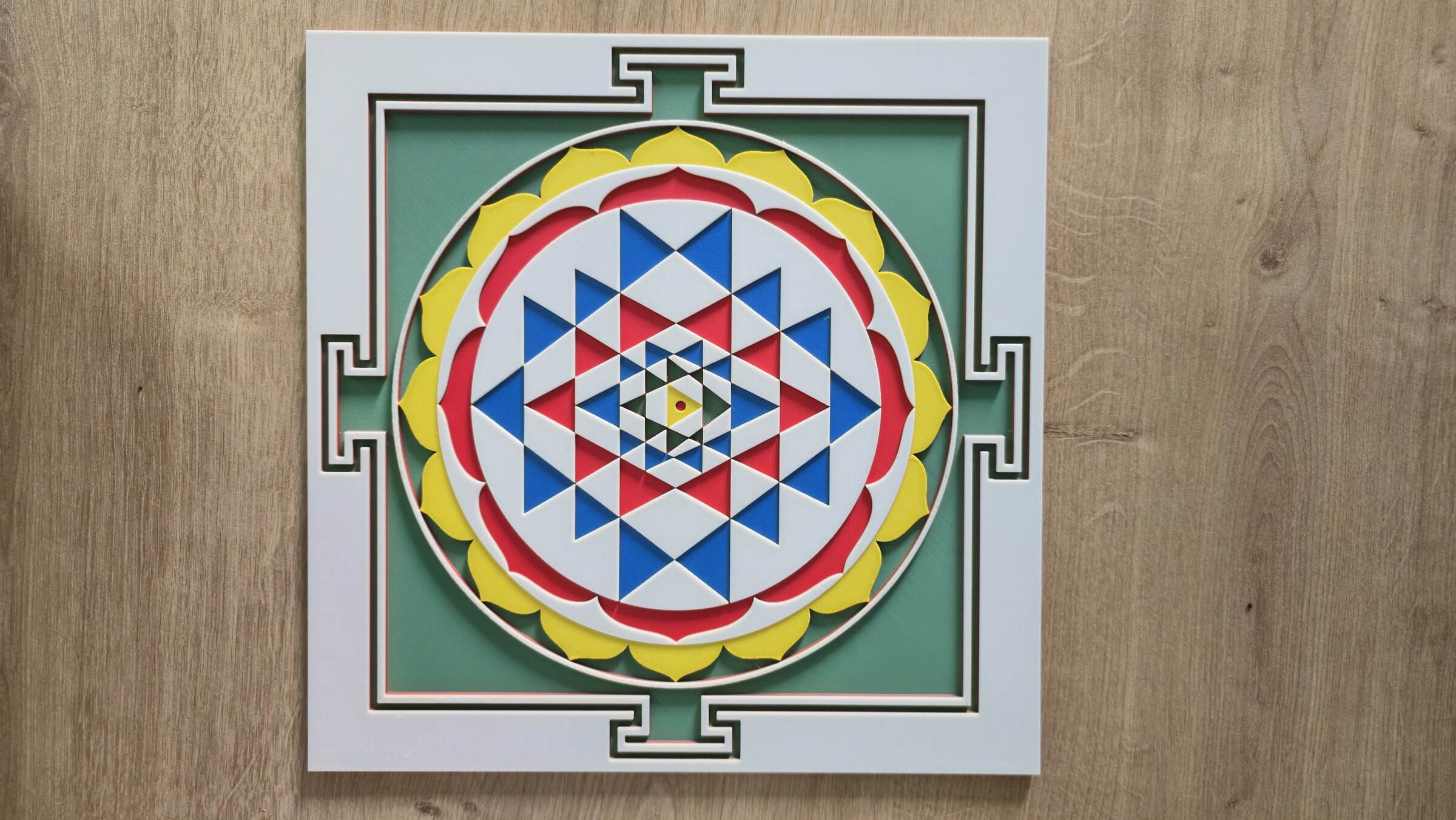
Trataka (fixed-gaze meditation) and singing bowl meditation are the same practice applied to different senses. In trataka, you gaze at a fixed point (a candle flame, a Sri Yantra, a dot on the wall) and notice when your gaze drifts or your eyes lose focus. In singing bowl meditation, you listen to a fixed tone and notice when your attention drifts or the sound fades below your awareness. Both are dharana. Both use an external focal object. Both have a built-in feedback signal: blurred vision in one case, decayed sound in the other. 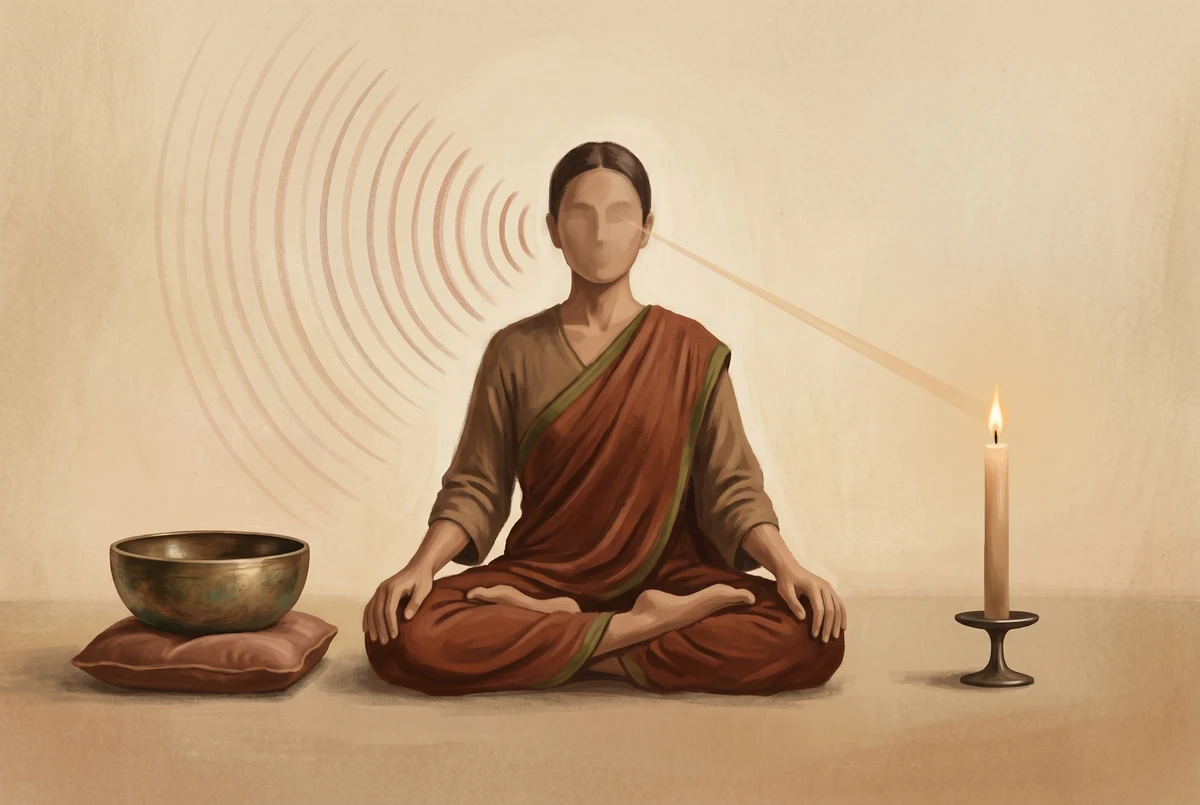
This makes them natural complements. A practical way to combine them: begin a session with 5 to 10 minutes of singing bowl strikes to settle the mind through auditory concentration, then transition to trataka on a candle flame or yantra for visual concentration. The bowl narrows attention from the wide field of scattered thoughts down to a single sensory channel. The gaze practice deepens that concentrated state.
For beginners, the singing bowl may be the easier starting point. Auditory attention is less effortful than holding a fixed gaze, and the bowl’s rich sound provides a more engaging anchor than a static visual point. As concentration strengthens, trataka becomes more accessible. In the classical yoga framework, dharana trains a general capacity for sustained attention, not tied to any single sense, which is why practitioners have long combined auditory and visual focal objects.
The history of ‘Tibetan’ singing bowls
The phrase “Tibetan singing bowl” implies an ancient monastic meditation tradition. The actual history is less romantic but more interesting.
According to reporting by the Kathmandu Post (2019), the term “singing bowl” was coined by Jit Bahadur Shahi, a Nepali handicraft trader. The bowls themselves are Nepali in origin, historically used as ritual rice bowls. They became “Tibetan” because Tibetan refugees sold them to Western buyers, and dealers found the label increased their perceived value. Tibetan monk Funchhok Dorje of Boudha told the Post directly: “They are called Tibetan singing bowls, but we don’t use them in our monastery for meditation.”
The use of these bowls as meditation tools appears to be largely a Western innovation from the latter half of the 20th century. Peter Effenberger, a German sound healer who has worked in Nepal for over two decades, told the Post he learned singing bowl techniques from fellow Germans and Australians, not from Tibetan or Nepali traditions.
None of this diminishes the practice. A bronze bowl that produces a 50-second decay with complex overtones is an effective concentration tool regardless of its origin story. But buying a bowl because you believe it connects you to an ancient Tibetan monastic tradition means paying for a narrative that the available evidence doesn’t support.
Sources
- Goldsby TL, Goldsby ME, McWalters M, Mills PJ. (2016). “Effects of Singing Bowl Sound Meditation on Mood, Tension, and Well-being: An Observational Study.” Journal of Evidence-Based Complementary & Alternative Medicine, 22(3):401–406. DOI: 10.1177/2156587216668109. PMID: 27694559.
- Stanhope J, Weinstein P. (2020). “The human health effects of singing bowls: A systematic review.” Complementary Therapies in Medicine, 51:102412. DOI: 10.1016/j.ctim.2020.102412. PMID: 32507429.
- Landry JM. (2014). “Physiological and psychological effects of a Himalayan singing bowl in meditation practice: a quantitative analysis.” American Journal of Health Promotion, 28(5):306–309. DOI: 10.4278/ajhp.121031-ARB-528. PMID: 23941101.
- Kim SC, Choi MJ. (2023). “Does the Sound of a Singing Bowl Synchronize Meditational Brainwaves in the Listeners?” International Journal of Environmental Research and Public Health, 20(12):6180. DOI: 10.3390/ijerph20126180. PMID: 37372766.
- Bajracharya S. (2019). “The tale of the singing bowl.” Kathmandu Post, August 14, 2019.
- Beider G. (2025). “The Seven Metal Singing Bowls Myth.” Bells of Bliss.
- Beider G. (2025). “Notes and Chakras: Spiritual Fraud with the Best Intentions.” Bells of Bliss.
- Beider G. (2024). “Sound Bowl Meditation: Exercise Listening to Separated Tones.” Bells of Bliss.