Trataka in the Yoga Tradition: Origins and Classification
Miha Cacic · April 11, 2026 · 5 min read

Trataka is classified as a shatkarma, a bodily purification technique, placed alongside nasal irrigation and stomach cleansing. Yet it’s the only practice in that list that works through attention rather than physical manipulation: sustained, unblinking concentration on a single point. This dual identity (physical purification and concentration technique) is what makes trataka’s place in the yoga tradition interesting and widely misunderstood.
Where trataka appears in the classical texts
The earliest written reference to trataka by name appears in the Hatha Yoga Pradipika, composed by Svātmārāma in the 15th century CE. Verses 2.31-32 give the full description:
“Being calm, one should gaze steadily at a small mark, till eyes are filled with tears. This is called Trataka by the Acharyas.”
“Trataka destroys the eye diseases and removes slothfulness, etc. It should be kept secret very carefully, like a box of jewels.”
That’s the entire treatment. Two verses. The instructions are minimal: fix your gaze, don’t blink, wait until tears come. The fact that Svātmārāma adds “keep it secret like a box of jewels” suggests the practice was considered advanced or specialized, not a casual exercise.
The second major source is the Gheranda Samhita, composed roughly two centuries later in the late 17th century. The GS lists trataka among the same six shatkarmas but frames it differently. Where the HYP treats trataka purely as a physical cleansing, the GS explicitly positions it as preparation for dharana (concentration), linking trataka to shambhavi mudra, the spontaneous inward gaze that arises when the practice deepens. This is a meaningful structural shift: the GS authors recognized that trataka’s real mechanism isn’t about cleaning your eyes. It’s about training your attention.
These are the only two classical texts that name trataka explicitly. It does not appear in the Yoga Sutras of Patanjali, the Upanishads, or any pre-medieval text. Multiple popular articles wrongly imply Patanjali described or endorsed gaze concentration. He didn’t. Patanjali defines dharana as “binding the mind to a place” (Yoga Sutras III.1) but prescribes no specific technique for achieving it. His system defines states, not methods. Trataka belongs to the later hatha yoga tradition, which developed practical techniques for the concentrated states Patanjali described but never prescribed methods to reach.
What about the common claim that trataka is “5,000 years old”? The name and formal technique are roughly 500-600 years old in writing. Gazing practices as a general category are likely older (the 7th-8th century Vijnana Bhairava Tantra contains several gaze-based concentration techniques), but we cannot date them with precision. There is no written evidence of a practice called “trataka” before the 15th century.
Why trataka is classified as a shatkarma (and what that means)
The six shatkarmas in the Hatha Yoga Pradipika are purification practices for the body:
- Neti: nasal irrigation (water or thread through the sinuses)
- Dhauti: digestive tract cleansing
- Nauli: abdominal churning
- Basti: yogic enema
- Kapalabhati: forced exhalation (“skull-brightening” breath)
- Trataka: steady gazing

Five of these are unmistakably physical. You’re flushing sinuses, cleaning the stomach lining, manipulating organs, irrigating the colon, pumping air. Then there’s trataka: you stare at something.
The traditional justification for including it is physiological: sustained non-blinking produces tears, which physically cleanse the eyes and nasolacrimal ducts. That’s a real effect. But the texts themselves go further. The HYP says trataka “removes slothfulness,” which is a mental claim, not an optometric one. The GS positions it as preparation for concentrated meditation. No other shatkarma doubles as a concentration technique.
This isn’t a classification error. The physical component (tear production through sustained non-blinking) provides the shatkarma justification. The mental component (fixed-point concentration) is the central experience. Both occur simultaneously, which is exactly why trataka sits in both categories.
How trataka bridges hatha yoga and raja yoga
The classical yoga progression moves through stages: shatkarmas purify the body, asana stabilizes it, pranayama regulates energy, pratyahara withdraws the senses. Only then does the practitioner move into dharana (concentration), dhyana (meditation), and samadhi (absorption).
Trataka is listed in stage one (shatkarmas). But its mechanism enacts stages four and five simultaneously.
In bahiranga (external) trataka, you fix your gaze on a physical object, typically a candle flame. The visual system locks onto that single point. Other sensory input falls away, not because you’ve deliberately shut it out, but because sustained single-pointed focus naturally narrows the field. This is pratyahara (sense withdrawal) arising through concentration itself. And the sustained focus IS dharana.
In antaranga (internal) trataka, you close your eyes and hold the afterimage. Now you’re concentrating on an internal object with no external anchor. This approaches dhyana: sustained awareness of something that exists only in the mind.
The Bihar School of Yoga commentary (Swami Muktibodhananda, 2000) traces an explicit progression: external object, retinal afterimage, void, spontaneous inward gaze. That final stage is shambhavi mudra, where the eyes naturally turn inward without effort. This isn’t a modern interpretation. The Gheranda Samhita already hints at this progression by placing trataka directly before its dharana chapter. 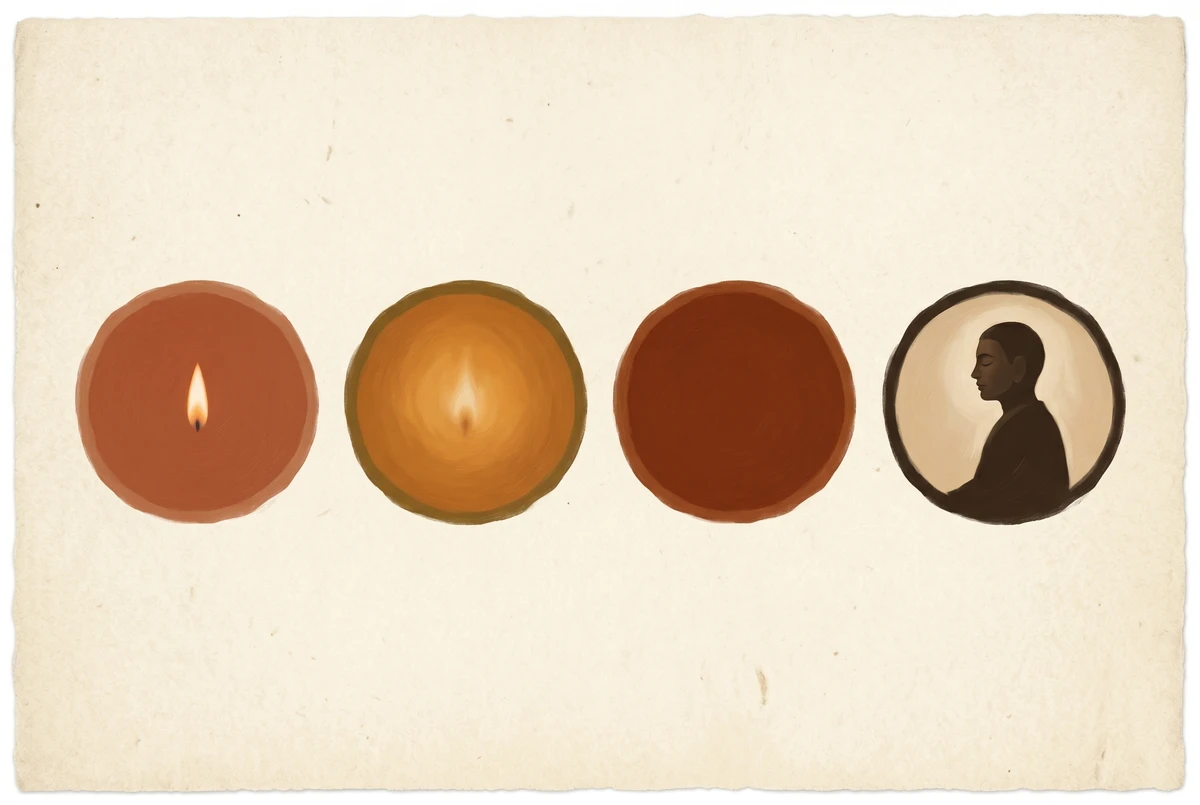
The traditional yogic concept of ekagrata (one-pointedness of mind) is the explicit goal. Trataka achieves it more directly than most practices because the object of concentration is externally fixed, visible, and unambiguous. Unlike breath-based concentration, where the object is subtle and can drift, a candle flame either has your attention or it doesn’t. You know immediately when you’ve lost focus. This makes trataka both an effective concentration technique and a diagnostic one: it shows you exactly how unstable your attention is.
Trataka beyond hatha yoga: the tantric and Buddhist connections
The hatha yoga framing of trataka as a shatkarma is one classification of a much broader category of practice: gaze-based concentration.
The Vijnana Bhairava Tantra (7th-8th century CE), a foundational text of Kashmir Shaivism, contains 112 dharanas (centering techniques). Several involve visual concentration: fixing awareness on flame, light, darkness, or the visual field without wavering. These are functionally analogous to trataka, though the VBT never uses that term. This matters historically: the VBT predates the Hatha Yoga Pradipika by 700-800 years. Gaze-based concentration was part of the tantric tradition long before hatha yoga codified it as a named purification practice.
The framing difference is significant. In Kashmir Shaivism’s non-dual philosophy, gazing practices serve as direct means of recognizing consciousness itself. The hatha yoga tradition took similar technical elements and reclassified them as physical purifications. Same mechanism, different metaphysical purpose.
Yantra meditation (sustained gazing at geometric diagrams like the Sri Yantra) follows the same pattern, appearing across Hindu tantric traditions as a form of bahiranga trataka with a more complex visual object. Tibetan Buddhism contains structural analogues too: sky-gazing as preparation for tögal in Dzogchen, and shamatha practices involving visual fixation on bindus (points of light) in the Bön and Nyingma traditions.
In Theravada Buddhism, kasina meditation involves sustained gazing at a colored disc, flame, earth, water, or sky until a stable mental image (called a nimitta) arises. The practitioner then works with the mental image rather than the physical object. This is structurally identical to the bahiranga-to-antaranga trataka progression. The fire kasina (gazing at a flame until the afterimage stabilizes internally) is functionally the same technique under a different name. Buddhaghosa’s Visuddhimagga (5th century CE) describes ten kasina objects and the stages of working with them.
Practitioners notice the overlap. On the Dharma Wheel forum, a meditator asked: “Why bring the blinking reflex under your control? Why not just focus on an image like kasina meditation?”
Zen’s approach provides an instructive contrast. The half-open downward gaze in zazen is explicitly not concentration on a point. It’s a diffuse, non-grasping visual field. Both trataka and zazen use the visual system to regulate mental states, but through opposite strategies: trataka narrows focus to a single point, zazen widens it to the whole field. 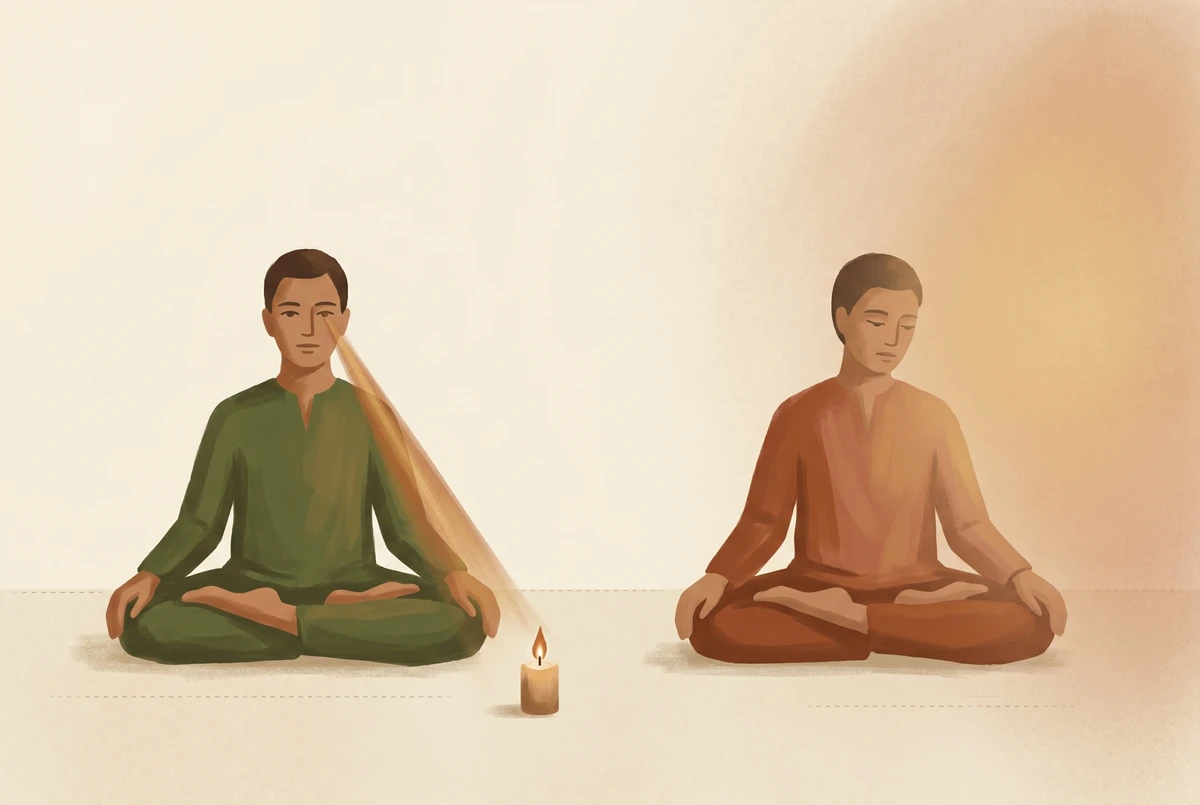
The pattern across these traditions: fixed-gaze concentration is not an isolated Hindu technique. It’s a cross-traditional practice that different contemplative systems arrived at and framed according to their own metaphysics. The hatha yoga classification as a shatkarma is one framing, and a relatively late one.
What the texts actually claim trataka does
The traditional claims are specific, and they differ substantially from how trataka is presented today.
The Hatha Yoga Pradipika claims trataka cures eye diseases and eliminates fatigue and sloth. The Gheranda Samhita and Bihar School commentaries add: development of subtle vision (divya drishti), awakening of ajna chakra, and attainment of shambhavi mudra. The explicit goal across all classical sources is ekagrata (one-pointedness), understood as a stage on the path toward samadhi.
The classical texts make no claim about relaxation, stress relief, nervous system calming, or “mindfulness.” Those are modern framings. The traditional purpose was concentration power and subtle perception, not wellness outcomes.
Modern research has found wellness-adjacent effects, but these are discoveries, not retrievals of traditional claims. Talwadkar, Jagannathan, and Raghuram (2014) conducted a randomized controlled trial with 60 elderly subjects over 26 days. The trataka group showed significant improvements in working memory, sustained attention, and cognitive flexibility (all P<0.01) compared to a wait-list control.
Swathi, Bhat, and Saoji (2021) ran a more rigorous study with 41 young adults, using an active control condition (eye exercises without candle-gazing). Trataka significantly improved both forward and backward visuospatial working memory. The critical finding: eye exercises alone produced no significant changes. The cognitive effect was specific to the candle-gazing and afterimage phases, not to the preparatory exercises.
A 2025 systematic review in the Journal of Neurosciences in Rural Practice proposed a neurophysiological model for how this might work. The hypothesis centers on saccade suppression: when you voluntarily hold your gaze still, you engage the Frontal Eye Field and Superior Colliculus (brain regions involved in attentional control), filter sensory noise through the thalamus, and downregulate the default mode network (associated with mind-wandering). This model is consistent with general neuroscience, but it hasn’t been directly tested with neuroimaging during trataka. No fMRI or EEG studies of trataka exist in the published literature yet. 
The available studies show trataka improves attention and working memory, though sample sizes remain small and the total number of controlled trials is in single digits. The proposed brain mechanism is plausible but hypothetical. And the traditional texts were aiming at something different altogether: not cognitive performance, but the capacity for sustained inner absorption that the yoga tradition considers the prerequisite for its deepest states.
Sources
- Svātmārāma. (15th century CE). Hatha Yoga Pradipika, Chapter 2, verses 31-32. Pancham Sinh translation.
- Gheranda. (late 17th century CE). Gheranda Samhita, Chapter 1.
- Muktibodhananda, Swami. (2000). Hatha Yoga Pradipika: Light on Hatha Yoga. Yoga Publications Trust, Munger.
- Talwadkar S, Jagannathan A, Raghuram N. (2014). “Effect of trataka on cognitive functions in the elderly.” International Journal of Yoga, 7(2):96-103. PMID: 25035618.
- Swathi PS, Bhat R, Saoji AA. (2021). “Effect of Trataka (Yogic Visual Concentration) on the Performance in the Corsi-Block Tapping Task: A Repeated Measures Study.” Frontiers in Psychology, 12:773049. PMID: 34975664.
- Pandya S. (2024). “Trataka: A promising intervention to reduce anxiety in children?” International Journal of Yoga, 17:217-21. PMID: 39959511.
- Kusuma SM, et al. (2021). “Immediate effect of trataka on blood pressure indices in individuals with primary hypertension.” Arterial Hypertension, 25:82-7.
- “Trataka and cognition: A systematic review with a proposed neurophysiological mechanism.” (2025). Journal of Neurosciences in Rural Practice, 16(4):493+.
- Raghavendra BR, Ramamurthy V. (2014). “Changes in heart rate variability following yogic visual concentration (Trataka).” Heart India, 2(15).
- Vijnana Bhairava Tantra. (7th-8th century CE).
- Buddhaghosa. (5th century CE). Visuddhimagga (Path of Purification).