How to Use a Mandala for Meditation
Miha Cacic · April 11, 2026 · 5 min read
You use a mandala for meditation by fixing your gaze on its center point with steady, relaxed focus. Hold your eyes still, breathe naturally, and return your attention each time it wanders. This practice has a name in yoga (trataka), a clear mechanism, and a defined progression that most online guides never get to.
The trouble is that “mandala meditation” now refers to at least three different activities, and only one of them is meditation in the traditional sense.
What mandala meditation actually is (and what it isn’t)
Three things get called “mandala meditation.” They work differently. 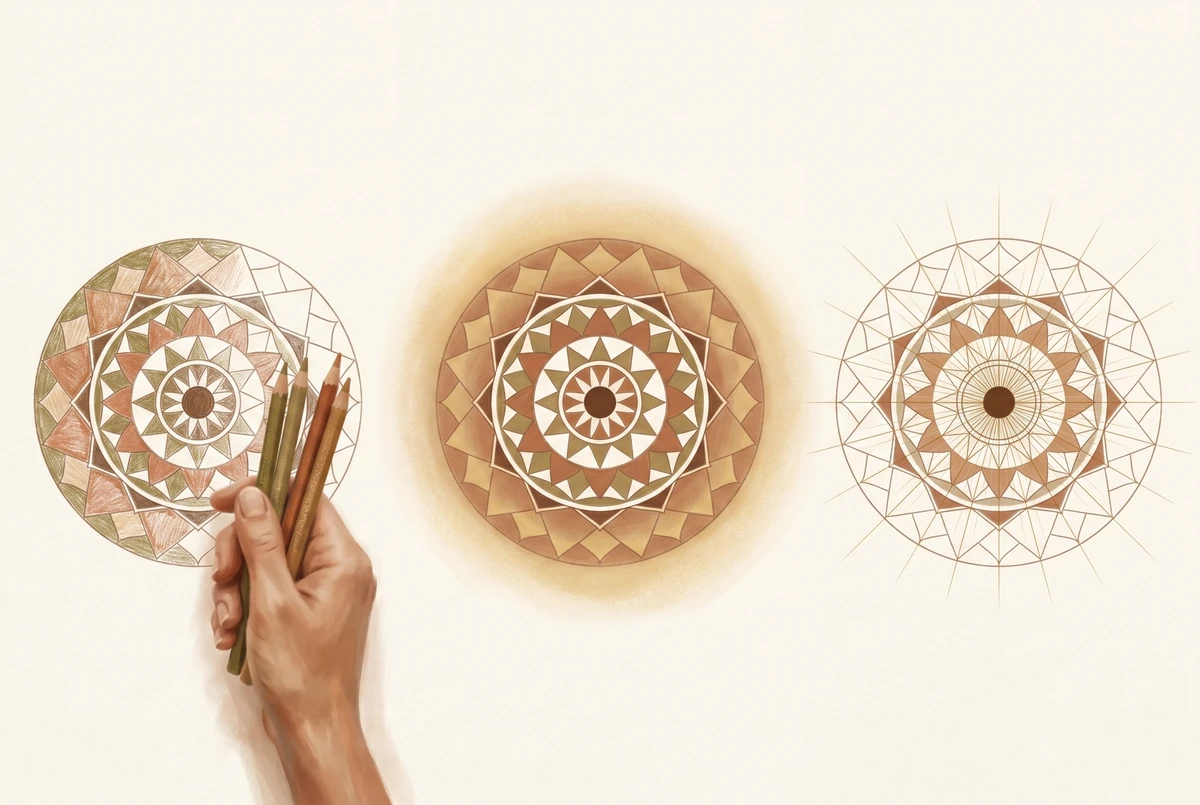
Coloring a mandala is a therapeutic activity. Filling in patterns with colored pencils promotes relaxation and present-moment focus. Curry and Kasser (2005) found that coloring mandalas reduced self-reported anxiety more than free-form coloring or coloring a plaid pattern. It’s genuinely calming. But there’s no sustained gaze, no internal visualization, no concentration training. It’s closer to a craft hobby than a meditation practice.
Looking at a mandala to relax is what most online guides describe: “gaze at the center and breathe.” This is a reasonable starting point, but the instructions always stop before the practice begins in earnest. You get the appetizer and never see the menu.
Gazing meditation using a mandala is the actual practice. You fix your eyes on the mandala’s center point, hold them still, and sustain that focus for minutes at a time. When you close your eyes afterward, you work with the afterimage that forms. This is a structured concentration exercise with specific stages, and it has been practiced in yoga for centuries under the name trataka.
All three are fine things to do. But if you came here looking for meditation, the third one is what the rest of this article covers.
Why staring at a pattern calms your mind
Your eye movements mirror your mental state. When your mind races, your eyes dart. When you concentrate deeply, they hold still. This relationship runs in both directions: controlling your eyes can influence your mental state.
Here’s what we know about the mechanism. Your eyes make constant tiny involuntary movements called microsaccades, which prevent the visual field from fading out. When you fix your gaze on a single point, these movements diminish and your visual system shifts from its default scanning pattern to sustained focus. Clinical research supports the link: altered saccadic patterns correlate with attention disorders like ADHD, confirming that eye movement and attentional state are tightly connected.
This is where the mandala’s geometry earns its place. A well-designed mandala has concentric rings and converging lines that naturally draw the eye toward a center point. As you hold your gaze there, a phenomenon called Troxler fading takes effect: the peripheral patterns begin to dissolve from awareness, sharpening your focus on the center even further. The geometry isn’t decoration. It’s doing work. 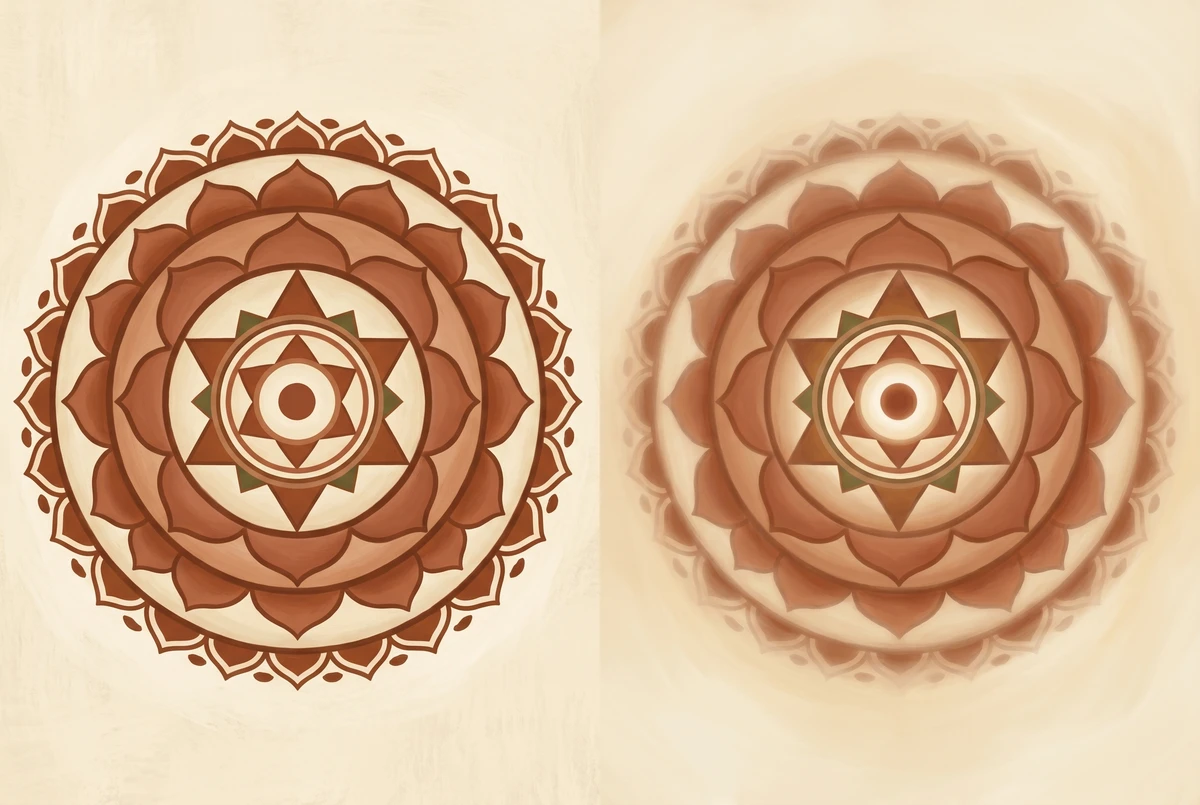
That’s why gazing at a mandala produces different results than staring at a blank wall. The wall gives your eyes nothing to anchor on. The mandala gives them a structured target that actively assists concentration, while its periphery fades, leaving you with a single bright point of focus.
How to meditate with a mandala (step by step)
Setup
Choose a mandala with a clear center point (called a bindu). Print it on paper or display it on a stand. Avoid screens if possible: a printed or physical image provides a more stable visual target than a backlit display.
Place the mandala at eye level, roughly arm’s length away. Sit comfortably with your spine straight. Dim lighting is fine; total darkness isn’t necessary. Minimize visual distractions in your field of view.
External gazing
Close your eyes and take three to five slow breaths to settle.
Open your eyes and rest your gaze softly on the center of the mandala. Don’t stare aggressively or strain to keep your eyes wide open. Blink naturally when you need to.
Keep your eyes as still as you can. Don’t trace the patterns. The geometry will enter your peripheral vision on its own.
When your attention drifts (and it will), notice the drift and bring your gaze back to center. This returning is the practice, not the never-drifting. Start with five to ten minutes and extend as your comfort allows.
Internal gazing
After your gazing period, close your eyes. You may see a faint afterimage of the mandala’s pattern, a retained visual impression from the sustained exposure. Hold your attention on this image for as long as it lasts. 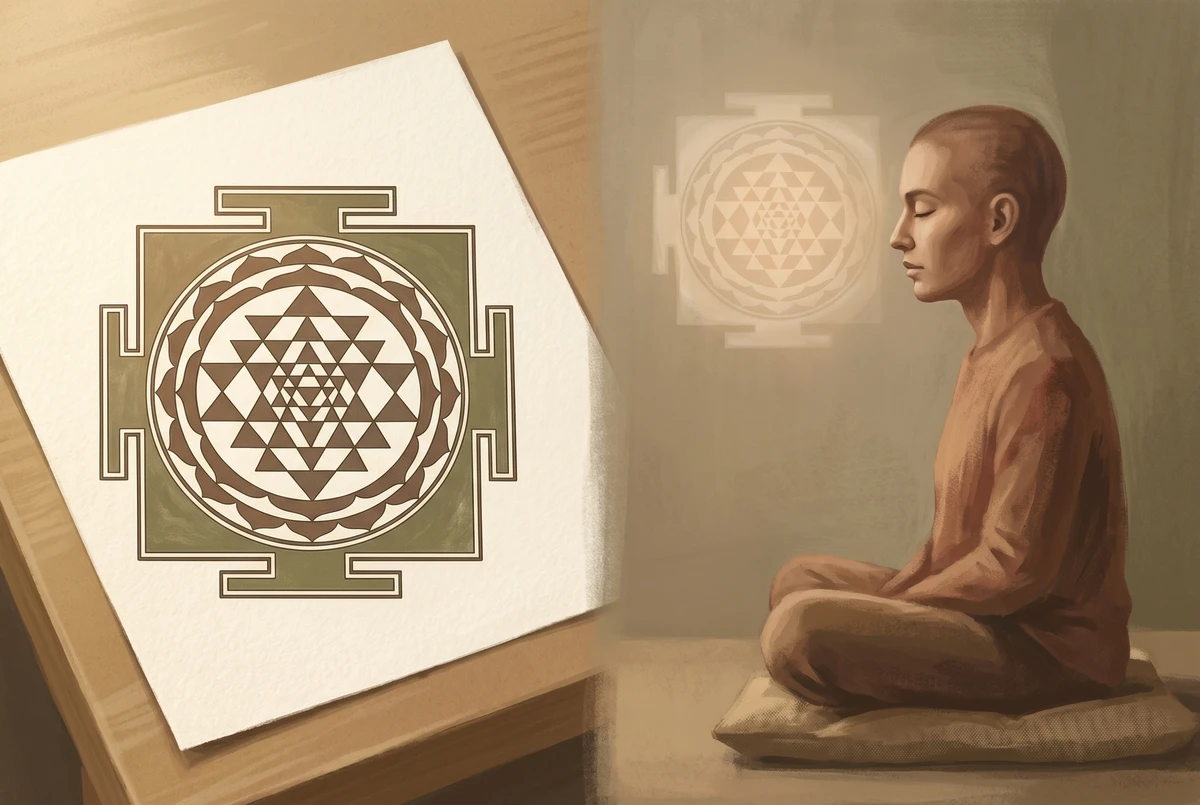
If no afterimage appears, that’s normal. It develops with consistent practice over weeks. For now, simply visualize the mandala’s center point with your eyes closed.
What starts as a passive visual afterimage becomes, with practice, a stable internal image you can summon at will. This internal phase is where gazing becomes meditation. The mandala moves from your wall to your mind.
Closing
Let the image dissolve naturally. Sit quietly for a minute. Open your eyes slowly.
If your eyes feel tired, splash them with cool water. This is a traditional recommendation for all gazing practices, and it helps.
What kind of mandala works best for meditation
Geometric precision matters more than beauty. A mandala with mathematically precise symmetry, concentric layers, and a clear center point gives your visual system a stable anchor. An irregular or overly busy design scatters attention rather than focusing it.
Simpler is better for beginners. A mandala with too many colors, details, or figurative elements overwhelms the gaze. Start with a design that has a clear center and two or three concentric layers.
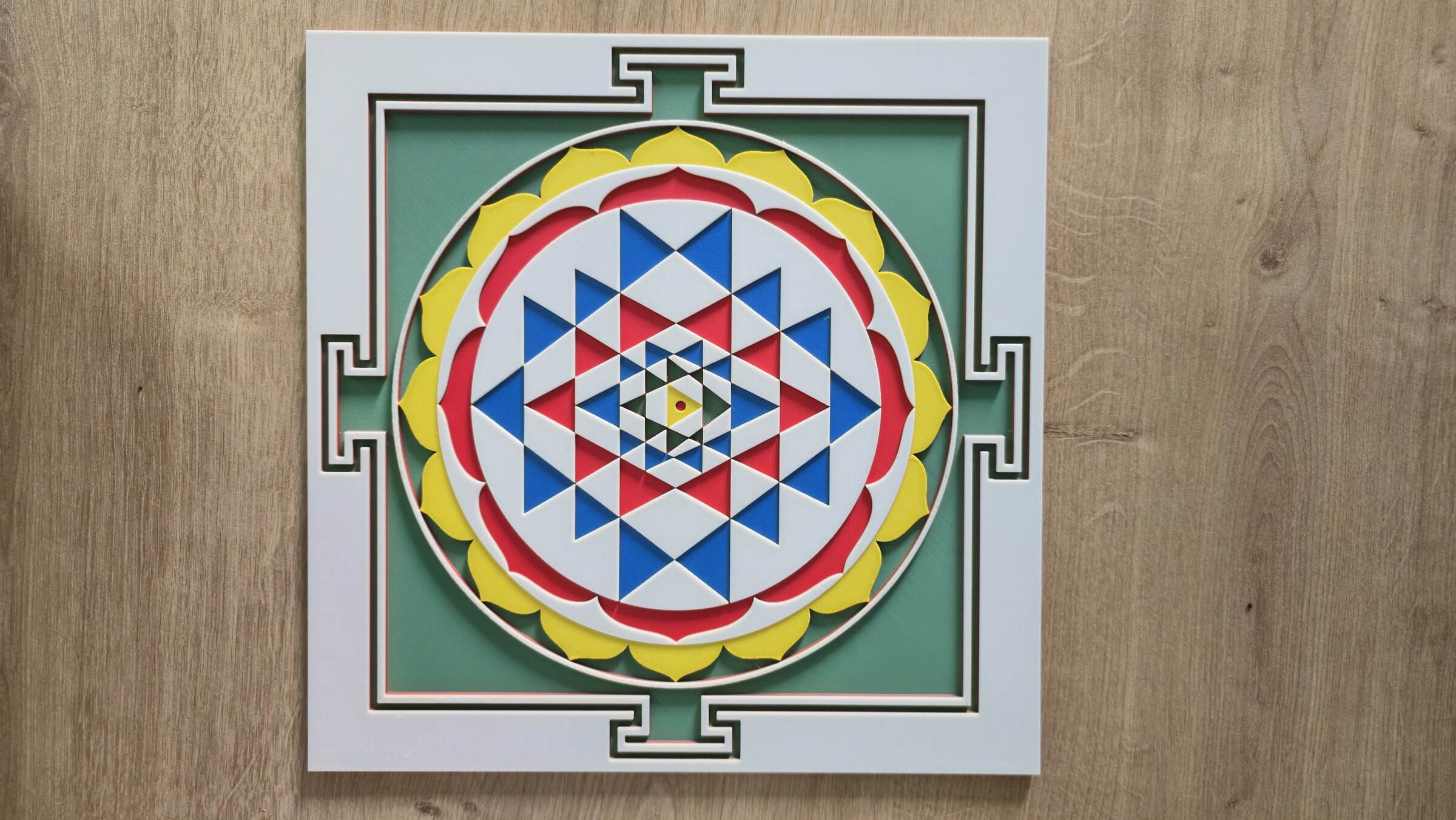
The yantra is a mandala optimized for gazing. In Hindu tantric tradition, a yantra is a mandala stripped to pure geometry: triangles, circles, lotus petals, and a central bindu, with nothing extra. Swami Satchidananda described the practice directly: “Gently gaze at it, holding the main part of the attention on the central dot. After some time, close the eyes and visualize the form mentally.” Yantras were designed specifically for this kind of gazing practice. The most well-known is the Sri Yantra, a pattern of nine interlocking triangles surrounding a central point. 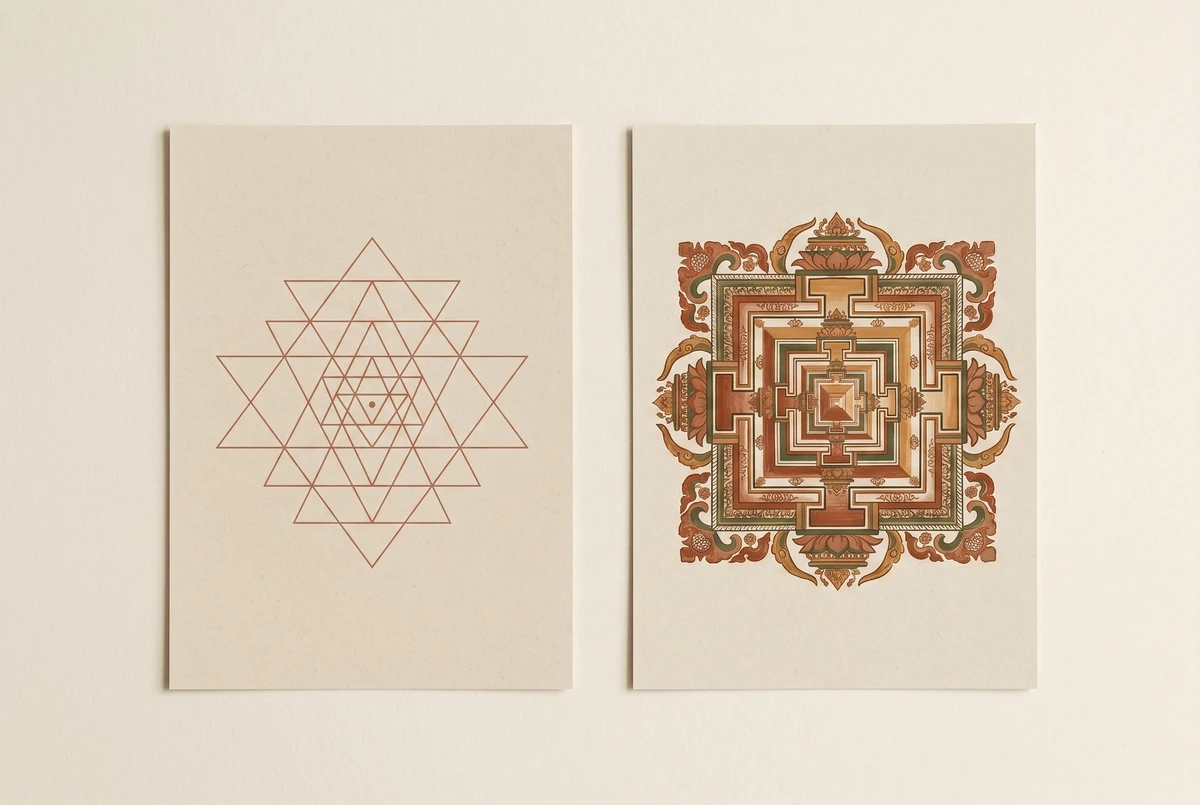
Tibetan Buddhist mandalas serve a different purpose. In Vajrayana Buddhism, mandalas are visual maps for deity visualization: the meditator mentally enters the mandala as a palace and navigates its symbolic rooms. This is a practice that requires initiation and a teacher. It eventually arrives at internal visualization, but through a completely different route (symbolic narrative rather than geometric concentration).
Coloring book “mandalas” are usually decorative patterns inspired by mandala aesthetics. They’re designed to be filled in with color, not gazed at. They rarely have the geometric precision needed for sustained gazing practice.
The key principle: match the mandala to the practice. Gazing meditation needs geometry with a focal point. Visualization practice needs symbolic narrative. Relaxation works with anything circular and pleasing.
The connection to trataka (and why it matters)
If you’ve been gazing at a mandala’s center point and noticed your mind settling, you’ve been practicing trataka without knowing it.
Trataka is the yogic practice of fixed-gaze meditation. The Hatha Yoga Pradipika, a foundational yoga text from the 15th century, defines it: “Looking intently with an unwavering gaze at a small point until tears are shed is known as trataka” (Chapter 2, Verse 31). It’s one of the six shatkarmas (purification practices) in Hatha Yoga, and the traditional gazing objects include a candle flame, a black dot, a symbol, or a yantra.
Knowing this name matters because it comes with a developmental path that casual guides never mention:
- External gazing (bahiranga trataka): Hold your gaze on the object. This is where most people start and stop.
- Internal visualization (antaranga trataka): Close your eyes and work with the afterimage. This is where concentration deepens into meditation.
- Objectless focus: The external object becomes unnecessary. The mind holds stable on its own.
The research supports the effectiveness of this progression. Raghavendra and Singh (2016) found that a single 25-minute trataka session improved performance on the Stroop color-word test by 26%, measuring selective attention and cognitive flexibility. Talwadkar, Jagannathan, and Raghuram (2014) found that one month of daily trataka practice significantly improved working memory, attention, and executive function in elderly subjects.
Both studies used candle flames rather than mandalas, because candles are easier to standardize in a lab. No study has yet compared different gazing objects head to head. But the mechanism is the same: sustained fixed-gaze concentration trains attention regardless of whether you’re looking at a flame or a geometric pattern. The studies validate the practice; the specific object is the practitioner’s choice.
Swami Niranjanananda Saraswati’s Dharana Darshan, published by the Bihar School of Yoga, devotes an entire chapter to trataka and classifies gazing objects from simple to complex: black dots, candle flames, symbols, and yantras. A mandala with a clear center point fits squarely within this framework.
If you want to deepen your practice, the path is clear: start with a simple mandala or black dot, develop a stable gaze, progress to a geometrically precise yantra (like the Sri Yantra), and eventually practice internal visualization without any external object at all.
Common mistakes and how to fix them
Tracing the patterns instead of gazing at the center. Your eyes naturally want to follow lines. Resist this. Anchor your gaze on the center point and let the geometry reach you through peripheral vision.
Straining to avoid blinking. The Hatha Yoga Pradipika describes trataka “until tears are shed,” which leads some practitioners to turn gazing into an endurance test. For meditation purposes (as opposed to the purification practice), blink naturally when you need to. The goal is steady attention, not an unblinking stare.
Using a screen. A screen adds backlight and visual complexity that a printed image doesn’t have. Use a physical mandala whenever possible.
Switching mandalas every session. The afterimage and internal visualization build from repeated exposure to the same pattern. Your visual system needs consistency to develop a stable internal image. Pick one mandala and use it for at least a month before switching.
Expecting immediate results. The Raghavendra study did find immediate cognitive benefits from a single session, so you’ll likely notice something right away. But the afterimage develops over weeks of daily practice, and the sense of deep mental stillness develops over months. Trataka is concentration training. Like building any capacity, progress is gradual and cumulative.
Sources
- Talwadkar S, Jagannathan A, Raghuram N. (2014). “Effect of trataka on cognitive functions in the elderly.” International Journal of Yoga, 7(2), 96–103. PMID: 25035618. PMC4097909.
- Raghavendra BR, Singh P. (2016). “Immediate effect of yogic visual concentration on cognitive performance.” Journal of Traditional and Complementary Medicine, 6(1), 34–36. PMID: 26870677. PMC4738033.
- Curry NA, Kasser T. (2005). “Can Coloring Mandalas Reduce Anxiety?” Art Therapy: Journal of the American Art Therapy Association, 22(2), 81–85. DOI: 10.1080/07421656.2005.10129441.
- Satchidananda, Swami. (1993). “Tratak: Meditation on a Form or Yantra.” Excerpted from Meditation. Integral Yoga Magazine.
- Svatmarama. (~15th century CE). Hatha Yoga Pradipika, Chapter 2, Verses 31–32. Translation via Muktibodhananda S., Yoga Publications Trust, 1993.
- Niranjanananda Saraswati, Swami. Dharana Darshan. Bihar School of Yoga, Munger, India.
- Dienstmann, G. (2017). ”Trataka Meditation: Still Eyes, Still Mind.” Live and Dare.