Vipassana vs Trataka: How They Work Together
Miha Cacic · April 11, 2026 · 5 min read
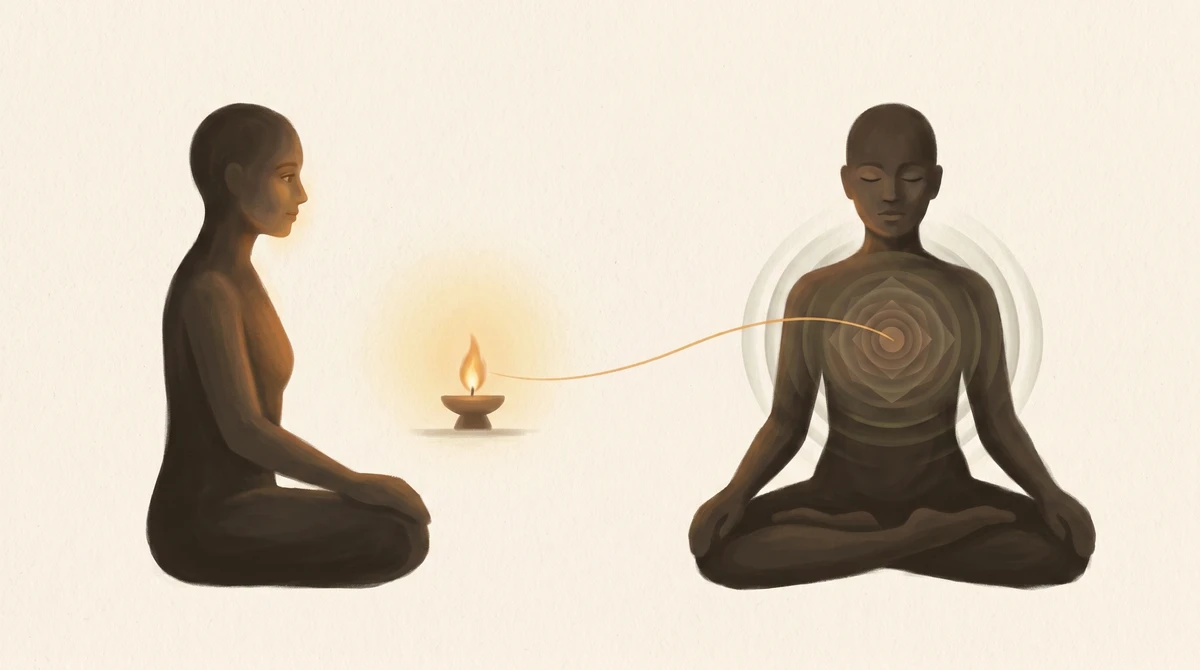
Vipassana and trataka are not two versions of the same thing. Trataka is a concentration technique: you fix your gaze on a single point until the mind has no choice but to settle. Vipassana is an insight technique: you observe whatever arises in your experience to see clearly how things actually work. The question isn’t which is better. It’s which you need right now, and how they fit together. If you’ve tried vipassana and felt like your mind wouldn’t cooperate, you were probably hitting a concentration problem, not a vipassana problem. Trataka was designed to solve exactly that.
What trataka does to the mind
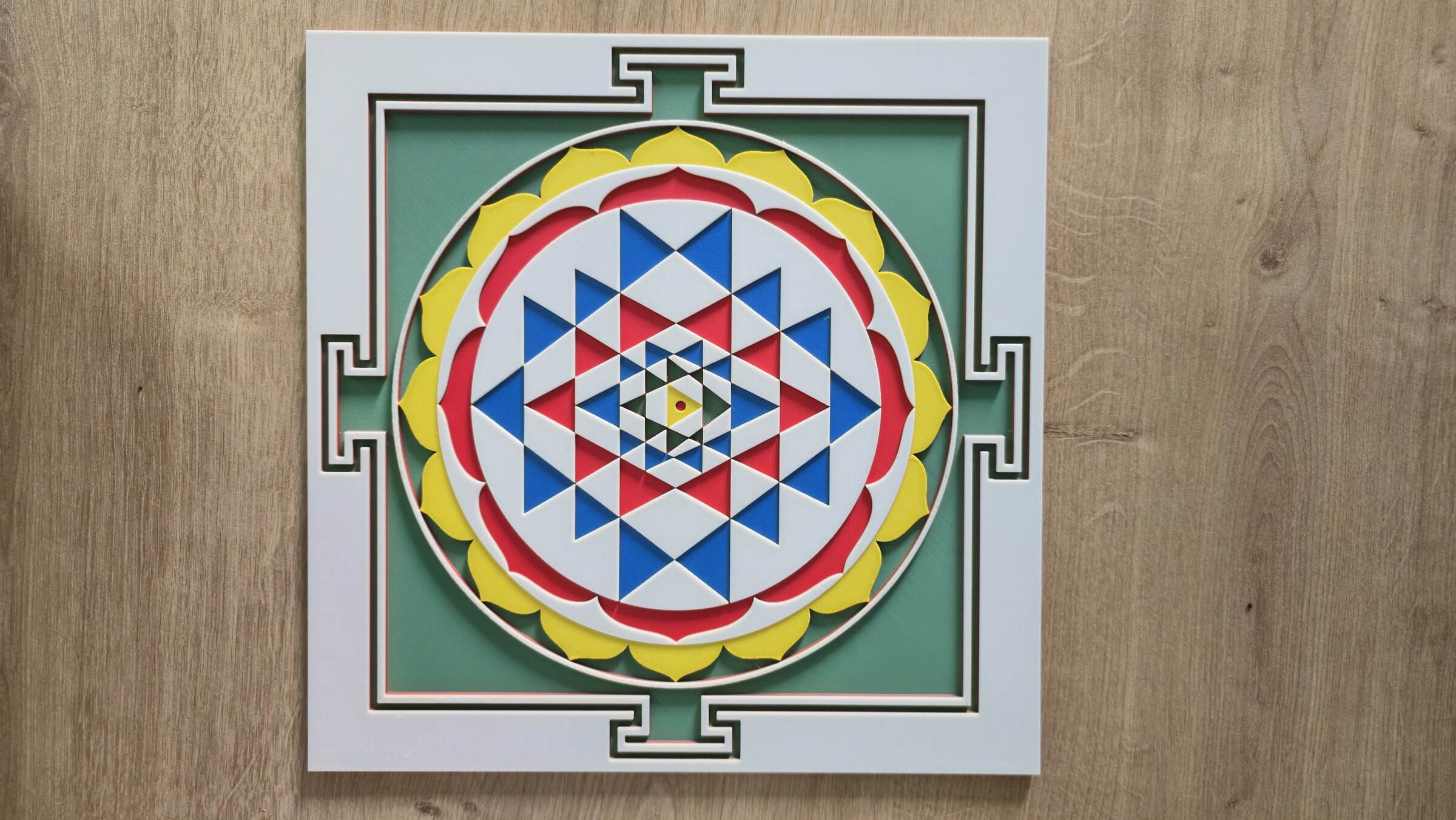
Trataka means “to gaze steadily” in Sanskrit. The practice is simple in description: you fix your eyes on an object (a candle flame, a black dot, a yantra) without blinking until tears come, then close your eyes and hold the afterimage internally. 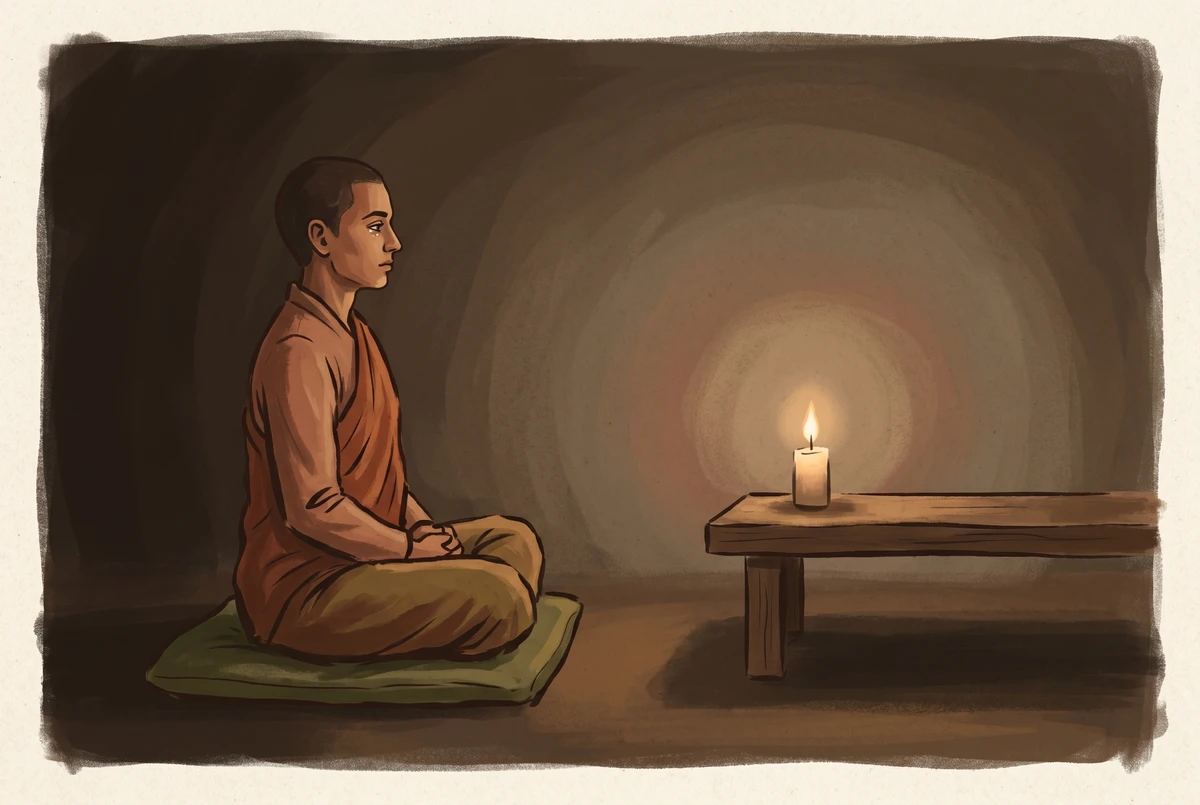
What it trains is sustained voluntary attention. The underlying principle: the mind follows the eyes. When your eyes are still, your mental chatter quiets. This isn’t mystical speculation. The retina develops as a direct outgrowth of the diencephalon (the forebrain). It is, structurally, a piece of the central nervous system that happens to sit in your eye socket. Vision dominates sensory experience, with estimates suggesting 60-80% of all sensory information processed by the brain arrives through the eyes.
Your eyes make constant microscopic jerking movements called microsaccades. These tiny shifts mirror the restlessness of the mind. Practitioners and vision researchers have observed that suppressing these micro-movements through fixed gazing induces mental stillness. Conditions involving disordered attention, such as ADHD and anxiety, also correlate with increased erratic eye movements.
The research supports what practitioners report. Raghavendra and Singh (2016) found that among 30 male volunteers, a single 25-minute trataka session significantly improved selective attention, cognitive flexibility, and response inhibition on the Stroop color-word test (p<0.001). A 2021 study of 41 volunteers found trataka enhanced working memory and spatial attention. A small 2020 study (n=29) found that 45 minutes of daily practice for 10 days reduced insomnia severity and improved sleep quality. These are small samples and early findings, but they point in the same direction: trataka measurably sharpens attention and calms the nervous system.
Traditionally, trataka is one of the six shatkarmas (purification techniques) described in the Hatha Yoga Pradipika (15th century CE). The text places it as a preparatory practice: shatkarmas precede pranayama, which precedes meditation. The broader tradition describes three progressive stages: external gazing (bahir trataka), internal visualization of the afterimage (antar trataka), and gazing the void. This isn’t “just staring at a candle.” It’s a systematic training program for attention, refined over centuries, with clearly defined developmental stages. 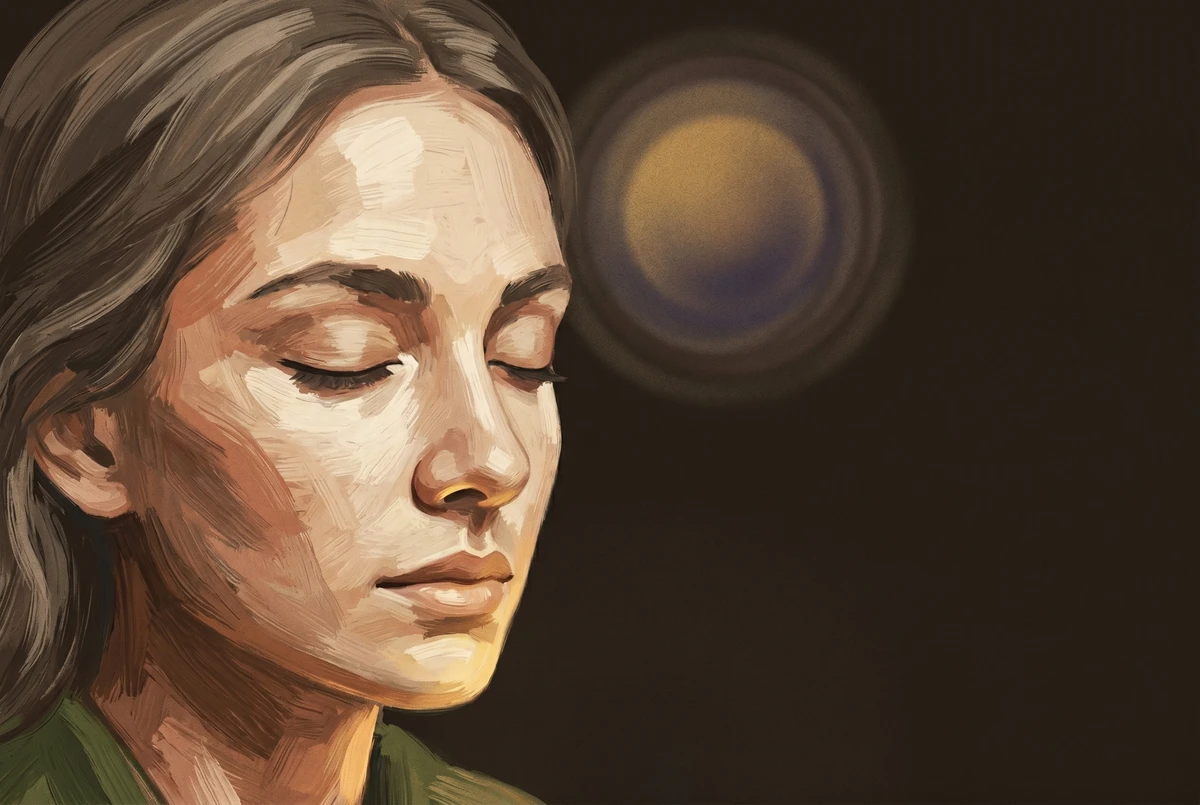
What vipassana does to the mind
Vipassana means “clear seeing” in Pali. The practice: you observe your own experience (bodily sensations, thoughts, emotions) as events arise and pass away, without reacting.
What it trains is insight (panna). Not intellectual understanding, but direct perception of three characteristics: impermanence (anicca), unsatisfactoriness (dukkha), and non-self (anatta). You watch a sensation appear, persist, and dissolve. You notice that the thing you call “I” is a shifting process, not a fixed entity.
Most Westerners encounter vipassana through Goenka-style 10-day retreats. The standard structure: approximately three days of anapana (breath awareness at the nostrils) to build concentration, then the remaining seven days of body scanning to develop insight. The breath phase is samatha. The scanning phase is vipassana. 
The key distinction from trataka: vipassana does not use a single external object. Attention moves through your own experience. The “object” is whatever is happening right now in your mind and body. You observe sensations come and go. You notice your impulse to react, and you don’t.
This requires something specific from you: a mind steady enough to actually observe. You can’t watch anything clearly through a windshield that’s vibrating.
The real relationship: concentration is the foundation, insight is the building
The Lutz et al. (2008) framework, widely cited in contemplative neuroscience, classifies meditation into two categories: Focused Attention (FA) and Open Monitoring (OM). Trataka is FA: sustained voluntary attention on a chosen object. Vipassana is OM: non-selective, moment-to-moment awareness of experience. The paper notes that FA training typically develops before OM training. This is the scientific framing of something contemplative traditions have said for centuries.
In Buddhist teaching, samatha (concentration) and vipassana (insight) are almost always paired. Thanissaro Bhikkhu’s analysis of the Pali discourses shows they were never presented as separate competing methods: “Although they do use the word samatha to mean tranquillity, and vipassana to mean clear-seeing, they otherwise confirm none of the received wisdom about these terms.” They’re complementary qualities. The Yuganaddha Sutta (AN 4.170) describes four valid paths to awakening, including “insight preceded by tranquillity,” “tranquillity preceded by insight,” and both developed in tandem. All four reach the same result.
Trataka is a samatha practice. It builds the exact capacity (sustained one-pointed attention) that Buddhist teaching identifies as the complement to vipassana. And Buddhism has its own trataka. It’s called fire kasina: gazing at a flame to develop samadhi, then working with the internal afterimage. It’s one of the 40 kammatthana (meditation objects) described by Buddhaghosa in the Visuddhimagga (5th century CE). Uppalavanna, one of the Buddha’s two chief female disciples, is said in the Theravada commentarial tradition to have attained arahantship using fire kasina.
The structural parallel is exact: external gazing at flame, then internal afterimage, then deep concentration states. The Hatha Yoga Pradipika calls it trataka. The Visuddhimagga calls it fire kasina. Same practice, different lineage.
When a yoga teacher says “start with trataka before deeper meditation” and a Buddhist teacher says “you need samatha before vipassana,” they’re saying the same thing in different languages.
Why most people struggle with vipassana (and how trataka helps)
Goenka-style retreats give you approximately three days of anapana (concentration work) before switching to vipassana body scanning. For many people, three days is not enough.
What “struggling with vipassana” looks like: the mind races. You can’t feel subtle sensations. Physical restlessness overwhelms you. Emotions surge and you get pulled under. People come home from retreats saying “I couldn’t do it.” But these are concentration problems, not vipassana problems. Bhante Gunaratana is direct about this: “If you emphasize the awareness function at this point, there will be so much to be aware of that concentration will be impossible.” His advice: “Put most of your effort into one-pointedness at the beginning… A couple of months down the track and you will have developed concentration power. Then you can start pumping your energy into mindfulness.”
A couple of months. Not three days.
Trataka is well-suited to build this foundation because the visual anchor is more compelling than breath for many people. Breath is subtle. A candle flame occupies your visual field. When your eyes lock onto it, your mind has less room to wander. The tears provide natural feedback (you know the practice is working). The afterimage phase trains internal visualization, which bridges to the inner work of vipassana. And research suggests that even short trataka sessions produce measurable improvements in the faculties vipassana demands: selective attention, cognitive flexibility, and the ability to inhibit automatic responses.
This doesn’t mean trataka is “the easy one.” Advanced trataka (internal visualization and space-gazing) is deeply demanding. The point is that the concentration skill it builds is the specific prerequisite for productive insight work.
How to Practice Trataka and Vipassana Together
Sequential in a single session. Start with 5-10 minutes of trataka (candle gazing or yantra gazing). Let the mind settle through the eyes. Then close your eyes and transition to vipassana: body scanning, breath-based insight practice, or open awareness. The trataka phase concentrates the mind; the vipassana phase applies that concentrated mind to insight. 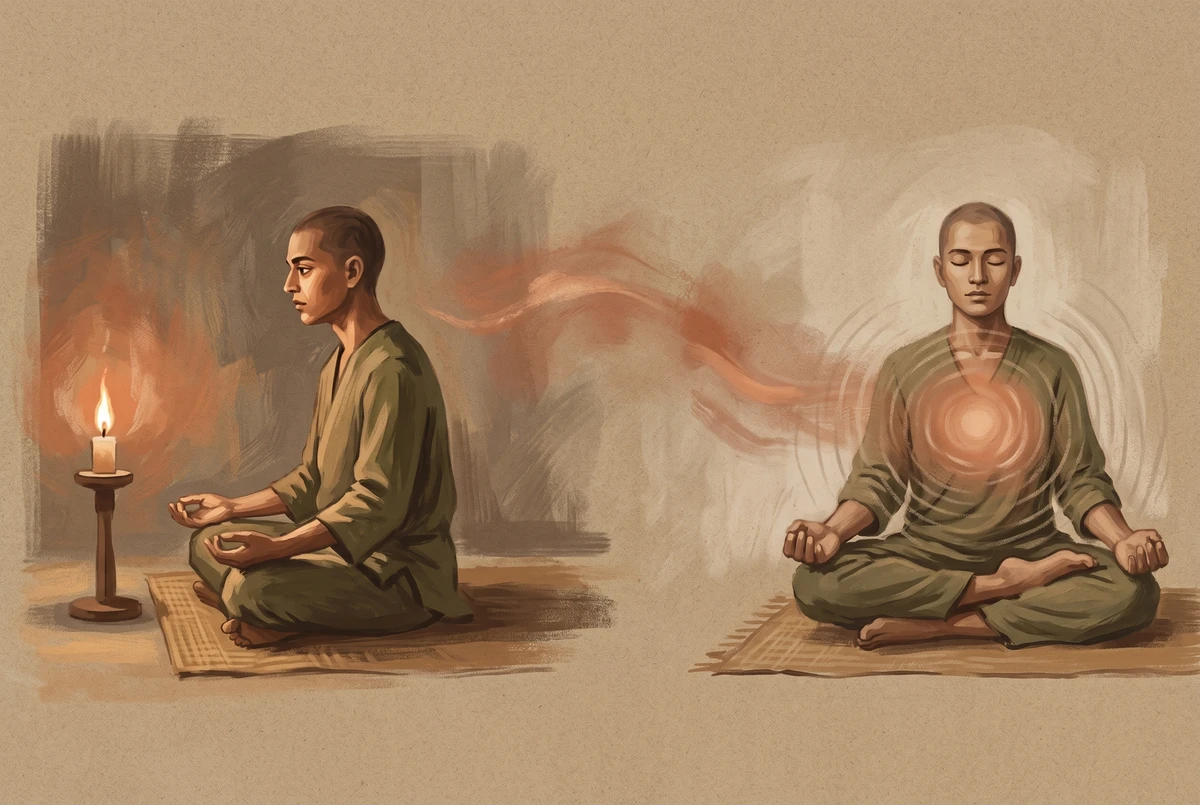
Developmental sequence over weeks or months. Dedicate daily practice to trataka until you can sustain unbroken external attention for several minutes without significant mental wandering. This might take a few weeks or a few months. Then introduce vipassana sessions while maintaining trataka as a maintenance practice, perhaps alternating days or using trataka as a warm-up.
Object-based insight. Some practitioners use the trataka object itself as a basis for vipassana. Watch impermanence in the flickering flame. Observe the afterimage arise, shift, and dissolve. Notice how the mind reacts to discomfort in the eyes. This is where concentration and insight merge: you’re sustaining focused attention (trataka) while observing the three characteristics (vipassana) within that very focus.
Sri Yantra as a bridge. The Sri Yantra’s geometric complexity demands more sustained visual engagement than a simple point of focus. Some practitioners find that its layered structure invites a more contemplative quality of gazing, making yantra trataka a natural bridge between concentration and insight work.
For timing: trataka sessions typically run 5-20 minutes for the external phase. Vipassana sessions benefit from longer sits (20-60 minutes). A combined practice might look like 10 minutes trataka followed by 30 minutes vipassana, done daily.
Trataka vs Vipassana: Key Differences at a Glance
| Trataka | Vipassana | |
|---|---|---|
| Origin | Hatha Yoga (Hindu tradition) | Theravada Buddhism |
| Type | Concentration (samatha) | Insight (vipassana) |
| Object | External fixed point (flame, dot, yantra) | Internal experience (sensations, thoughts) |
| Eyes | Open (external phase); closed (internal phase) | Typically closed |
| Goal | Mental stillness, one-pointed focus | Seeing impermanence, non-self, unsatisfactoriness |
| Physical experience | Tears, afterimages, eye fatigue | Body sensations, emotional surfacing |
| Typical session | 5-20 minutes | 20-60+ minutes |
| Common entry point | Candle flame | Breath awareness (anapana) |
| Buddhist equivalent | Fire kasina meditation | (Is the Buddhist practice) |
| Relationship | Builds the concentration that vipassana depends on | Applies concentration toward liberating insight |
The bottom line: if you’re choosing between them, you’re asking the wrong question. Trataka builds the steady mind. Vipassana uses it to see clearly. One without the other is either a sharp lens with nothing to focus on, or a fascinating landscape viewed through fog.
Sources
- Raghavendra BR, Singh P. (2016). “Immediate effect of yogic visual concentration on cognitive performance.” Journal of Traditional and Complementary Medicine, 6(1), 34-36. DOI: 10.1016/j.jtcme.2014.11.030.
- Swathi PS, Raghavendra BR, Saoji AA. (2021). “Health and therapeutic benefits of Shatkarma: A narrative review of scientific studies.” Journal of Ayurveda and Integrative Medicine, 12(1), 206-212. PMCID: PMC8039332.
- “Effect of Trataka (Yogic Visual Concentration) on the Performance in the Corsi-Block Tapping Task: A Repeated Measures Study.” (2021). Frontiers in Psychology. PMID: 34975664.
- “Effect of trataka (yogic gazing) on insomnia severity and quality of sleep in people with insomnia.” (2020). PMID: 33036930.
- Lutz A, Slagter HA, Dunne JD, Davidson RJ. (2008). “Attention regulation and monitoring in meditation.” Trends in Cognitive Sciences, 12(4), 163-169. PMID: 18329323.
- Thanissaro Bhikkhu. (1997). “One Tool Among Many: The Place of Vipassana in Buddhist Practice.” Noble Strategy. Access to Insight edition, 2011.
- “Yuganaddha Sutta: In Tandem” (AN 4.170). Translated by Thanissaro Bhikkhu. Access to Insight, 2013.
- Bhante Gunaratana. Mindfulness in Plain English, Chapter 14: “Mindfulness Versus Concentration.”
- Dienstmann, Giovanni. (2017). “Trataka Meditation: Still Eyes, Still Mind.” Live and Dare.
- Ingram, Daniel et al. Fire Kasina. firekasina.org.
- Swatmarama. Hatha Yoga Pradipika (15th century CE), Chapter 2, verses 31-32.
- Buddhaghosa. Visuddhimagga (Path of Purification) (5th century CE). Fire kasina and the 40 kammatthana.