What Happens When You Stare at a Sri Yantra
Miha Cacic · April 9, 2026 · 7 min read
Your eyes water, the geometry appears to move, and your mind gets quieter than it has any right to. That’s the short answer. The longer answer involves a sequence of perceptual shifts that unfold over minutes and weeks, some of which neuroscience can explain, some of which belong to a 1,200-year-old meditation tradition, and some of which sit in the gap between the two.
Here’s what actually happens, and why.
The first 30 seconds: your eyes lock on and the noise drops away
When you fix your gaze on the central point of a Sri Yantra (the bindu), something counterintuitive happens: your mental chatter starts to quiet. Not because you’re trying to suppress thoughts, but because you’ve given your visual system something complex enough to fully occupy it.
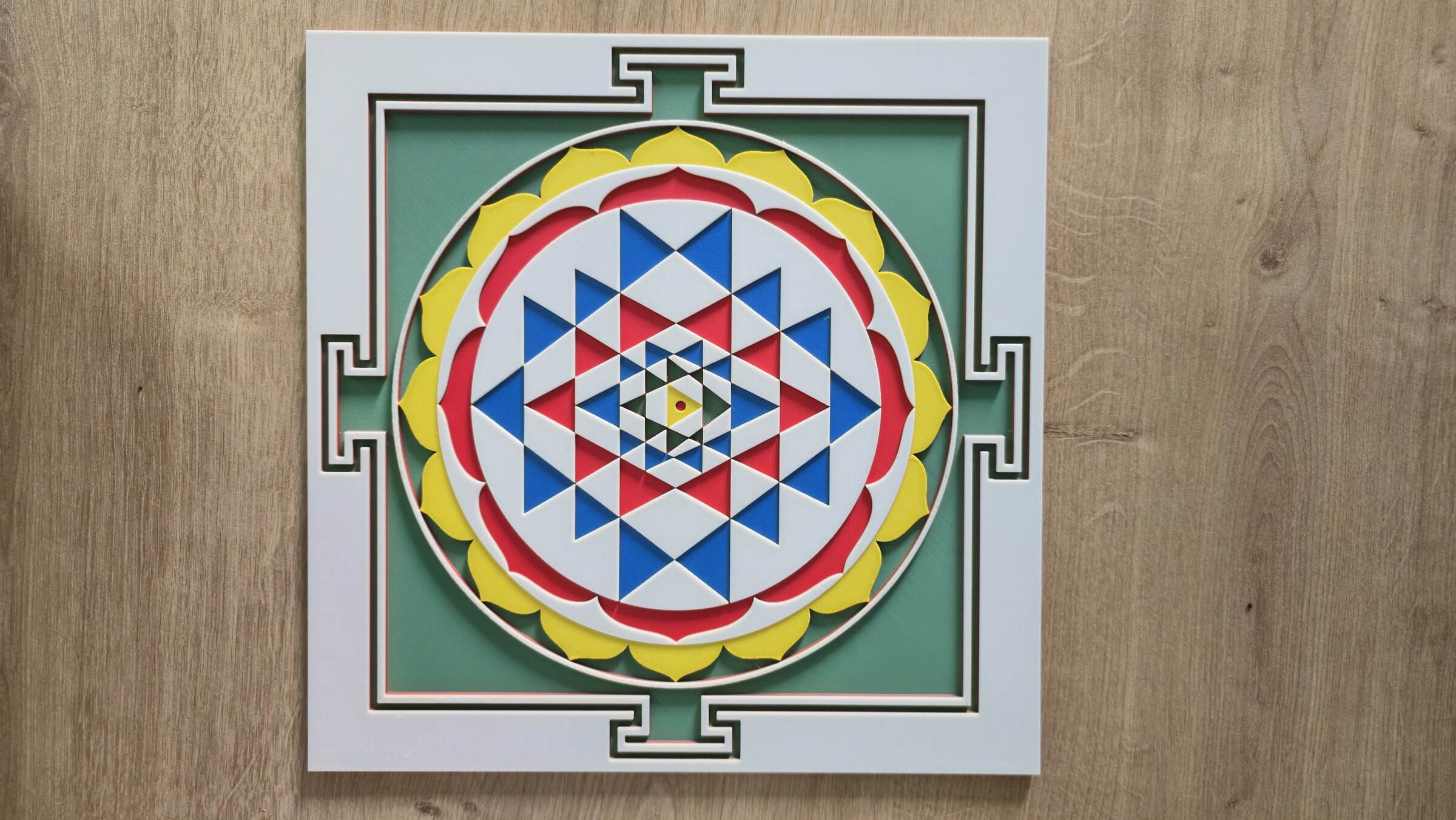
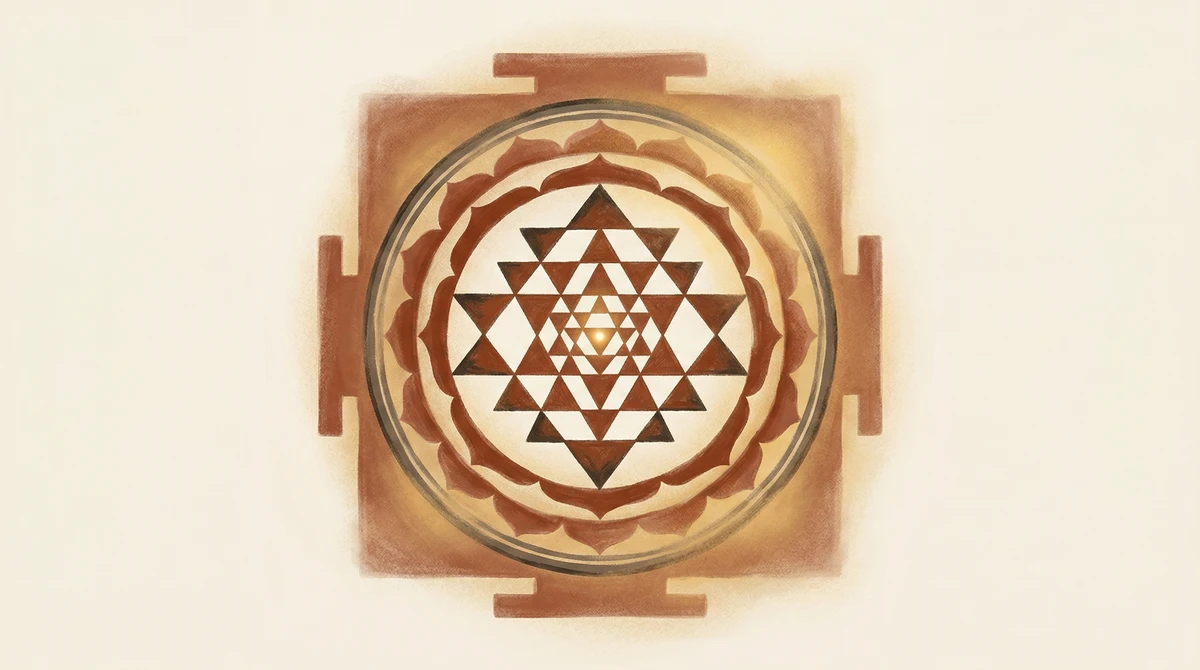
This isn’t accidental. The Sri Yantra packs nine interlocking triangles into 43 subsidiary triangles, organized across five concentric levels, all enclosed by lotus petals and a square boundary. That’s an enormous amount of geometric information for your brain to process. About 30% of your cortex is devoted to visual processing (more than any other sense), and a pattern this dense recruits a significant share of it.
The bindu works like a visual anchor. In eyes-closed meditation, your anchor is typically the breath or a mantra, and holding attention on something so subtle takes real skill. The bindu gives you something concrete and visible to return to when attention wanders. This is why trataka (fixed-gaze meditation) is often recommended for people who struggle with eyes-closed practice: the object does half the work of holding your attention.
The technique is old. The Hatha Yoga Pradipika, a 15th-century yoga text, lists trataka as one of six cleansing practices: “Being calm, one should gaze steadily at a small mark, till eyes are filled with tears.” The Gheranda Samhita, written roughly two centuries later, prescribes the same.
The first few minutes: the geometry starts to shift
After 60 to 90 seconds of steady gazing, the Sri Yantra stops looking like a flat image on paper.
The peripheral elements begin to fade. Triangles at the edges seem to dissolve or become transparent. The geometry around the bindu appears sharper and more vivid than what surrounds it. This is Troxler’s fading, a well-documented perceptual phenomenon: when you hold your gaze fixed, neurons processing your peripheral visual field adapt to the unchanging stimulus and gradually stop responding. Your brain fills in the gap with whatever it expects to see, which often means the peripheral pattern simply disappears.
This fading isn’t just happening in your retinas. Research by Martinez-Conde, Macknik, and Hubel (2004) showed that tiny involuntary eye movements called microsaccades normally counteract this neural adaptation. During fixation, microsaccade rate drops, and fading episodes increase. Hsieh and Tse (2006) went further, demonstrating that “at least some portion of the perceptual fading occurred in the brain, not in the eyes.” It’s a cortical event, not just tired rods and cones. 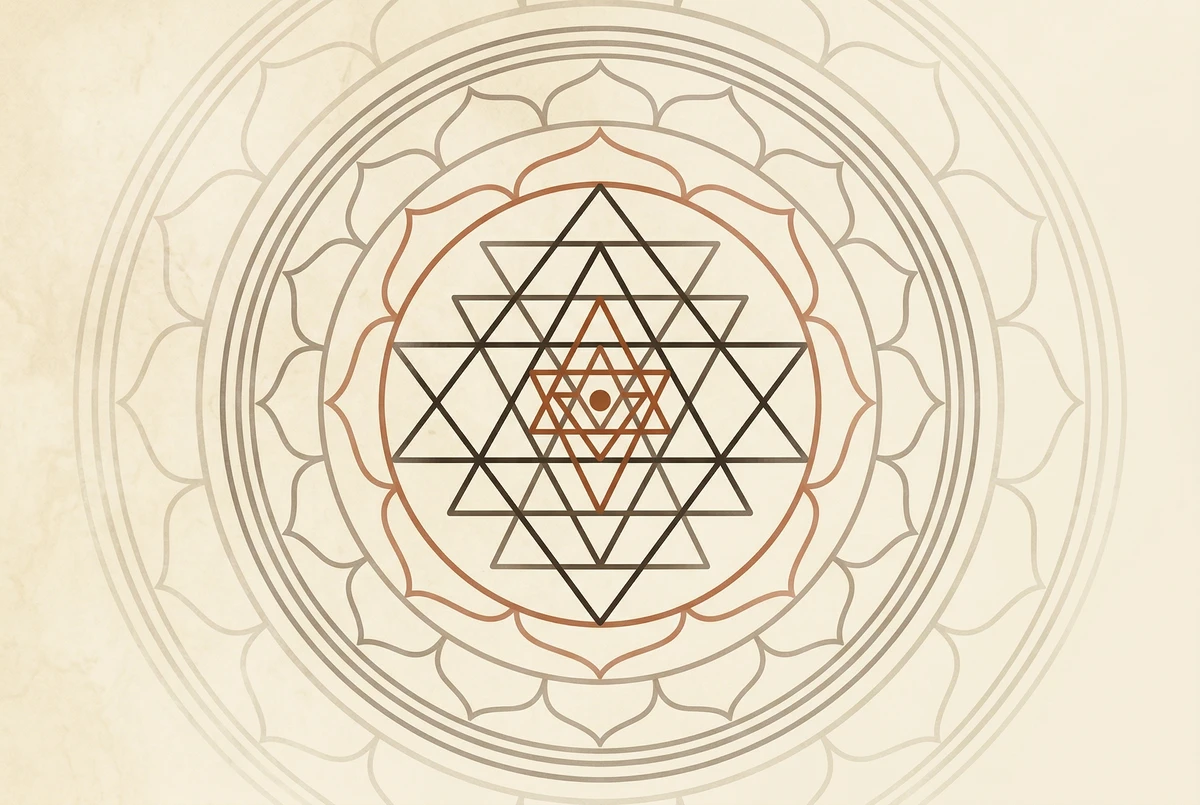
Then the triangles start to move. The interlocking geometry appears to shift in depth, as if the flat image has become three-dimensional. Some practitioners describe the triangles lifting off the page; others see them receding into a tunnel. This is bistable perception, the same mechanism behind the Necker cube illusion. When a pattern contains ambiguous depth cues (and interlocking upward and downward triangles are full of them), your brain oscillates between competing interpretations. The fronto-parietal networks that resolve this ambiguity overlap with the attention networks engaged during meditation, which may be one reason geometric patterns are effective meditation objects.
Colors emerge at the edges of triangles. Lines appear bolder, sometimes glowing. One practitioner described seeing “beautiful multi-colored lines surrounding the geometries… right out of nowhere, as if in bold.” These chromatic effects arise from retinal adaptation at high-contrast boundaries, where opponent color channels overshoot after prolonged stimulation.
These effects happen with any complex geometric pattern under sustained fixation. They are not unique to the Sri Yantra. But the Sri Yantra’s specific geometry (the precise interlocking of triangles, the concentric layering, the radial symmetry) produces particularly rich and structured versions of these effects. The traditional designers likely understood this from centuries of empirical observation.
This matters for meditation: these perceptual shifts are not distractions or “just optical illusions.” They indicate the pattern has captured enough of your visual processing to displace the usual churn of verbal thought. The “illusion” is the meditation working.
After 5-10 minutes: the afterimage and internal visualization
When you close your eyes after several minutes of gazing, you see a photonegative of the Sri Yantra floating in your visual field. Light areas become dark, dark becomes light, and the colors invert. This afterimage forms because the photoreceptors stimulated by the pattern become temporarily less responsive, while unstimulated neighboring receptors remain at full sensitivity. The result is a complementary image that persists for seconds to minutes.
This isn’t a bonus effect. It’s the point.
The traditional practice cycles between two phases: bahiranga trataka (external gazing) and antaranga trataka (internal visualization). You gaze at the yantra until your eyes water or burn, then close your eyes and hold the afterimage as long as you can. When it fades, you open your eyes and repeat. The Frontiers in Psychology study by Swathi, Bhat, and Saoji (2021) found that this complete cycle improved working memory significantly, while eye exercises alone produced no measurable cognitive benefit. The internal visualization phase isn’t optional decoration; it’s integral to the practice that produced these results.
The Sri Yantra’s sharp black-on-white lines and symmetrical structure translate into a clear complementary afterimage with recognizable geometry, which gives your mind something specific and structured to hold onto during the eyes-closed phase.
In yogic terminology, the capacity to hold this internal image is dharana (concentration). With practice, dharana becomes dhyana (unbroken meditation), where the image is sustained without effort. A 2024 study published in Neuroscience of Consciousness found that experienced meditators perceive afterimages as more vivid and sharper than non-meditators, suggesting that the perceptual system itself changes with practice. Eventually, practitioners report being able to summon the yantra’s image mentally without needing to gaze first.
With regular practice: what changes over weeks and months
The research on cumulative effects comes primarily from candle-gazing trataka (not Sri Yantra specifically), but the findings are consistent with what practitioners report.
Working memory and attention improve measurably. Swathi et al. (2021) found that after two weeks of daily 20-minute trataka sessions, participants showed significant gains in both forward and backward spatial working memory (the Corsi-Block Tapping Task). Forward span scores improved from an average of 5.5 to 6.1 (d = 0.64), with a medium-to-large effect on total score (d = 0.74). A randomized controlled trial by Talwadkar, Jagannathan, and Raghuram (2014) found similar improvements in elderly subjects after a month of daily practice: working memory, sustained attention, and executive function all improved, and gains persisted at the 30-day follow-up. The waitlist control group showed no change.
The afterimage becomes more vivid and lasts longer. No study has tracked this directly for trataka, but practitioners consistently report it, and the 2024 finding that meditation practice correlates with sharper afterimage perception makes the claim plausible. General neuroscience research shows that afterimage processing improves with repeated exposure.
The visual effects deepen. Where a beginner sees mild distortion and fading, practitioners with months of regular practice report the geometry appearing to breathe, rotate, or pulse. The two-dimensional image seems to acquire genuine depth. These reports are consistent across cultures and traditions, though no controlled study has measured the progression.
What the science doesn’t cover: The existing research examines trataka with a candle flame, not a Sri Yantra. The traditional teaching holds that the Sri Yantra is a superior trataka object because its geometry carries specific sacred significance, but this claim hasn’t been tested in a controlled comparison. A single study by Kulaichev (1988) at Moscow University found that gazing at a Sri Yantra produced faster onset of alpha rhythms (brain waves associated with relaxation) compared to gazing at a pseudo-yantra, concentric circles, or radiating lines. The finding is suggestive but based on a small, poorly documented sample.
The deeper experiences: what advanced practitioners describe
Beyond the territory of perceptual science, long-term practitioners describe experiences that current neuroscience cannot explain.
The Sri Yantra appears to become fully three-dimensional, and the practitioner feels located inside the geometry rather than looking at it from outside. The counter-rotating movement of inner and outer elements intensifies into what one practitioner called “a forever non-ending movement” that “will activate the more central part (called the ‘Drum of Creation’) and it will show you a kind of labyrinth going to the Bindu point, which is also moving to the far never-ending infinite.”
Teachers in the tradition report the yantra morphing into deity forms: one described seeing “the Sri Yantra dissolve into a mandala… Shiva and Shakti were practicing maithuna in the center,” and noted that students independently reported the yantra transforming into “a variety of geometrical figures and deities.”
These experiences need honest framing. They’re subjectively real and consistent across practitioners. They can’t be replicated in a lab. The early-stage perceptual effects (Troxler’s fading, bistable perception, afterimages) have clear scientific explanations, but at some point the experiences described by advanced practitioners leave the domain of vision science entirely.
In the Sri Vidya tradition, this is expected and deliberate. The Sri Yantra is not simply a meditation object; it is considered the geometric form of the goddess Tripura Sundari, the entire cosmos mapped into two dimensions. As the Soundarya Lahari (attributed to 8th-century philosopher Adi Shankaracharya) teaches, each verse of the tradition carries both mantra shakti (power of sound) and yantra shakti (power of geometric form). For traditional practitioners, the visual transformations during deep gazing are not side effects of retinal fatigue. They are encounters with the structure of consciousness itself.
The perceptual science is real. The traditional understanding is real (in the sense that it’s a coherent system with centuries of empirical observation behind it). Where the boundary falls between neuroscience and contemplative experience remains an open question.
Why the Sri Yantra specifically (and not just any pattern)
The practical answer: the Sri Yantra’s geometry is unusually well-suited for producing the perceptual effects that support deep meditation.
Its nine interlocking triangles (four pointing up, five pointing down) create 43 subsidiary triangles, giving the eye an extraordinary density of geometric information to process. The concentric layering (bindu at the center, then triangles, then lotus petals, then a square outer boundary) creates natural depth for your gaze to travel through. The radial symmetry means the pattern remains stable regardless of small eye movements, which strengthens the afterimage.
The mathematics are notable. Analysis of correctly constructed Sri Yantras shows that the base angle of the largest triangles is approximately 51°, matching the slope of the Great Pyramid’s faces (51°50’). The ratio of the hypotenuse to half-base in these triangles approximates phi (1.618), the golden ratio. This doesn’t mean the entire yantra “follows the golden ratio” (a common overstatement), but the key proportions do relate to phi, and those proportions may contribute to the visual harmony that makes the pattern compelling under sustained fixation.
The traditional answer is different. In Sri Vidya cosmology, the Sri Yantra encodes the pattern of creation itself: the union of Shiva (the five downward triangles, consciousness) and Shakti (the four upward triangles, energy). Gazing at it attunes your consciousness to that pattern. The Brahmanda Purana and Markandeya Purana teach that looking at the Sri Yantra itself is a blessing.
The tradition also prescribes two directions of contemplation: srsti (outward from the bindu, following the expansion of creation) and samhara (inward from the boundary to the bindu, the path of dissolution). These aren’t just metaphors. Practitioners who move their attention through the geometry in different directions report distinct experiential qualities.
What to expect in your first session (and what’s normal)
Your first session will probably be underwhelming, and that’s fine.
In the first 1-3 minutes, your eyes will water. This is normal. The urge to blink will be strong. Traditional texts say to hold the gaze until tears flow; modern guidance says it’s fine to blink softly and return focus to the bindu. Torturing your corneas is not the point. Sustained soft focus is.
By 2-4 minutes, you’ll likely notice the peripheral triangles fading or becoming transparent. The area around the bindu may appear brighter or more vivid. These are the Troxler’s fading effects described above, and they’re the first sign that the practice is working.
Some sessions, nothing dramatic happens. You stare, your eyes water, you close them and see a blurry afterimage for a few seconds, and that’s it. This is normal, especially in the first weeks. The progression is gradual.
Practical guidance:
- Start with 3-5 minutes of gazing per session
- Work up gradually; 15-20 minutes is a solid practice
- Sit at arm’s length from the yantra, with the bindu at eye level
- Soft natural light works better than harsh overhead lighting
- After each gazing period, close your eyes and hold the afterimage as long as you can; when it fades, open your eyes and resume
Stop if you experience a headache, sharp eye pain, persistent visual disturbance that doesn’t fade within a few minutes after the session, or dizziness. These are signs of overexertion, not spiritual progress. If you have glaucoma, retinal disorders, or acute eye inflammation, consult a doctor before beginning a trataka practice.
Sources
- Swathi PS, Bhat R, Saoji AA. (2021). “Effect of Trataka (Yogic Visual Concentration) on the Performance in the Corsi-Block Tapping Task: A Repeated Measures Study.” Frontiers in Psychology, 12:773049. DOI: 10.3389/fpsyg.2021.773049. PMCID: PMC8718544.
- Talwadkar S, Jagannathan A, Raghuram N. (2014). “Effect of trataka on cognitive functions in the elderly.” International Journal of Yoga, 7(2):96-103. DOI: 10.4103/0973-6131.133872. PMCID: PMC4097909.
- Kulaichev AP. (1988). “Sriyantra: The Ancient Instrument to Control the Psychophysiological State of Man.” Indian Journal of History of Science, 23(2):163-169.
- Martinez-Conde S, Macknik SL, Hubel DH. (2004). “The role of fixational eye movements in visual perception.” Nature Reviews Neuroscience, 5:229-240.
- Hsieh PJ, Tse PU. (2006). “Illusory color mixing upon perceptual fading and filling-in does not result in ‘forbidden colors.‘” Vision Research, 46(14):2251-2258.
- “Bistable perception: neural bases and usefulness in psychological research.” (2020). Spatial Vision. PMCID: PMC7110285.
- “Visual imagery vividness correlates with afterimage conscious perception.” (2024). Neuroscience of Consciousness, 2024(1):niae032. PMCID: PMC11294681.
- Swatmarama. (~15th century CE). Hatha Yoga Pradipika, Chapter 2, Verses 31-32. Translation: Rai Bahadur Srisa Chandra Vasu.
- Gheranda Samhita. (~17th century CE). Chapter 1.
- Adi Shankaracharya (attributed). (~8th century CE). Soundarya Lahari.