Visual Meditation Practices Across World Cultures
Miha Cacic · April 11, 2026 · 10 min read
Indian yogis, Tibetan lamas, Byzantine monks, Sufi mystics, and Kabbalist scholars all arrived at the same discovery: fix your gaze on a single point, and the mind follows. Some of these traditions may have cross-pollinated along trade routes and pilgrimage paths, but the convergence is too widespread and too consistent to explain through cultural contact alone. The human visual system is wired so that stilling the eyes interrupts the constant scanning that feeds mental chatter. Every tradition built a contemplative practice around this principle, but each chose a different object to gaze at. That choice reveals what each culture believes meditation is actually for.
The eyes-mind connection: why visual meditation works
The retina develops from an outgrowth of the diencephalon during embryonic development. It is, in a literal neurological sense, part of the brain. More cortical surface area is dedicated to visual processing than to all other senses combined (roughly 30% of the cerebral cortex processes visual information). This means that controlling what the eyes do gives you unusual leverage over what the mind does.
The mechanism works through two well-documented phenomena. The first is microsaccades: tiny involuntary eye movements that constantly refresh the retinal image. Neuroscientist Susana Martinez-Conde and colleagues (2004) have shown that these movements are essential for maintaining visual perception, because photoreceptors stop firing when the image on the retina stays static. The second is Troxler’s fading, discovered by Swiss physician Ignaz Paul Vital Troxler in 1804: when the eyes hold very still, peripheral stimuli gradually vanish from awareness as neurons adapted to static input reduce their firing rate. 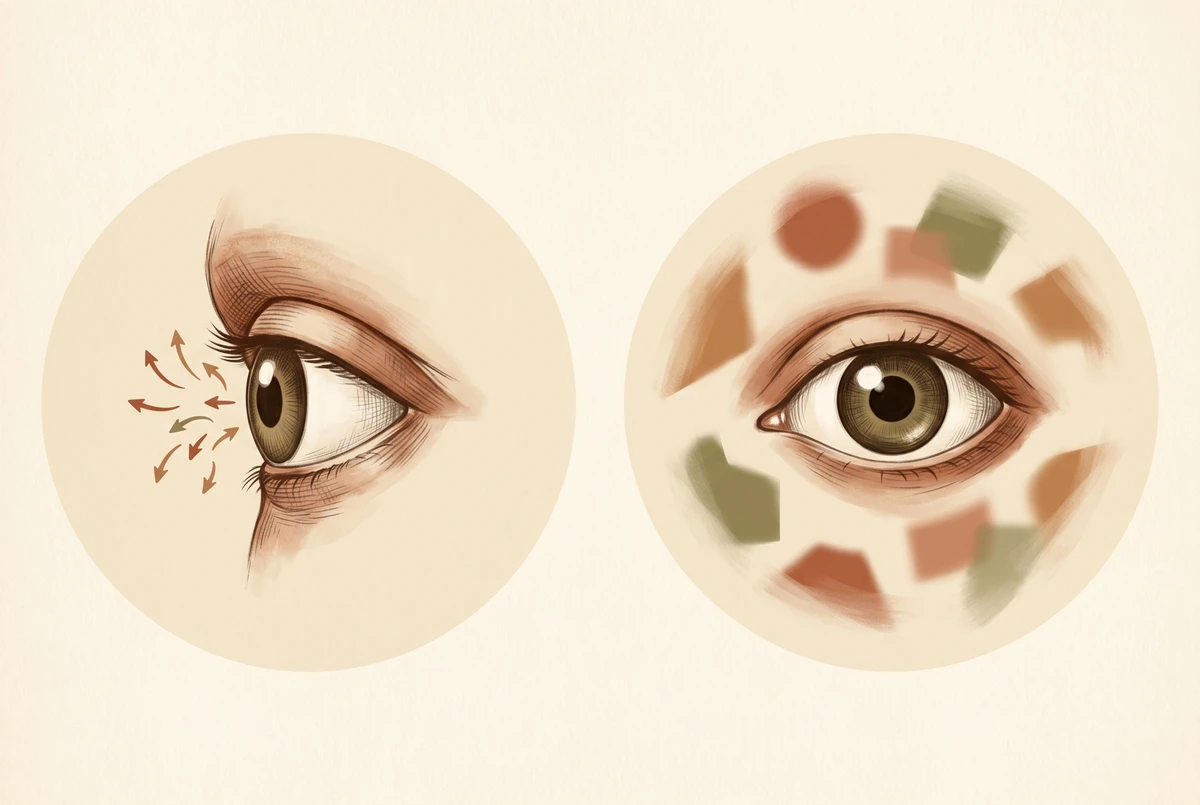
Here’s why this matters for meditation. When you fix your gaze on a single point, you suppress microsaccades. The visual field begins to simplify and fade. The brain’s constant cycle of scanning, categorizing, and reacting to visual input slows down. Erratic eye movements correlate with anxiety and mental restlessness. Contemplatives across traditions report that the reverse also holds: still the eyes, and the mind quiets.
Multiple traditions describe what happens next in strikingly similar terms: the physical object fades, an internal image takes its place, and that image eventually dissolves into luminous or formless awareness. This three-stage progression (external object, internal image, formless state) appears across Hindu, Buddhist, Christian, and other traditions, including some that developed in complete isolation from each other. The shared neuroscience offers one explanation: they were all working with the same visual system and hitting the same perceptual thresholds.
Trataka: the yogic art of gazing
Trataka is the most systematic codification of visual meditation in any tradition. The Hatha Yoga Pradipika (15th century CE) defines it simply: “gazing steadily at a small mark until tears flow” (ch. 2, śloka 31-32). The Gheranda Samhita (17th century CE) lists it among the six purification practices (shatkarmas) and recommends it as preparation for concentration (dharana).
That dual classification matters. Trataka is both a physical cleansing technique (like nasal irrigation or stomach washing) and a mental training practice. It sits at the hinge point of Hatha Yoga, bridging the body practices (asana, pranayama) and the mind practices (dharana, dhyana, samadhi).
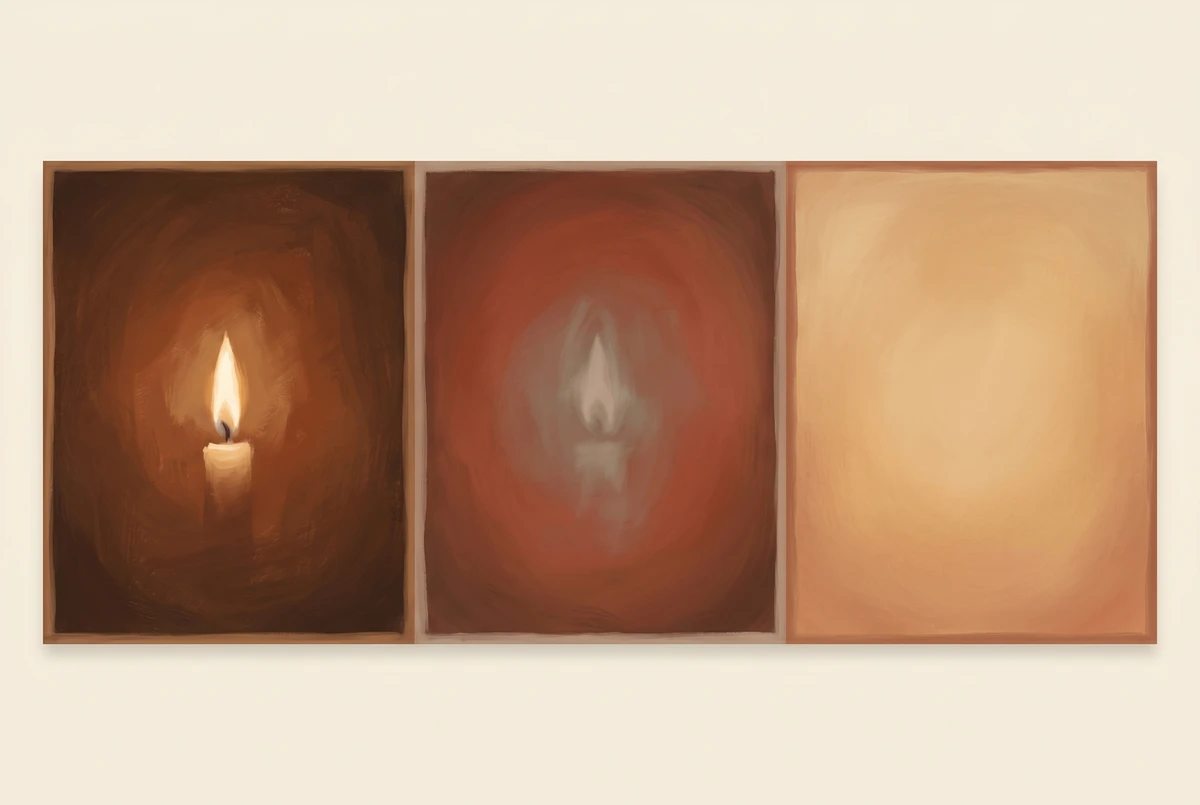
Modern yoga instruction, particularly from the Bihar School of Yoga and the Sivananda lineage, teaches trataka in three stages:
- Bahiranga (external gazing): steady, unblinking gaze at a physical object until tears form.
- Antaranga (internal gazing): closing the eyes and holding the afterimage as long as possible.
- Shunya (gazing the void): when the afterimage fades, resting in the dark, objectless awareness that remains.
The classical texts don’t prescribe the object rigidly. Trataka can be practiced on a candle flame, a black dot on a white wall, the rising sun, the moon, a water current, one’s own reflection, the tip of the nose (nasikagra drishti), or the space between the eyebrows (shambhavi mudra). The candle flame became the default in modern practice because fire has a natural magnetism for attention and produces a strong, distinct afterimage. The black dot is considered safer for extended practice since it carries no risk of eye strain from light.
You start with something you can see with your eyes, graduate to something only your mind can see, and arrive at a state beyond seeing altogether, mirroring the broader yogic progression from gross to subtle.
Kasina: the Buddhist system of visual meditation objects
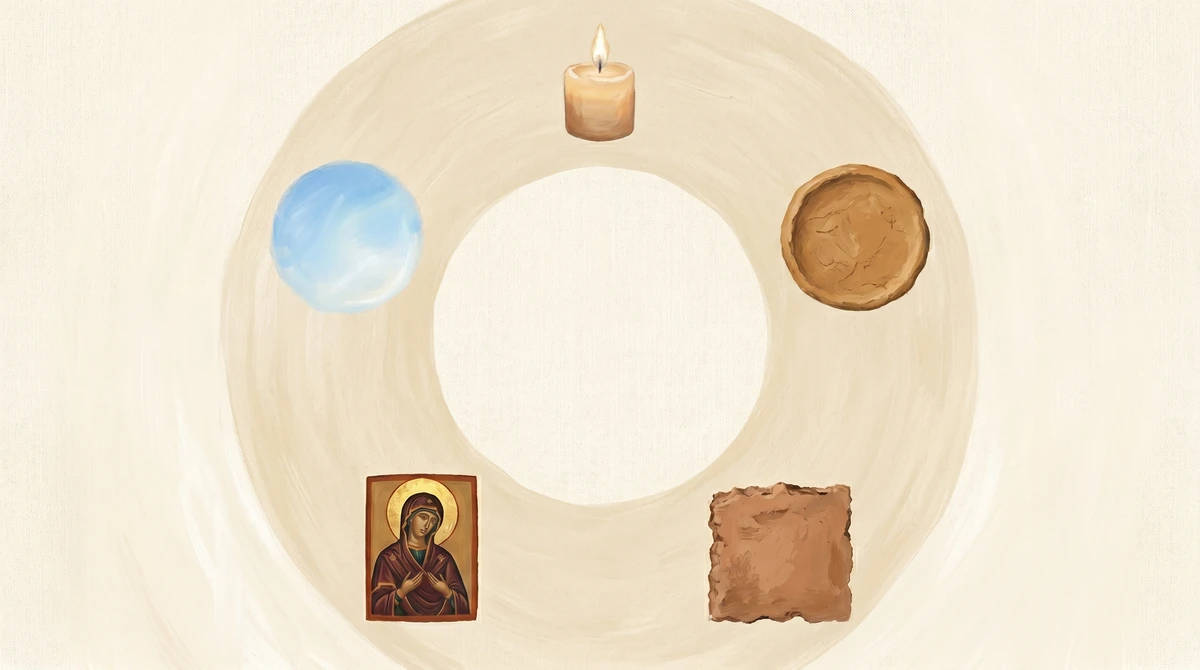
The Theravada Buddhist tradition produced the most detailed taxonomy of visual meditation objects ever compiled. Buddhaghosa’s Visuddhimagga (Path of Purification, 5th century CE) describes ten kasina objects, each a different category of experience:
The four elements: earth (pathavi), water (apo), fire (tejo), wind (vayo) Four colors: blue-green (nila), yellow (pita), red (lohita), white (odata) Two abstract qualities: light (aloka), bounded space (paricchinnakasa) 
Practitioners create physical kasina disks and gaze at them, much like trataka. But the kasina system provides something trataka doesn’t: a precise phenomenological map of what happens during sustained gazing.
The three stages of the mental sign (nimitta) are:
- Parikamma-nimitta (preliminary image): the actual physical disk as perceived by the eyes.
- Uggaha-nimitta (learning sign): a visual imprint retained after the eyes close, often unstable, murky, or flickering.
- Patibhaga-nimitta (counterpart sign): a refined, luminous mental image, “brighter than real life, with a uniform quality,” as meditation teacher Daniel Ingram describes it in Mastering the Core Teachings of the Buddha. This sign marks the threshold of access concentration, the doorway to jhana (deep absorption states).
Ingram, one of the most detailed modern practitioners to write about kasina, recommends colored disks of 1-5 cm on a dark background for most people, noting that “the color kasinas are the easiest for most practitioners.” He documents an intermediate phase he calls “the murk,” a confused, jumbled visual experience between the learning sign and the counterpart sign, which many meditators mistake for failure when it’s actually progress.
The parallel with trataka is obvious. Fire kasina and candle trataka are functionally the same practice: sustained gaze on a flame, cultivation of an afterimage, deepening into absorption. But the frameworks diverge. Trataka aims at purification and concentration. Kasina aims at jhana, a specific set of absorption states mapped with precision in the Theravada system. Same technique, different destination.
If you practice trataka and see colors, patterns, or unexplained light behind your closed eyes, the kasina tradition has your map. Those experiences correspond to the transition from uggaha-nimitta to patibhaga-nimitta, and they’re a normal part of the process.
Deity yoga and thangka meditation in Tibetan Buddhism
Vajrayana Buddhism takes visual meditation in a radically different direction. Instead of gazing at a simple external object and waiting for an internal image to arise, the practitioner constructs an extraordinarily detailed mental image from the inside out.
In deity yoga (yidam practice), the meditator visualizes becoming a specific deity, with precise colors, ornaments, posture, facial expressions, hand gestures, throne, surrounding beings, and the complete mandala environment. This is not passive reception. It is active, disciplined imagination with a specific spiritual purpose: the practitioner identifies with the enlightened qualities the deity represents.
Thangka paintings, the intricate scroll paintings of Tibetan Buddhism, serve as external supports for this internal work. Just as a kasina disk provides a starting point for nimitta development, the thangka provides a reference image that the meditator internalizes. The progression is structurally parallel to trataka: external image (thangka), internal reconstruction (visualization), dissolution into emptiness (sunyata). But the complexity of the internal image far exceeds anything in trataka or kasina.
Kozhevnikov and colleagues (2009), in a study published in Psychological Science, found that monks trained in deity meditation showed enhanced visuospatial memory compared to controls, consistent with what daily practice in mentally constructing and holding extraordinarily detailed images would predict.
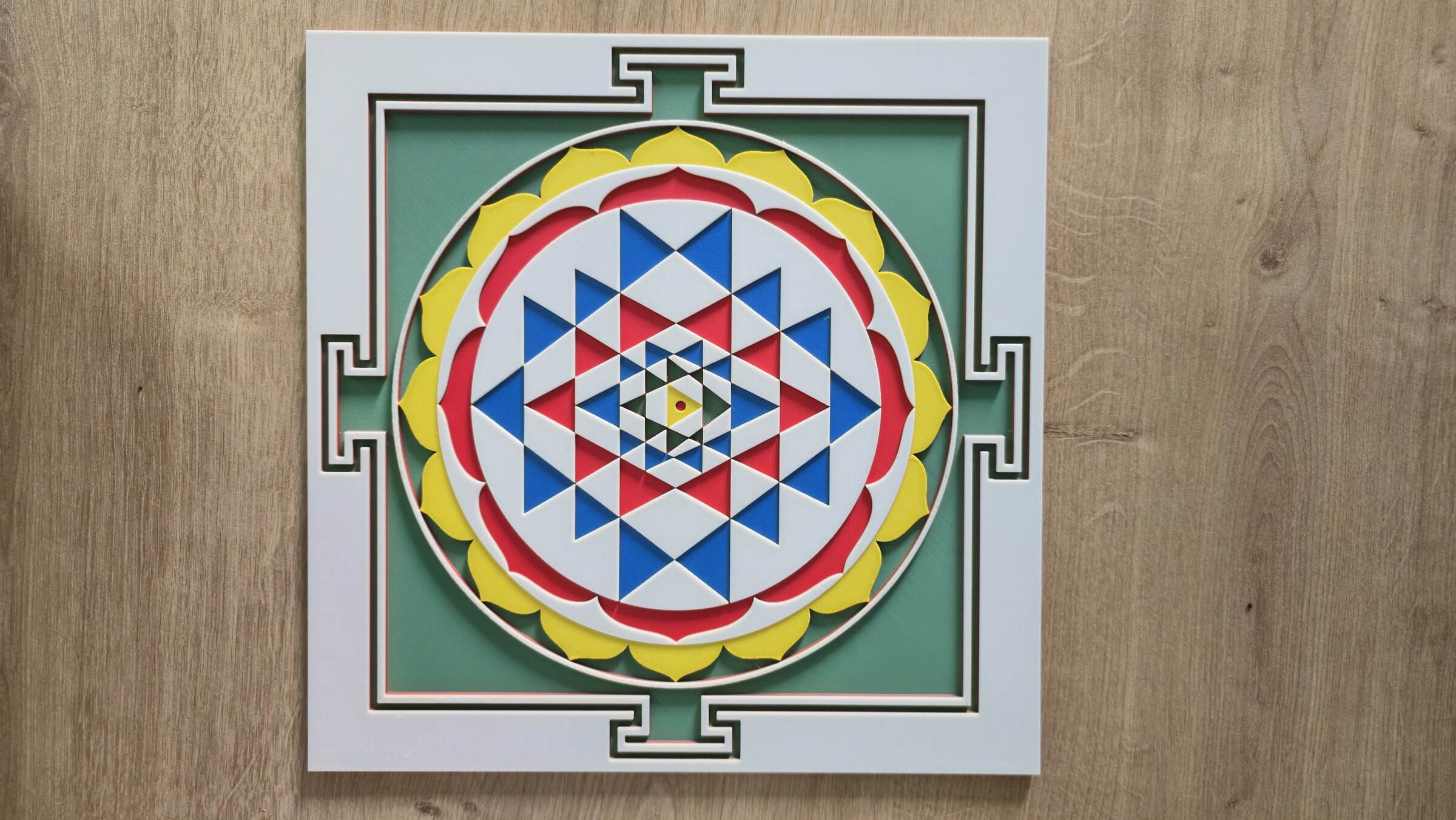
The mandala adds another dimension. It functions simultaneously as a visual meditation object and a cosmological model. The practitioner doesn’t just look at the mandala; they mentally enter it, navigating its concentric circles and gates from the periphery of ordinary experience toward the center of enlightened awareness.
Dzogchen sky gazing: meditating on emptiness itself
If trataka sharpens focus to a point, Dzogchen sky gazing dissolves it entirely.
The practice is straightforward: gaze at the open sky. No object, no focal point, no effort to concentrate. The sky is chosen precisely because it has no edges, no color boundaries, no thing to grasp. It is the visual equivalent of non-attachment.
This makes sky gazing the structural opposite of trataka. Where trataka fixes attention, sky gazing releases it. Where kasina builds a mental image, sky gazing lets all images dissolve. The goal is to recognize rigpa, the natural state of mind, by giving it nothing to cling to. 
Sky gazing predates Buddhism in Tibet. The tradition originates in Bön, the pre-Buddhist spiritual tradition of the Tibetan plateau, which revered the sky as the primordial source. When Buddhism arrived and merged with Bön practices, sky gazing was absorbed into the Dzogchen lineage. Flavio Geisshuesler’s 2024 research documents these pre-Buddhist origins in detail.
The advanced Dzogchen practice of tögal takes sky gazing further, involving gazing at clear sky or sunlight to perceive thigles: luminous spheres of colored light that evolve through a four-stage progression. Tögal requires specific preparatory attainments (trekchö, or “cutting through”) before it’s taught. The thigles are considered direct manifestations of awareness itself, not optical artifacts, though the boundary between phenomenology and neurology here is a matter of interpretation.
Trataka’s third stage (shunya, gazing the void), kasina’s endpoint (formless jhanas), and Dzogchen sky gazing all converge on the same territory from different starting points. Fix your gaze until there’s nothing left to see, release your gaze so there was never anything to see, or skip the object entirely. Three paths, same destination.
Zen: wall gazing and the discipline of open eyes
Zen takes a characteristically minimalist approach. In zazen, the practitioner sits facing a blank wall with eyes half-open, gaze lowered and unfocused. No object. No visualization. No stages to progress through.
The legend of Bodhidharma, the monk credited with bringing Chan Buddhism from India to China, says he sat facing a wall at the Shaolin monastery for nine years. This is hagiographic tradition rather than documented history (Bodhidharma’s traditional epithet is “wall-gazing Brahmin,” or 壁觀婆羅門 in Chinese), but the story encodes the Zen attitude toward visual meditation: the wall has nothing to teach you. The teaching is in the sitting.
Zen keeps the eyes open for practical reasons. Closed eyes invite drowsiness and fantasy. Open eyes maintain contact with the present moment. But the gaze is deliberately unfocused, neither pursuing visual experience nor rejecting it. Where trataka actively engages the gaze and sky gazing actively releases it, Zen simply leaves the eyes alone.
The blank wall removes the variable of the meditation object entirely. There is nothing to concentrate on, and nothing to distract from awareness itself.
Icon gazing in Orthodox Christianity
The hesychast tradition of Eastern Orthodox Christianity developed a visual meditation practice that parallels trataka in structure while diverging completely in theology.
The method, described in the Philokalia (the standard anthology of hesychast texts), combines visual focus on an icon with breath control and the continuous repetition of the Jesus Prayer: “Lord Jesus Christ, Son of God, have mercy on me, a sinner.” Nicodemos of the Holy Mountain described the posture: placing the mind within the heart while saying the prayer with “inner words spoken in the heart.”
The icon is not a neutral attention anchor like a kasina disk. Orthodox theology holds that icons participate in the divine reality they depict. As scholars Olga Luchakova and Kenneth Johnson wrote in Quest magazine (2000), “A famous icon is like a painted sutra, a terse capsule containing nonverbal information about the stages leading to the attainment of theosis.” The gaze instruction for icon contemplation resembles trataka’s intermediate stage: “Let your eye muscles relax, so that your gaze is slightly out of focus. Let the icon itself guide you.”
The structural parallel with trataka runs deep. Hesychasm combines visual focus with breath control and mantra (the Jesus Prayer), making it formally identical to trataka combined with pranayama and japa. Both traditions describe a progression from external practice to internal absorption. And both report luminous phenomena during deep practice.
Gregory Palamas (1296-1359), the primary theological defender of hesychasm, argued that the light perceived by advanced practitioners was the uncreated Tabor Light, the same divine radiance witnessed by the Apostles at Christ’s Transfiguration. As Mitchell Liester wrote in Quest (2000): “Divine Light is an inner light described as ‘spiritual’ or ‘divine’… This divine light can be seen with the eyes of the body, the eye of the soul (the nous), or both… they describe a direct experience of a suprasensible light which provides knowledge that transcends time, space, and reason.”
Compare this with the patibhaga-nimitta of kasina practice: a luminous mental image, brighter and more perfect than the physical object, arising at the threshold of deep absorption. The phenomenology overlaps. The interpretation differs entirely. For the Buddhist, it’s a mental sign of concentration. For the hesychast, it’s the uncreated light of God.
Symeon the New Theologian (949-1022 CE) recommended gazing toward the navel or heart center as a physical posture for prayer, a practice later mocked by the critic Barlaam of Calabria, who called hesychasts “navel-gazers” (omphalopsychoi). Gregory Palamas defended the practice. This is how the modern pejorative “navel-gazing” entered the language: as a dismissal of a genuine contemplative technique that parallels the yogic nasikagra drishti.
Visual contemplation in Judaism and Islam
Kabbalistic meditation and Sufi contemplation both developed visual practices that fit the same pattern, though with their own distinctive emphases.
Kabbalistic letter meditation
The Sefer Yetzirah (Book of Formation, c. 3rd-6th century CE) describes the 22 Hebrew letters as the instruments through which God created the universe. Each letter carries a visual form, a numerical value (gematria), and cosmic significance. Medieval Kabbalists, particularly Abraham Abulafia’s 13th-century school in Castile, developed practices of combining, rotating, and visualizing letters as active meditation objects.
What makes Kabbalistic letter meditation distinctive is that the visual object is simultaneously linguistic. A kasina disk is pure color. A candle flame is pure light. But a Hebrew letter carries meaning, sound, numerical association, and visual form all at once. The meditator gazes at the letter and engages multiple cognitive channels simultaneously. The later Chabad tradition’s hitbonenut practice extends this into sustained contemplation of divine names.
Aryeh Kaplan’s Meditation and Kabbalah (1982) remains the most accessible secondary source on these practices.
Sufi muraqabah
The Arabic word muraqabah comes from a root meaning “to guard and watch over.” In classical Arabic, it referred to someone watching the night sky for stars, and the visual metaphor is embedded in the practice.
Muraqabah describes a contemplative practice of maintaining mindfulness of God’s perpetual awareness. The tradition maps a progression through stages of increasing intimacy with the divine: from gnosis of self, through kashf (unveiling) and fanaa (annihilation of self), to baqaa (subsistence in God).
Sufi practice includes visualization of the sheikh’s face as a meditation support (tawajjuh, or spiritual attention through eye contact) and gazing at the heart center or nose tip. This nose-tip focus closely parallels the yogic nasikagra drishti, a similarity that could reflect historical transmission along trade routes between India and the Islamic world, or independent discovery of the same anatomical logic.
Islamic geometric art and calligraphy serve a structural function similar to Hindu yantras: mathematical precision that draws the eye inward along recursive patterns. The intricate geometric tilework of Sufi mosques is designed not just as decoration but as architecture for contemplation.
Indigenous and ancient practices
Fire gazing may be humanity’s original visual meditation, predating every organized religion.
Charles Laughlin, in his 2018 paper “Meditation across cultures: a neuroanthropological approach” (Time and Mind, Vol. 11, No. 2), situates meditation origins in the Paleolithic, linking early human altered states of consciousness to the archaeological record. His framework argues that shared human neurological structures produce convergent contemplative practices across cultures, whether or not those cultures were in contact.
The human response to fire (calming, focusing, mildly trance-inducing) is a plausible common ancestor of trataka, fire kasina, and fire-gazing practices found across many cultures. Anyone who has sat around a campfire and found their thoughts dissolving has experienced the entry point of visual meditation.
The boundary between “staring into a fire” and “visual meditation practice” is the addition of intentional technique: specific gaze instructions, defined stages, and a framework for interpreting what happens. Every tradition covered in this article crossed that boundary, building elaborate systems of practice around the same neurological foundation.
The meditation object as a mirror of worldview
Each culture’s choice of visual object reveals its theory of what meditation does and what consciousness is. 
Neutral objects (kasina disks, black dots): the object doesn’t matter, only attention does. The Theravada Buddhist position is explicit about this. A colored disk has no spiritual content. Its only function is to anchor attention until concentration deepens into jhana. This implies that meditation is a technology of attention, and any sufficiently simple object will work.
Sacred objects (icons, deities, yantras, Hebrew letters): the object transmits something beyond attention. The Orthodox icon participates in divine reality. The Vajrayana deity embodies enlightened qualities. The Hebrew letter channels creative divine energy. In these traditions, what you look at changes what happens to you, not just how focused you become. The gaze is a form of relationship.
No object (sky, blank wall, void): the goal is to transcend the distinction between observer and observed. Dzogchen, Zen, and the third stage of trataka all arrive here. If the object were the point, then no-object would be worse than some-object. These traditions say the opposite: objectless awareness is where the practice was heading all along.
This spectrum (neutral, sacred, no object) maps to three theories of consciousness. Attention-training models say the mind is a muscle and meditation strengthens it. Devotional models say the mind is a receiver and meditation tunes it. Non-dual models say the mind is already what it’s looking for, and meditation clears the confusion.
Practical guide: choosing your visual meditation object
If you’ve tried eyes-closed meditation and found your mind racing, visual meditation gives you something concrete to work with. Here’s how to choose an object and begin.
Start with what naturally holds your attention. A candle flame, a simple colored dot, a meaningful image. The kasina tradition’s insight applies here: the color kasinas are the easiest for most people (Ingram, MCTB2). A 1-5 cm colored disk on a dark background is a good starting point.
Match the object to your goal:
- For concentration training: a black dot on white paper, or a small colored disk. Neutral objects keep the practice simple and avoid conceptual overlay.
- For relaxation with depth: a candle flame. Fire has natural magnetism and produces a strong afterimage, making the transition to internal gazing (antaranga trataka) easier.
- For spaciousness: the open sky (Dzogchen approach). This works well if you find focused gazing stressful.
- For devotional practice: an icon, deity image, or sacred symbol appropriate to your tradition. The object carries meaning that deepens with familiarity.
The basic technique (shared across all traditions):
- Sit comfortably. Place your object at eye level, about arm’s length away.
- Gaze steadily without straining. Blink naturally (forcing yourself not to blink isn’t necessary and can cause eye strain).
- When your eyes water or fatigue, close them gently and observe the afterimage.
- When the afterimage fades, either open your eyes and repeat, or sit in the darkness that remains.
- Start with 5-10 minutes. Duration matters less than regularity.
Safety notes: Avoid gazing directly at the sun (despite some advanced practices that include this, it risks retinal damage). If you have epilepsy, migraines triggered by visual stimuli, or glaucoma, consult a doctor before beginning any gazing practice. Candle gazing can cause temporary eye fatigue; the black dot is the gentlest option for extended sessions.
When strange things happen: Colors, geometric patterns, or unexplained light during or after gazing are normal. The kasina tradition’s nimitta stages (preliminary image, learning sign, counterpart sign) provide the most precise map of these experiences. What feels alarming in isolation becomes expected when you know the territory.
The specific object matters less than regular practice. All visual meditation works through the same mechanism: stabilizing the eyes, simplifying the visual field, and allowing attention to settle. The traditions behind each object provide structure for deeper work (kasina stages map your progress, trataka stages provide a curriculum, deity yoga adds devotional dimension), but even a simple daily practice of gazing at a dot on the wall for ten minutes changes the relationship between your eyes and your mind.
Sources
- Svātmārāma. (15th c. CE). Haṭha Yoga Pradīpikā, ch. 2, śloka 31-32. Translation: Brian Dana Akers (2002).
- Gheranda. (17th c. CE). Gheranda Saṃhitā, ch. 1.
- Buddhaghosa. (5th c. CE). Visuddhimagga (Path of Purification). Translated by Bhikkhu Ñāṇamoli (1956).
- Ingram, Daniel. Mastering the Core Teachings of the Buddha (MCTB2), ch. 29: “Kasina Practice.” https://www.mctb.org/mctb2/table-of-contents/part-iii-the-samatha-jhanas/29-kasina-practice/
- Laughlin, Charles D. (2018). “Meditation across cultures: a neuroanthropological approach.” Time and Mind: The Journal of Archaeology, Consciousness and Culture, 11(2), 153-182. DOI: 10.1080/1751696X.2018.1503381
- Kozhevnikov, M., Louchakova, O., Josipovic, Z., & Motes, M. A. (2009). “The Enhancement of Visuospatial Processing Efficiency Through Buddhist Deity Meditation.” Psychological Science, 20(5). PMID: 19476594. DOI: 10.1111/j.1467-9280.2009.02345.x
- Liester, Mitchell B. (2000). “Hesychasm: A Christian Path of Transcendence.” Quest, 89(2), 54-59, 65.
- Luchakova, Olga & Johnson, Kenneth. (2000). “Icons: Windows to the Divine.” Quest, 89(2), 44-49.
- Geisshuesler, Flavio. (2024). [Research on pre-Buddhist Bön origins of sky gazing in Tibet].
- Palamas, Gregory. (14th c. CE). Triads (in defense of hesychasm).
- Palmer, G. E. H., Sherrard, P., & Ware, K. (trans.). The Philokalia. Faber and Faber.
- Kaplan, Aryeh. (1982). Meditation and Kabbalah. Samuel Weiser.
- Martinez-Conde, S., Macknik, S. L., & Hubel, D. H. (2004). “The role of fixational eye movements in visual perception.” Nature Reviews Neuroscience, 5, 229-240.
- Troxler, I. P. V. (1804). “Über das Verschwinden gegebener Gegenstände innerhalb unseres Gesichtskreises.” Ophthalmologische Bibliothek, 2(2), 1-53.
- Gore, Makarand Madhukar. (2008). Anatomy and Physiology of Yogic Practices. Motilal Banarsidass, pp. 160-162.