What Did Ancient Meditators Use as Tools?
Miha Cacic · April 11, 2026 · 6 min read
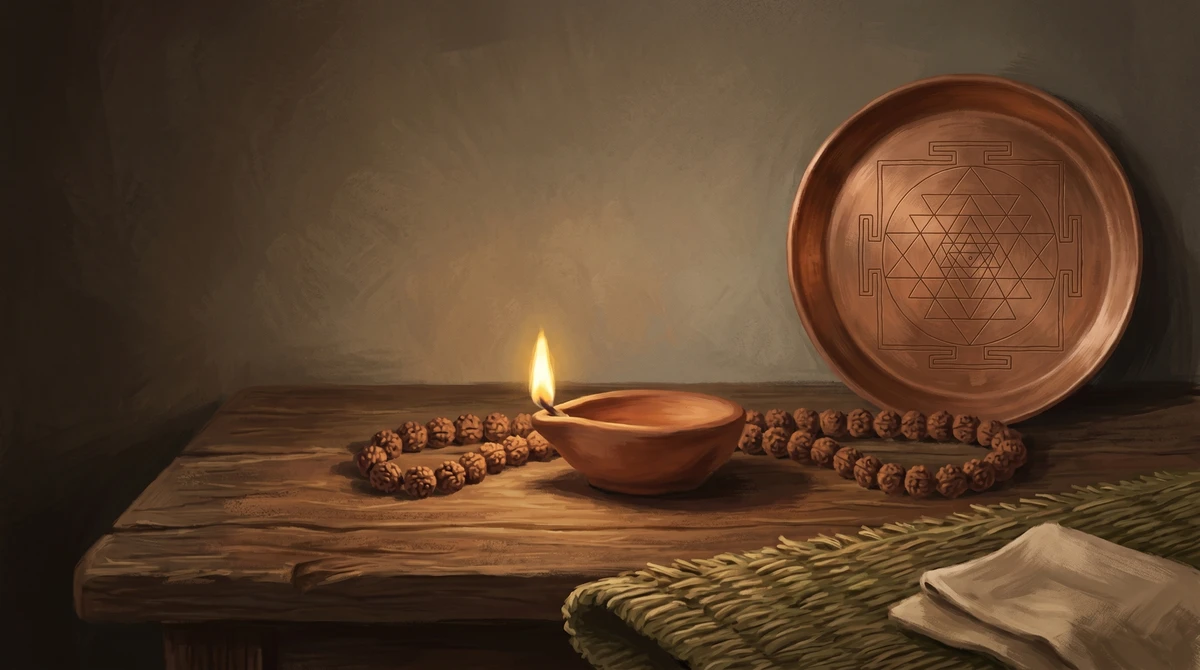
Ancient meditators used their own bodies: breath, voice, hands, and eyes. Beyond that, they used a small number of physical objects: oil lamps, geometric diagrams, strings of seeds, and whatever they could sit on. No singing bowls. No apps. No special cushions. The most powerful meditation tools ever designed are thousands of years old, cost almost nothing, and most people have never heard of them.
The body as the first meditation tool
Breath is the oldest and most universal anchor for attention. Vedic yogis developed structured breathing patterns (pranayama) codified in the Yoga Sutras of Patanjali around 400 BCE. The Buddhist Anapanasati Sutta (Majjhima Nikaya 118) lays out sixteen steps of breath-based attention training. Daoist meditation centers on abdominal breathing and qi cultivation. Traditions separated by thousands of miles arrived at the same insight: steadying the breath steadies the mind.
Voice works through a different sensory channel. Vedic mantras, transmitted orally from around 1500 BCE, gave practitioners a rhythmic sound to anchor attention. Buddhist chanting does the same. So does Sufi dhikr, the rhythmic repetition of God’s names, practiced since the 8th or 9th century CE. The Christian Jesus Prayer (“Lord Jesus Christ, Son of God, have mercy on me”) uses identical mechanics. Rhythm and repetition narrow the mind’s focus to a single stream, regardless of which tradition supplies the words.
Hands served as tactile anchors. The Buddhist dhyana mudra (hands resting in the lap, thumbs touching) and the Hindu chin mudra (thumb and index finger joined) appear in early Buddhist sculpture from the Amaravati stupa reliefs, dating to around the 2nd century BCE to 3rd century CE. Beyond whatever symbolic meaning a tradition ascribes to them, mudras give the body a subtle task that keeps awareness grounded in the physical, preventing the meditator from drifting entirely into thought. 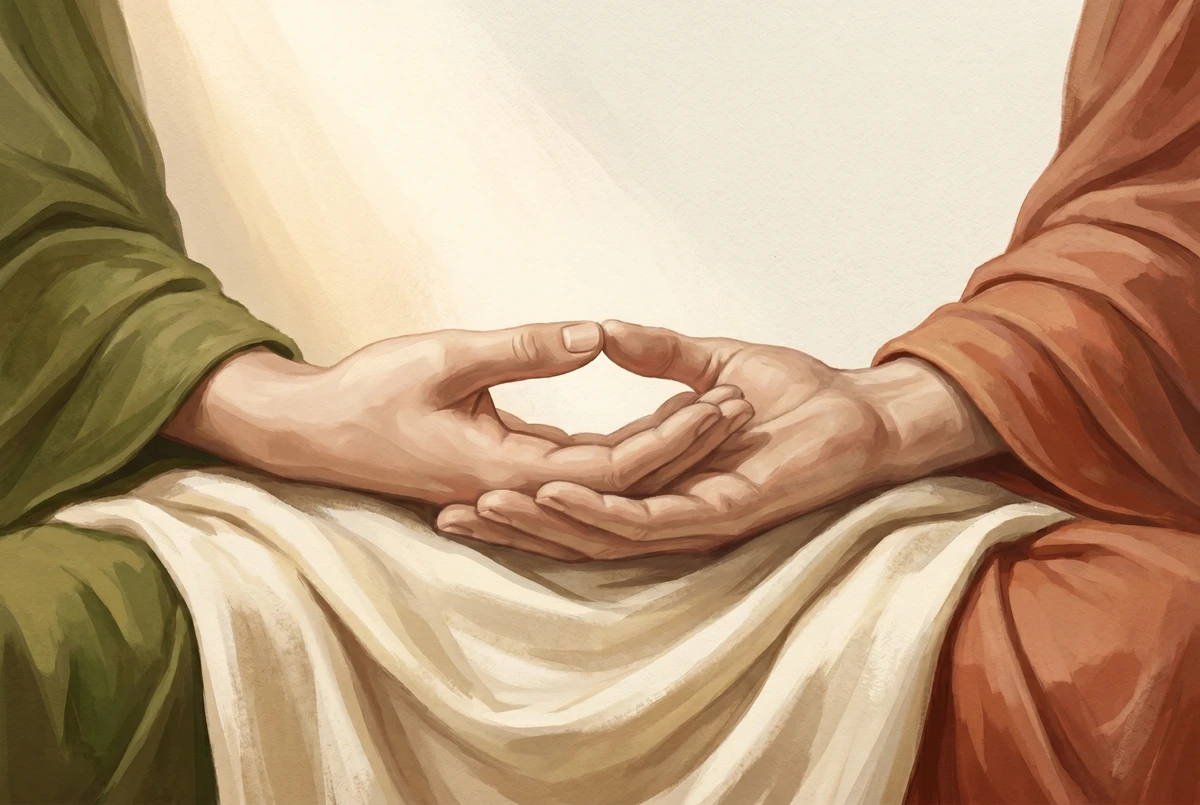
Eyes are perhaps the most underappreciated. Yogic drishti, controlled gaze direction toward specific points (the nose tip, the space between the eyebrows, the navel), is described in the Bhagavad Gita. Trataka, sustained open-eye gazing, is listed as one of the six shatkarmas (purification practices) in the Hatha Yoga Pradipika (~15th century CE). Fixing the gaze on a single point anchors attention through a channel most people never think to use, which is why ancient traditions built entire meditation systems around visual objects.
Modern meditation has largely narrowed to just one of these four: the breath. Ancient meditators used all four, often in combination.
Flames and lamps: the original gazing objects
Fire may be humanity’s first meditation object. In a 2007 paper in the Cambridge Archaeological Journal, evolutionary anthropologist Matt Rossano proposed that campfire gazing created selection pressure for enhanced working memory in early humans. The hypothesis is speculative and contested, but the observation behind it is sound: staring into fire narrows attention to a single point, and humans have been doing it for as long as we’ve controlled fire.
What’s documented with certainty is that oil lamps (diyas) became the standard trataka object in Hindu practice. They were cheap, available in every home, and produced a steady point of light. The Hatha Yoga Pradipika describes the technique precisely: “Looking intently with an unwavering gaze at a small point until tears are shed is known as trataka” (Chapter 2, Verse 31). The next verse claims the practice “eradicates all eye diseases, fatigue, and lethargy.” 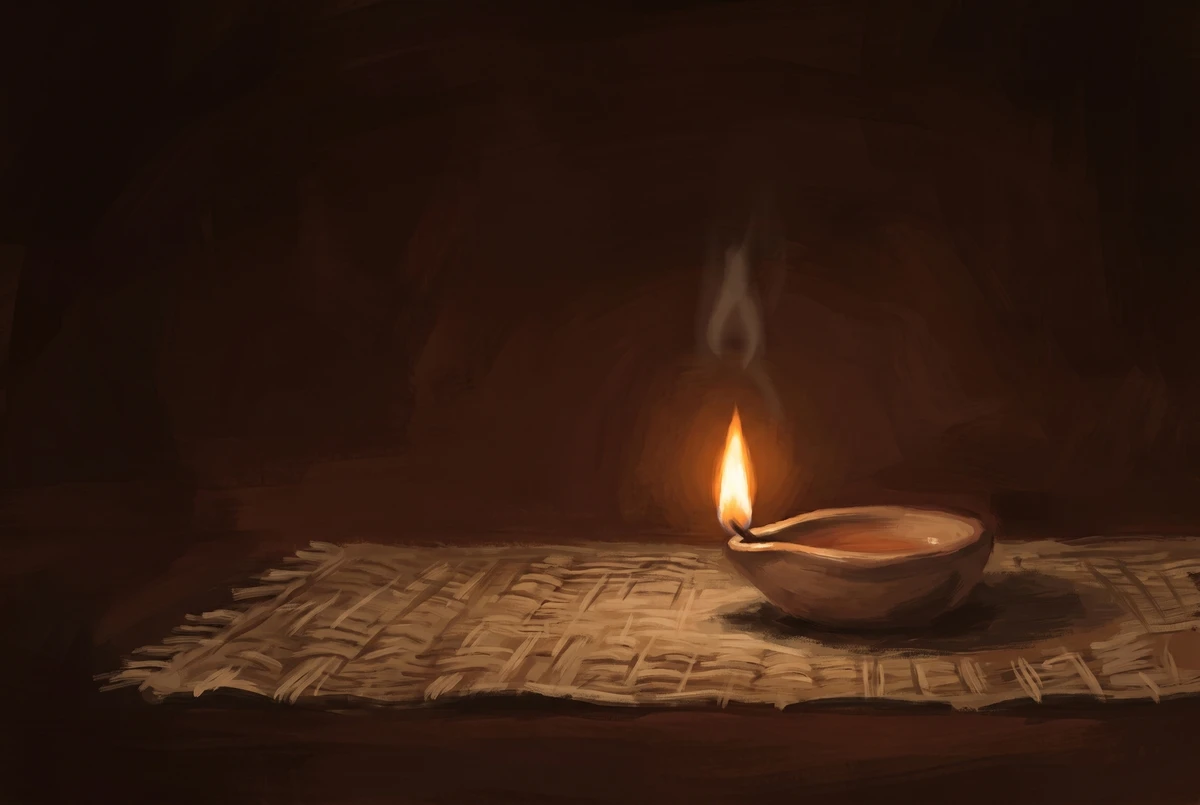
The practice has two phases. Bahiranga trataka is external gazing: you stare at the flame without blinking until tears form. Antaranga trataka follows: you close your eyes and hold the after-image in your mind’s eye, meditating on the internal image until it fades. This progression from external object to internal visualization repeats across ancient visual meditation tools.
Two small modern studies suggest the practice produces measurable cognitive effects. Raghavendra and Singh (2015) tested 30 young men on the Stroop color-word test before and after a single trataka session and found significant improvements in selective attention, cognitive flexibility, and response inhibition (p<0.001). Swathi, Bhat, and Saoji (2021) found that two weeks of daily trataka (20 minutes per session) improved working memory and spatial attention in 41 volunteers. Neither study is large enough to be conclusive on its own, but both point in the same direction: the practice trains concentration through the visual channel.
Why fire? A flickering flame holds attention without being monotonous, and a single point of light trains what yogic texts call ekagrata: one-pointed focus.
Prayer beads: the meditator’s counting device
Mala beads are a physical technology, not jewelry. They solve a specific problem: counting mantra repetitions without the counting itself becoming a distraction.
The exact origin is unknown. According to John Kieschnick’s The Impact of Buddhism on Chinese Material Culture (2003), no references to malas appear in the oldest Buddhist literature (the Agamas and Pali Nikayas), and the practice could have originated with Buddhists, Brahmins, Jains, or another community. The earliest surviving literary reference is the Mu Huanzi Jing (木槵子經), a Mahayana Buddhist text attributed to the Eastern Jin era (4th to 5th century CE). In it, a king asks the Buddha for a simple daily practice. The Buddha tells him to string 108 seeds from a soapberry tree and pass them through his fingers while reciting homage to the three jewels. The earliest artistic depiction, a Northern Wei dynasty bodhisattva (4th to 6th century CE), shows a mala held in the hand for recitation rather than worn as an accessory. 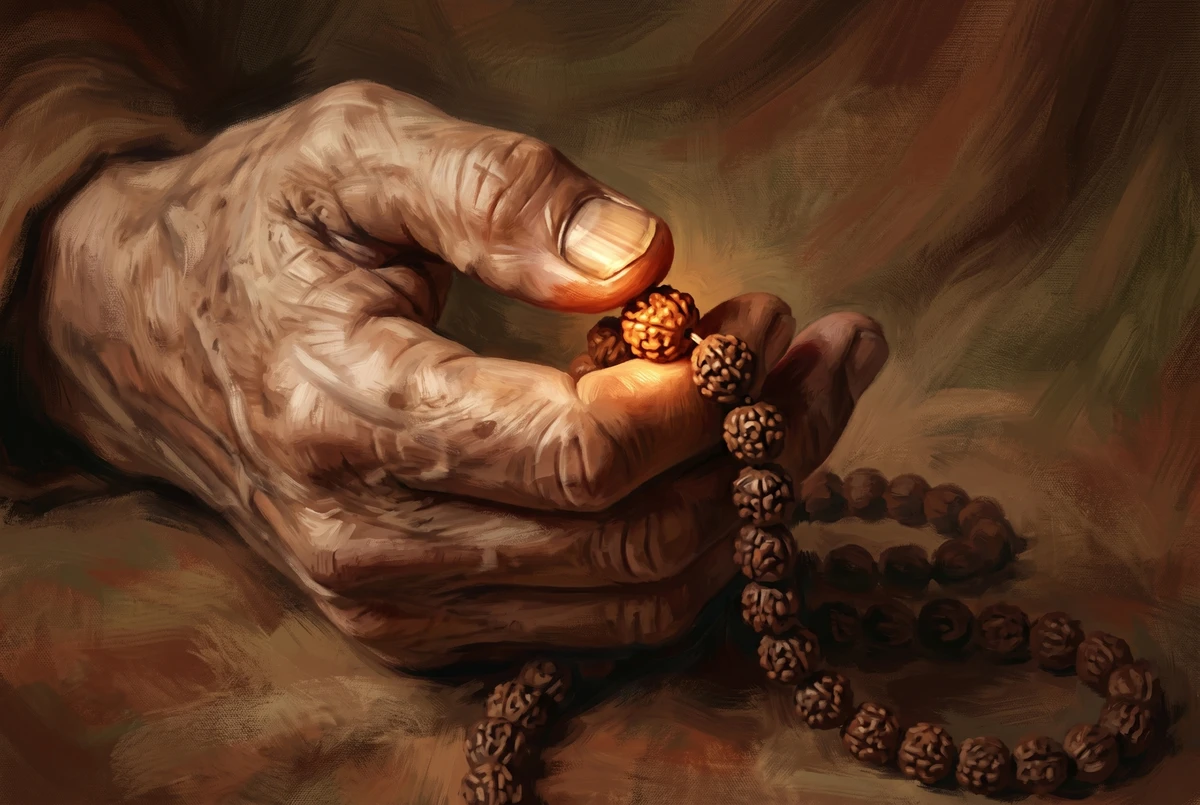
The standard mala has 108 beads. The Mu Huanzi Jing itself provides the most textually grounded explanation: completing a million recitations would “end the one hundred and eight passions” (kleshas). Many other explanations circulate (108 Upanishads, 12 zodiac houses multiplied by 9 planets), but these lack the same primary-source support.
Materials varied by tradition. Rudraksha seeds for Shaivite Hindus. Tulasi wood for Vaishnavites. Bodhi seeds for Buddhists. Bone for Tibetan practitioners. But the mechanism was always the same: each bead marks one repetition. The fingers track progress. The analytical mind has a job (counting), which frees the contemplative mind to dissolve into the sound of the mantra.
Prayer beads appear across traditions spanning continents and centuries. Muslims developed the misbaha (99 beads for the 99 names of Allah). Christians developed the rosary. Eastern Orthodox monks use the komboskini, a knotted prayer rope. Some of these traditions influenced one another, but the underlying pattern kept recurring: the fingers need something to do during repetitive practice. Giving them a repetitive task lets the rest of the mind settle.
Yantras and mandalas: geometry as meditation technology
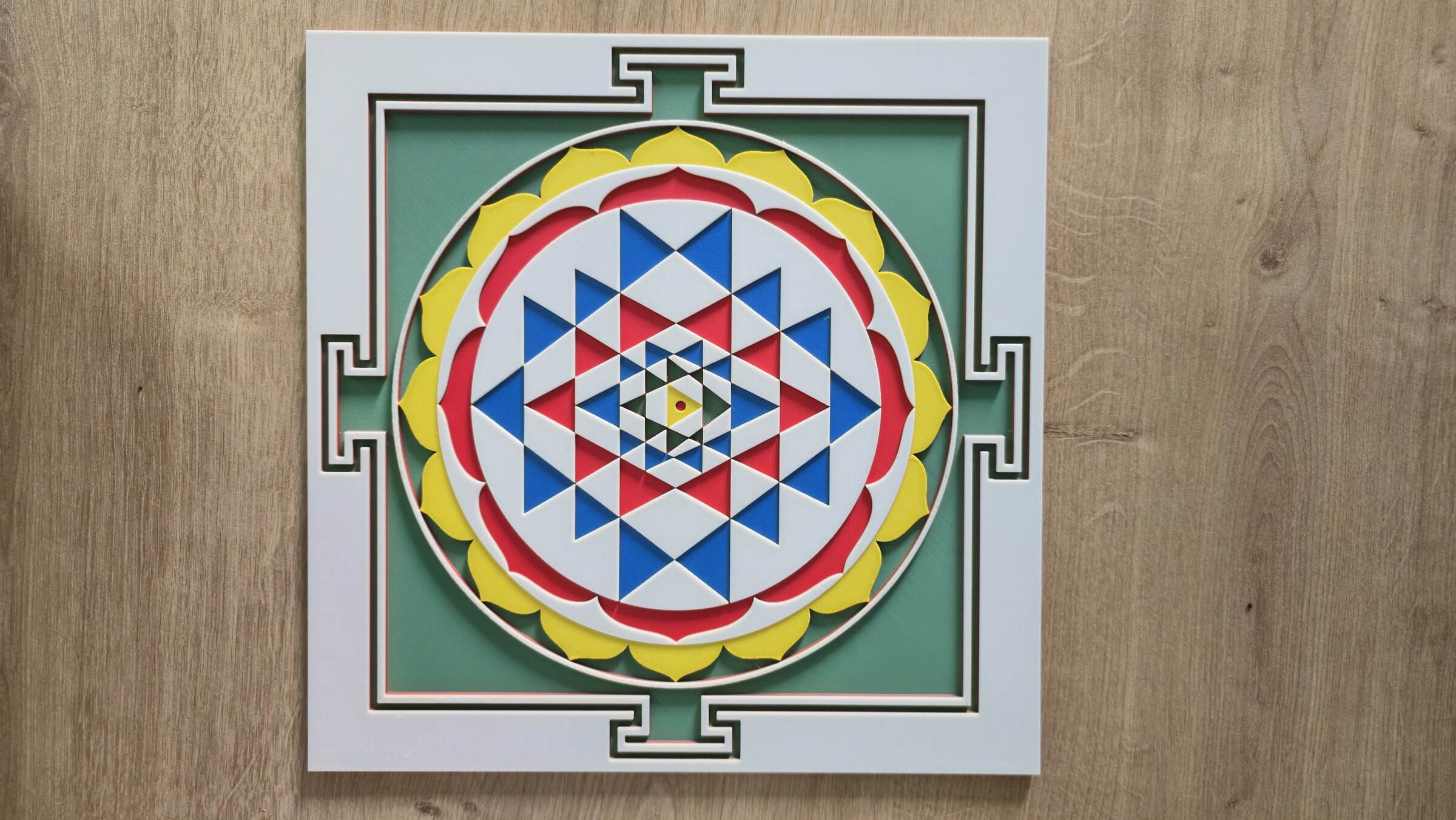
A yantra is a geometric diagram designed to direct visual attention inward. The word comes from the Sanskrit root yam (to restrain, to direct) plus the suffix -tra (instrument). Literally: an instrument for directing the mind.
Yantras come from the Hindu tantric tradition. They’re built in concentric layers: an outer square (bhupura), lotus petals, circles, interlocking triangles, and a central point (bindu). Each layer represents a progressive stage of deepening focus. The meditator gazes at the center using trataka technique, and the geometry draws the eyes inward through the layers.
The Sri Yantra is the most complex example: nine interlocking triangles forming 43 sub-triangles, representing the totality of creation in the Tantric cosmological view. But simpler yantras work on the same principle. The geometry is the meditation instruction. You don’t need a teacher to explain what to do, because the design shows your eyes where to go.
Buddhist mandalas serve a similar purpose but tend to be more figurative and pictorial. In Tibetan Vajrayana tradition, mandalas function as cosmic maps for visualization practice. Sand mandalas, painstakingly created and then swept away, add a meditation on impermanence to the visual practice.
The Theravada Buddhist tradition developed a parallel technique. The kasina system, described in Buddhaghosa’s Visuddhimagga (~5th century CE), uses ten colored discs (earth, water, fire, air, blue, yellow, red, white, light, and space) for concentrated gazing. The earth kasina, for example, is a red-brown disc of clay spread on a piece of canvas. The meditator gazes at the disc until a stable mental image (nimitta) forms, then closes the eyes and meditates on the internal image. The technique is nearly identical to yantra trataka, and the two traditions likely developed independently. 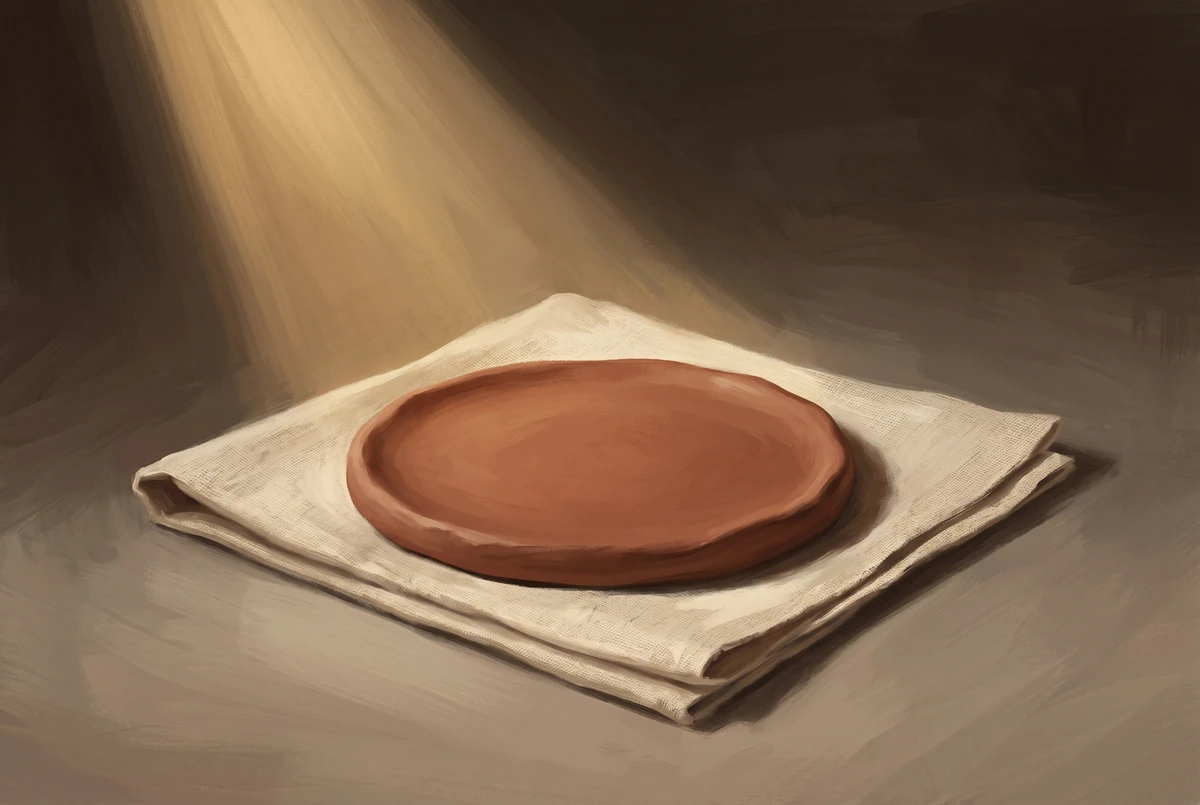
Sitting supports and sacred spaces
The ancient meditation seat was simpler than modern marketing suggests.
The Bhagavad Gita, Chapter 6, Verse 11, prescribes the traditional Hindu meditation seat: kusha grass on the bottom, a deerskin on top of that, and a cloth on top of the deerskin. In a clean place, neither too high nor too low. The kusha grass was believed to insulate the meditator from the ground and repel insects. Functionally, it kept the seat warm and dry. Not a zafu cushion. Grass, skin, cloth. 
The Japanese zafu and zabuton (round cushion and rectangular mat) developed later, after Zen Buddhism established itself in Japan from the 12th century onward. The round zafu elevates the hips for cross-legged sitting. Before this, meditators sat on whatever was available: animal skins, folded cloth, bare ground.
The physical space itself functioned as a tool. Indian yogis used caves. Desert Fathers used small cells. Zen Buddhists built zendos, dedicated meditation halls. The controlled environment (dim lighting, minimal stimulation, consistent temperature) reduces sensory distraction, even if nobody at the time would have called it technology.
Incense served double duty across Hindu, Buddhist, and Christian traditions. Burning aromatic resin or wood marked the beginning and end of a meditation session, and the consistent scent became a cue for the shift into practice. Incense appears in the Vedas as part of puja ritual, making it one of the oldest documented meditation-adjacent tools.
Sound tools: bells, bowls, and what’s actually ancient
This is where the historical record and popular belief diverge the most.
What’s genuinely ancient: bells (ghanta) struck to mark transitions in Hindu and Buddhist ritual. Conch shells (shankha) blown at the start of ceremonies. Drums accompanying rhythmic chanting. And above all, the human voice. Mantras, chanting, and dhikr are the primary “sound tools” of ancient meditation. The instruments were ritual markers (a bell to begin, a bell to end) rather than the meditation itself.
What’s not ancient in the way people think: “Tibetan singing bowls.” The scholarly evidence is clear. As the Wikipedia article on standing bells notes, citing Jansen (1992): “Buddhist ritual makes no use of the ‘singing’ mode of bell operation.” Bowls capable of producing sustained tones through rim-rubbing began appearing in the West around 1972, when Henry Wolff and Nancy Hennings released their album Tibetan Bells. Samuel Grimes, writing in the Buddhist magazine Tricycle in 2020, found that the claim of ancient Tibetan origin doesn’t hold up. He quotes a Geluk monk and geshe: “When I was in Tibet, I never saw those bowls that you hit and spin around the rim.”
Traditional Buddhist monasteries do use standing bells. They strike them. The sustained “singing” produced by rubbing the rim is a Western addition from the last fifty years, not a centuries-old monastic tradition.
This doesn’t mean modern sound baths have no value. But when someone asks what ancient meditators used as sound tools, the honest answer is: mostly their own voice.
What this tells us about meditation itself
Every tool described here solves the same problem: the human mind wanders.
Breath gives the mind a rhythm. Mantras give it a sound. Beads give the fingers a task. Flames and yantras give the eyes a target. The sophistication is not in the tool. It’s in the recognition that the wandering mind needs to hold onto something before it can learn to let go.
The visual tools share a consistent progression: start with an external anchor (a flame, a colored disc, a geometric diagram), then internalize it. Visualize the flame with eyes closed. Hold the kasina’s nimitta in the mind’s eye. The tool trains a capacity, then becomes unnecessary. But you needed it to get there.
You don’t need to buy anything to meditate. You already have breath, a voice, hands, and eyes. If you want a physical object, a candle and a printed yantra put you in the same tradition as practitioners who trained their attention two thousand years ago. The tools haven’t changed because the problem hasn’t changed.
Sources
- Rossano, M. J. (2007). “Did Meditating Make Us Human?” Cambridge Archaeological Journal, 17(1). doi: 10.1017/S0959774307000054.
- Raghavendra, B. R., & Singh, P. (2015). “Immediate effect of yogic visual concentration on cognitive performance.” Journal of Traditional and Complementary Medicine, 6(1), 34–36. doi: 10.1016/j.jtcme.2014.11.030. PMC: 4738033.
- Swathi, P. S., Bhat, R., & Saoji, A. A. (2021). “Effect of Trataka (Yogic Visual Concentration) on the Performance in the Corsi-Block Tapping Task: A Repeated Measures Study.” Frontiers in Psychology, 12, 773049. doi: 10.3389/fpsyg.2021.773049. PMC: 8718544.
- Talwadkar, S., Jagannathan, A., & Raghuram, N. (2014). “Effect of trataka on cognitive functions in the elderly.” International Journal of Yoga, 7(2), 96–103. doi: 10.4103/0973-6131.133872. PMC: 4097909.
- Kieschnick, J. (2003). The Impact of Buddhism on Chinese Material Culture. Princeton University Press, pp. 118–138.
- Grimes, S. M. (2020). “Tibetan Singing Bowls: Where Did They Really Come From?” Tricycle: The Buddhist Review.
- Jansen, E. R. (1992). Singing Bowls: A Practical Handbook of Instruction and Use. pp. 23–25.
- Svatmarama. (~15th century CE). Hatha Yoga Pradipika. Chapter 2, Verses 31–32.
- Buddhaghosa. (~5th century CE). Visuddhimagga (The Path of Purification).
- Bhagavad Gita. Chapter 6, Verses 11–12.
- Mu Huanzi Jing (木槵子經). Taishō Tripiṭaka, Vol. 17, No. 786. Eastern Jin era (attributed 4th–5th century CE).
- Anapanasati Sutta. Majjhima Nikaya 118, Pali Canon.
- Patanjali. (~400 BCE). Yoga Sutras.