What Is Concentration Meditation?
Miha Cacic · April 11, 2026 · 9 min read

Concentration meditation is the practice of training your mind to stay with one thing. You choose an object of focus (your breath, a candle flame, a mantra, a point in your body) and hold your attention there. When the mind wanders, you bring it back. That’s the basic mechanism, and it works: a 2022 meta-analysis of fMRI studies found that this type of practice consistently engages three major brain networks involved in attention, self-referential thinking, and cognitive control.
But most explanations stop there. They present concentration meditation as a flat exercise: focus, get distracted, refocus, repeat forever. In the traditions that developed this practice (Buddhist samatha and yogic dharana), concentration has a mapped progression. Your mind moves through recognizable stages, from fighting distraction to sustained attention to states of deep mental absorption where ordinary thinking goes quiet and a different quality of awareness takes over. Understanding this progression changes how you practice, because you stop treating distraction as failure and start recognizing where you are on the staircase.
How concentration meditation works
The mechanism has three parts. 
Choose an object. Anything that can anchor attention: breath sensations, a visual point, a repeated phrase, a sound, a body sensation. The object matters less than having a stable anchor.
Hold attention there. Not by forcing or gripping. The Pali word for this practice, samadhi, literally means “to fully place” or “to collect” (from the Sanskrit sam + ā + dhā). It describes composing scattered attention, not straining. As Spirit Rock Meditation Center puts it: “While the word ‘concentration’ may suggest forceful effort, in practice the primary qualities of samādhi are relaxation, stillness, and letting go.”
When the mind wanders, notice and return. This is the actual training. Every time you notice the mind has drifted and bring it back, you’re strengthening the neural circuits of voluntary attention. The Ganesan et al. (2022) meta-analysis describes the neurological basis: “With practice, the effort necessary for attentional engagement with the target and disengagement from distractors typically decreases, due to improved introspective meta-awareness.”
Most people think the goal is to never get distracted. The actual goal is to shorten the gap between wandering and noticing. Advanced practitioners aren’t people whose minds never wander. They’re people who catch the wandering within a breath or two.
What you can focus on
Breath is the most commonly taught concentration object. You focus on the sensation of air at the nostrils or the rise and fall of the abdomen. It’s always available and requires no equipment. For beginners, counting breaths from one to ten (then restarting) adds structure. A 2026 randomized study on competitive athletes used exactly this breath-counting method and found that even a single 10-minute session significantly reduced state anxiety compared to a random-thinking control.
Candle flame (trataka). A yogic technique where you gaze steadily at a flame, then close your eyes and hold the afterimage. Trataka is one of the six shatkarmas (purification practices) in hatha yoga, making it the only yogic cleansing technique that doubles as a concentration practice. Practitioners and teachers report that stilling the eyes quiets the mind, a connection that may relate to the visual system’s unique continuity with the central nervous system (the retina develops from the same neural tissue that forms the brain). For people who find breath meditation too subtle or slippery, visual concentration offers something more tangible to anchor on.
Mantra. Repeating a word or phrase, silently or aloud. Common across traditions: Om Mani Padme Hum in Tibetan Buddhism, So Hum in Hinduism, the Jesus Prayer in contemplative Christianity. Practitioners describe the repetition as occupying the verbal mind, leaving less room for the usual internal narration.
Kasina. An ancient Buddhist technique using colored discs or simple visual objects as concentration anchors. The Visuddhimagga (the fifth-century Theravada meditation manual) describes ten kasina objects. The meditator gazes at the disc until a stable mental image (patibhaga-nimitta) appears with eyes closed, which then becomes the concentration object. Kasina and trataka operate on the same principle: using a visual anchor to collect attention.
Body sensations. Focusing on sensations in the hands, feet, or a specific point in the body. Walking meditation is a concentration practice built on this principle: attention rests on the sensations of each step.
Sound. Any sustained sound can serve as an anchor: a singing bowl, ambient hum, or the subtle high-pitched tone you hear in silence (what the Thai forest teacher Ajahn Sumedho calls “the sound of silence”).
Loving-kindness phrases. The metta practice uses phrases (“May I be happy, may I be at peace”) as concentration objects. It develops concentration and goodwill simultaneously. 
The right object is the one you can actually stay with. If breath doesn’t work after several weeks of honest practice, switch. The concentration skill transfers regardless of the object.
Concentration meditation vs. mindfulness meditation
These two terms cause genuine confusion.
Concentration meditation (samatha): Narrow focus on one object. You deliberately exclude everything else. Like a spotlight aimed at a single point.
Mindfulness meditation (vipassana): Open awareness. You observe whatever arises (thoughts, sensations, emotions) without clinging to or pushing away any of it.
These are complementary skills, not competing practices. Concentration provides the power to hold attention steady. Mindfulness provides the awareness to know where attention is and what’s happening.
Bhante Gunaratana, the Sri Lankan monk whose Mindfulness in Plain English is one of the most widely read meditation books in English, puts it clearly: “Mindfulness picks the object of attention, and notices when the attention has gone astray. Concentration does the actual work of holding the attention steady.” 
In practice, this partnership is constant. During a concentration session, you still need mindfulness to notice when the mind has wandered. During a mindfulness session, you need concentration to sustain observation without getting swept into every passing thought.
The Pali Canon reflects this. In the Anguttara Nikaya (AN 4.170), the Buddha describes samatha and vipassana as two qualities that can develop in either order or in tandem, but must ultimately work together. As Thanissaro Bhikkhu summarizes: “Vipassana is not a meditation technique. It’s a quality of mind. Vipassana needs to be teamed with samatha, the ability to settle the mind comfortably in the present, so as to master the attainment of strong states of absorption.”
A 2025 study with 27 meditation novices (a non-randomized trial with 9 participants per group) found that those who practiced four weeks of concentration before four weeks of mindfulness developed awareness, acceptance, and observing skills earlier than the reverse-order group, though both groups reached similar skill levels by the end of the study. The researchers concluded: “It is reasonable to practice FA meditation prior to OM meditation to cultivate mindfulness skills for novices.” This is preliminary empirical support for what Buddhist teachers have taught for centuries: concentration is the foundation on which mindfulness is built.
What the research says about concentration meditation
In 2008, Lutz, Slagter, Dunne, and Davidson at the University of Wisconsin published the paper that gave meditation science its working vocabulary. They classified meditation into two types: focused attention (FA), where you sustain attention on a target object, and open monitoring (OM), where you observe whatever arises without selective focus. Concentration meditation maps directly to the FA category.
Brain networks. The Ganesan et al. (2022) meta-analysis pooled 28 fMRI studies (10 eligible for formal meta-analysis, covering 200 participants) and found that focused attention meditation consistently engages three large-scale brain networks: the default mode network (involved in mind-wandering and self-referential thought), the salience network (which detects what’s relevant), and the executive control network (which manages deliberate attention). Specific regions included the anterior cingulate cortex, posterior cingulate cortex, and dorsolateral prefrontal cortex. Both novices and experienced meditators activated the same regions; experienced meditators showed more efficient activation.
Brain architecture. In a single-case longitudinal study, Kajimura et al. (2020) tracked one participant over 65 days of intensive fMRI scanning and found that focused attention meditation changed the boundaries and configuration of functional brain networks. Default mode network activity (associated with mind-wandering) was suppressed, while frontoparietal network activity (associated with cognitive control) was enhanced. A single case cannot establish that this happens for everyone, but it demonstrates that the changes concentration meditation produces can extend beyond activation patterns to the architecture of brain networks themselves.
Sustained attention. Pagnoni (2012) compared experienced Zen meditators to non-meditators and found that the meditators showed significantly lower incidence of elevated activity in the ventral posteromedial cortex (a region associated with mind-wandering). This correlated with better performance on a sustained attention test conducted outside the scanner.
Anxiety. Tomita et al. (2026) ran a randomized crossover study with 26 competitive speed skaters who had no prior meditation experience. A single 10-minute session of breath-counting concentration meditation significantly reduced state anxiety compared to a random-thinking control. The researchers attributed this to the active cognitive engagement of concentration: participants had to detect counting errors and reset their attention, training attentional control and error monitoring simultaneously.
Concentration supports mindfulness. The Ishikawa et al. (2025) study described in the previous section found that concentration-first sequencing helped novices develop mindfulness skills earlier. The meta-analysis by Ganesan et al. supports this at the neural level, noting that focused attention meditation “effectively trains the attentional skills required by other types of meditation.”
A caveat: meditation science is still young. Many studies have small sample sizes, and the neuroimaging work relies on a limited pool of experienced meditators. The findings are consistent and suggestive, not definitive. What the research does confirm is that concentration meditation produces measurable changes in brain function and attention, not just subjective feelings of calm.
The stages of deepening concentration
This is the part that most popular accounts leave out. There’s a historical reason: in the 19th century, Burmese Buddhist reformers developed “dry vipassana” (insight meditation without deep concentration) as a practice accessible to lay people. This is the lineage that reached the West and shaped the mindfulness movement, which is why the concentration stages described below are poorly understood in Western meditation culture even though they are central to the traditional samatha practice.
Stage 1: Fighting distraction. Where everyone starts. You place attention on the object and the mind wanders within seconds. You bring it back. It wanders again. This feels frustrating, but it’s productive: every return is a repetition of voluntary attention. Most beginners mistakenly think this IS concentration meditation. It’s actually the beginning.
Stage 2: Sustained attention with interruptions. After days or weeks of regular practice, you begin holding attention on the object for longer stretches (30 seconds, a minute, several minutes) before the mind wanders. The interruptions still come, but they’re shorter and less frequent. You catch them faster.
Stage 3: Access concentration (upacāra samādhi). A recognizable threshold. The mind settles onto the object with relative ease. Distractions arise but don’t pull you away; you notice them in the periphery without losing your anchor. The body often relaxes noticeably. A sense of lightness or quiet pleasure may arise. In Buddhist terminology, the five hindrances (sensual desire, ill-will, restlessness, sloth, and doubt) are temporarily suppressed. The Spirit Rock meditation guide describes this as the stage where “mindfulness is strong” and the mind “neighborhoods” the deeper states of absorption. 
Many meditators plateau here, either because they don’t know there’s more or because they mistake access concentration for the final goal.
Stage 4: Absorption (jhāna). The mind becomes fully absorbed in the object. Thinking doesn’t just quiet down; it genuinely stops. Attention unifies. The Buddhist tradition describes four progressive levels of absorption (the rūpa jhānas), each characterized by the presence or absence of specific mental factors:
- First jhana: Directed attention (vitakka) and sustained attention (vicāra) are active. Rapture (pīti) and happiness (sukha) arise from the seclusion from ordinary mental activity. You’re still placing and holding attention, but the quality of attention has shifted.
- Second jhana: Directed and sustained attention subside. The focusing becomes effortless. As Spirit Rock’s guide describes it: “Intentional effort to maintain focus now ceases.”
- Third jhana: Even the energetic rapture (pīti) fades, leaving only the deeper contentment of sukha, along with equanimity and mindfulness.
- Fourth jhana: Pure equanimity and what the texts call “purified mindfulness.” Neither pleasure nor pain. The mind is still, clear, and perfectly balanced.
The yogic tradition maps a parallel progression. Patanjali’s Yoga Sutras describe three stages: dharana (concentration, fixing the mind on one point), dhyana (meditation, the unbroken flow of attention toward that point), and samadhi (absorption, where the meditator dissolves into the object of meditation and only consciousness of the object remains).
You don’t force your way into these states. They arise naturally when concentration is sustained and balanced. The effort/ease ratio reverses as you deepen: early stages require deliberate effort, later stages require letting go of effort.
The science of jhana is still emerging. Hagerty et al. (2013) published the first neural recording during jhana states, a case study of one experienced meditator. During reported states of joy, they observed activation of the nucleus accumbens in the brain’s dopamine/opioid reward system, suggesting the meditator was accessing an endogenous reward circuit through internal mental processes alone. A 2024 review from Massachusetts General Hospital and Harvard Medical School described jhana states as involving “heightened attention, clarity, high energy, effortlessness, and bliss.” And a systematic classification by Sparby and Sacchet (2024) reviewed eight contemporary jhana manuals and found both common ground and genuine disagreement among teachers about what exactly constitutes jhana, particularly regarding whether any thought can be present during absorption. This reflects a longstanding distinction between the approach of the early suttas (which describe jhana in somewhat lighter terms) and the later Visuddhimagga (which describes deeper, more complete absorption).
The jhanas aren’t the goal of the practice the way finishing a race is the goal of running. They’re natural waypoints that indicate the mind is settling deeply. In the insight traditions, the clarity that emerges from deep concentration is then used to investigate the nature of mind and experience. The concentration creates the conditions; what you do with those conditions depends on your tradition and intention.
The five hindrances
The Buddhist tradition identifies five specific obstacles to concentration. They’re worth knowing because you’ll meet all of them, and naming them loosens their grip. 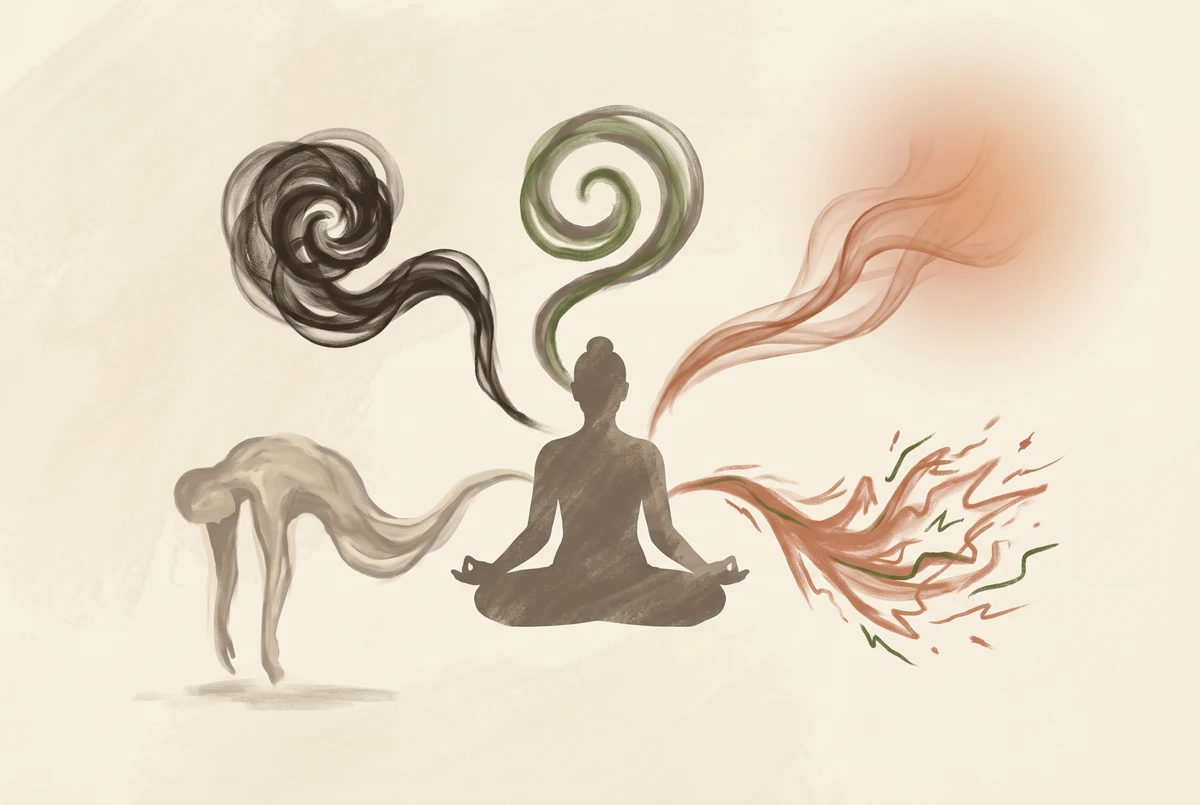
Sensual desire. The mind reaches toward pleasant experiences. During practice, this shows up as fantasizing, planning enjoyable activities, or wishing the meditation felt better.
Ill-will. The mind pushes away unpleasant experiences. Irritation at noise, physical discomfort, frustration with the practice itself.
Restlessness and worry. Too much scattered energy. The body fidgets, the mind races through to-do lists and anxieties.
Sloth and torpor. Too little energy. Drowsiness, mental dullness, the urge to sleep.
Doubt. Questioning the practice, your ability, or whether any of this works. “Am I doing this right?” is doubt in action.
The traditional remedy is the same for all five: recognize the hindrance as a hindrance. Simply noting “this is restlessness” or “this is doubt” often loosens its hold enough to return to the object. Over time, you learn your personal patterns (most people are dominated by one or two) and develop more specific strategies.
Common concentration meditation mistakes
Straining. The most common mistake. “Concentration” in English implies gritting your teeth and trying harder, but samadhi is about composing the mind, not clenching it. If you notice tension in your forehead, jaw, or shoulders, you’re over-efforting. Try imagining your attention resting on the object rather than gripping it.
Treating every distraction as failure. The wandering IS the practice. If your mind wanders a hundred times in ten minutes, you’ve done a hundred reps. The people on Reddit asking “I try to focus on my breath and my mind wanders after five seconds, is this normal?” need to hear: yes, completely normal, and that’s the practice working exactly as designed.
Expecting instant calm. Concentration meditation often feels harder before it feels easier. You become aware of how scattered your mind actually is. This was always the case; you just weren’t noticing. That awareness is progress, not regression.
Sticking with an object that doesn’t work. If breath meditation consistently frustrates you after several weeks of genuine practice, switch to a candle flame, a mantra, or body sensations. The technique matters less than finding an anchor you can actually stay with.
Practicing inconsistently. Short daily sessions build concentration faster than occasional long ones. Ten to fifteen minutes every day is more effective than an hour once a week. Concentration strengthens specifically with regular, repeated practice.
How to start concentration meditation
- Choose your object. Breath at the nostrils is the simplest starting point. If you’ve tried breath and struggled, try a candle flame at eye level in a dim room.
- Set a timer for 10 minutes.
- Sit comfortably with your spine upright. Eyes closed for breath, softly open for trataka or kasina.
- Place your attention on the object. Don’t try to control it. Just notice it as it is.
- When the mind wanders (it will), notice where it went, then gently return to the object. No judgment, no frustration, just return.
- That’s it. The entire practice is steps 4 and 5, repeated.
After a few weeks, consider extending to 15 or 20 minutes. The concentration quality deepens significantly between minutes 10 and 20, because it takes the mind time to settle past the initial restlessness.
Sources
- Ganesan S, Beyer E, Moffat B, Van Dam NT, Lorenzetti V, Zalesky A. (2022). “Focused attention meditation in healthy adults: A systematic review and meta-analysis of cross-sectional functional MRI studies.” Neuroscience & Biobehavioral Reviews, 141:104846. DOI: 10.1016/j.neubiorev.2022.104846.
- Tomita Y, Yokoo M, Shimoda K, Iizuka T, Sakamoto E, Irisawa K, Tozato F, Tsuchiya K. (2026). “Focused Attention Meditation as a Pre-Exercise Strategy for Reducing Anxiety in Speed Skaters.” Sensors, 26(2):475. DOI: 10.3390/s26020475.
- Ishikawa H, Muta T, Abe T, Imajo N, Koshikawa F. (2025). “The individual and sequential effect of focused attention and open monitoring meditation on mindfulness skills.” PLOS ONE. PMCID: PMC12057964.
- Kajimura S, Masuda N, Lau JKL, Murayama K. (2020). “Focused attention meditation changes the boundary and configuration of functional networks in the brain.” Scientific Reports, 10:18426. DOI: 10.1038/s41598-020-75396-9.
- Lutz A, Slagter HA, Dunne JD, Davidson RJ. (2008). “Attention regulation and monitoring in meditation.” Trends in Cognitive Sciences, 12(4):163-9. DOI: 10.1016/j.tics.2008.01.005.
- Pagnoni G. (2012). “Dynamical properties of BOLD activity from the ventral posteromedial cortex associated with meditation and attentional skills.” Journal of Neuroscience, 32(16):5521-30. DOI: 10.1523/JNEUROSCI.4135-11.2012.
- Hagerty MR, Isaacs J, Brasington L, Shupe L, Fetz EE, Cramer SC. (2013). “Case study of ecstatic meditation: fMRI and EEG evidence of self-stimulating a reward system.” Neural Plasticity, 2013:653572. DOI: 10.1155/2013/653572.
- Yang WFZ, Sparby T, Wright M, Kim E, Sacchet MD. (2024). “Volitional mental absorption in meditation: Toward a scientific understanding of advanced concentrative absorption meditation and the case of jhana.” Heliyon, 10(10):e31223. DOI: 10.1016/j.heliyon.2024.e31223.
- Sparby T, Sacchet MD, et al. (2024). “Toward a Unified Account of Advanced Concentrative Absorption Meditation: A Systematic Definition and Classification of Jhāna.” Mindfulness, 15:1375-1394. DOI: 10.1007/s12671-024-02367-w.
- Bhante Gunaratana. Mindfulness in Plain English. Wisdom Publications.
- Patanjali. Yoga Sutras. (BonGiovanni translation, Sacred Texts Archive.)
- Spirit Rock Meditation Center. (2024). “The Four Absorptions.” Practice Guides.
- Thanissaro Bhikkhu. “One Tool Among Many.” Access to Insight.