What Is Gazing Meditation? Science, Types, and How to Start
Miha Cacic · April 11, 2026 · 7 min read

Gazing meditation is exactly what it sounds like: you fix your eyes on a single point and let that visual anchor pull your mind into stillness. In the yoga tradition, the practice is called trataka (Sanskrit for “to gaze steadily”). But gazing meditation predates any single tradition. Hindu, Buddhist, Taoist, Sufi, and Christian contemplatives all independently arrived at the same basic insight: when your eyes stop moving, your mind follows.
The question is why.
Why gazing meditation works
Your retina is brain tissue. Not metaphorically. During embryonic development, the retina and optic nerve grow directly out of the developing brain (the embryonic diencephalon) as early as three weeks after conception. The retina is classified as part of the central nervous system. As neuroscientist Steven Silverstein of Rutgers University put it, “the retina is essentially a proxy for what’s happening in the brain.” 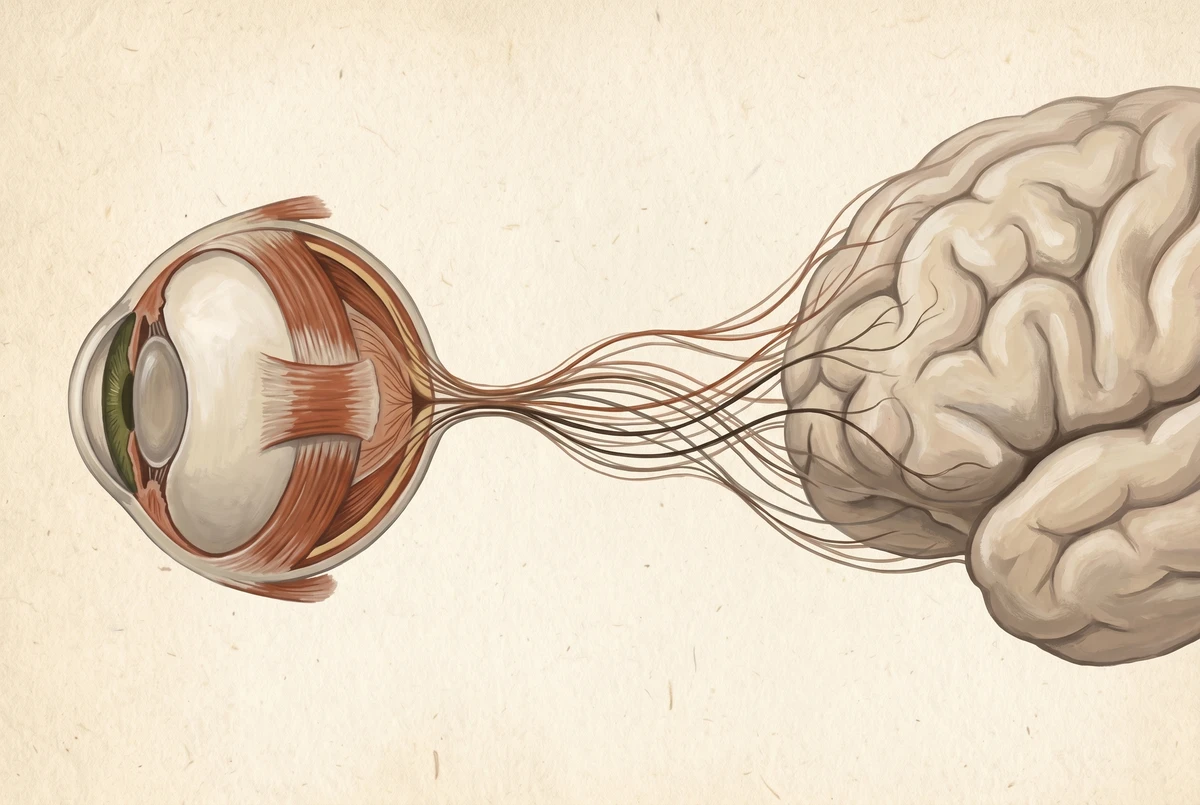
This connection runs deep. Roughly half of the brain’s neural pathways are devoted, directly or indirectly, to processing visual information (Sur et al., 1996). No other sense comes close. Your visual system is the largest pipeline into your brain, and your eyes are its exposed endpoint.
Your eyes are never truly still. Even when you think you’re staring at a fixed point, your eyes make tiny involuntary movements called microsaccades, small jerks that refresh the visual field and prevent it from fading. (This fading is a real phenomenon, first described by Swiss physician Ignaz Paul Vital Troxler in 1804: fix your gaze long enough, and unchanging stimuli in your peripheral vision literally disappear.)
Research suggests these micro-movements track shifts in attention. When your mind wanders, your eyes tend to wander. When your attention scatters, your microsaccades become erratic. The relationship appears to work in reverse, too: studies have found that eye position influences memory retrieval and decision-making, not just the other way around (Johansson, Lund University; Richardson, UCL). Western psychology arrived at a practical application of this bidirectional link through EMDR (Eye Movement Desensitization and Reprocessing), now a WHO-recognized treatment for PTSD built around the principle that controlled eye movements change how the brain processes traumatic memory.
The proposed physiological mechanism behind gazing meditation goes like this: when you deliberately hold a steady gaze, the reticular activating system (your brain’s arousal center, responsible for transitions between relaxed and high-attention states) receives less proprioceptive feedback from the eye muscles. With reduced input, the nervous system’s scanning-for-threats mode quiets down. The small studies that exist support this direction: one found lower blood pressure, slower pulse, and reduced cortisol after a single 30-minute session (Raghavendra, 2014). The fight-or-flight machinery appears to go idle.
The ancient yogic formula, “still eyes, still mind,” isn’t a metaphor. It describes a neurological relationship: because your eyes are brain tissue, and because vision dominates brain activity, stilling the visual system is one of the most direct ways to still the brain itself.
Types of gazing meditation
Gazing meditation is a family of practices, not a single technique.
Candle gazing (trataka) is the most common starting point. A flame is a natural attractor for the eyes. It’s bright enough to leave a strong afterimage (which matters for the later stages of practice), and its gentle flickering provides just enough visual interest to hold attention without overwhelming it. Traditionally practiced in a dark, draft-free room with the candle at eye level, two to three feet away.
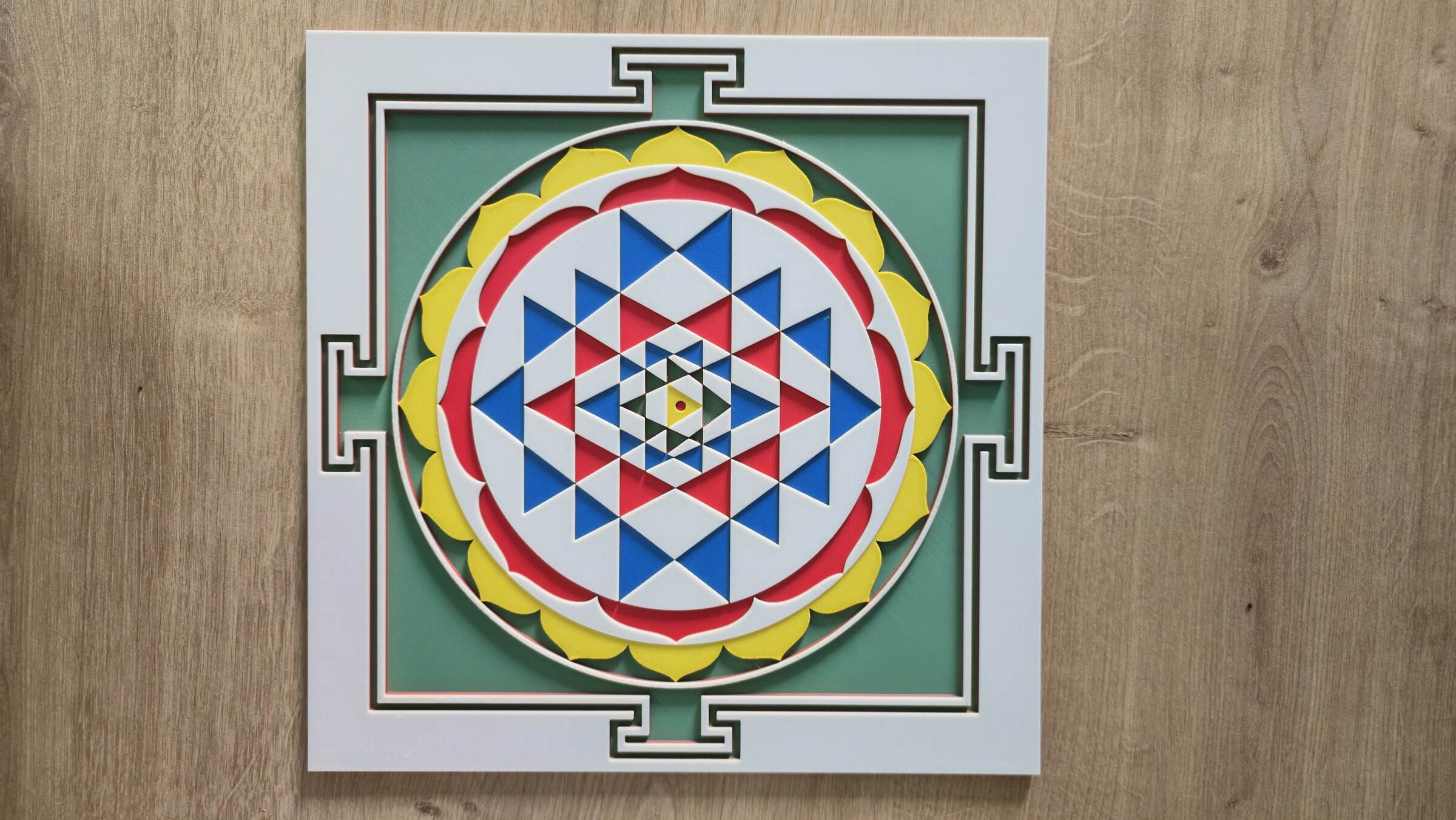
Object gazing uses a fixed target: a black dot on white paper, a crystal, a flower, or a yantra (a sacred geometric diagram). The specific object matters less than the quality of sustained, relaxed attention you bring to it.
Mirror gazing means looking at your own reflection, usually focusing on one pupil or the point between the eyebrows. It has a different experiential quality than other forms: it’s uniquely confrontational. Your own face becomes the meditation object, and the practice tends to surface self-perception, judgment, and emotion more quickly than an impersonal object would.
Sky gazing comes from the Dzogchen tradition of Tibetan Buddhism. You gaze into open blue sky without fixing on any particular point. The emphasis shifts from sharp concentration to resting in expansive, unfocused awareness.
Wall gazing is the Zen approach. In zazen, the eyes rest on a blank wall or the floor at a soft downward angle, without locking onto any point. Bodhidharma, the legendary founder of Chan Buddhism, was known as the “wall-gazing Brahmin” for his reputed nine years of wall-facing meditation at Shaolin (though scholars debate whether this was literal gaze practice or a metaphor for unshakeable mental stillness).
Partner eye gazing involves sustained eye contact with another person. Used in tantric and Buddhist relational practices, the experience is fundamentally different: relational rather than introspective, often surprisingly intense.
Internal gazing (antaranga trataka) is the advanced form. After gazing at an external object, you close your eyes and hold the afterimage on your mental screen. When you can sustain a clear internal image without an external prompt, you’ve crossed from gazing meditation into pure mental concentration. This progression from external to internal is the traditional trataka path. 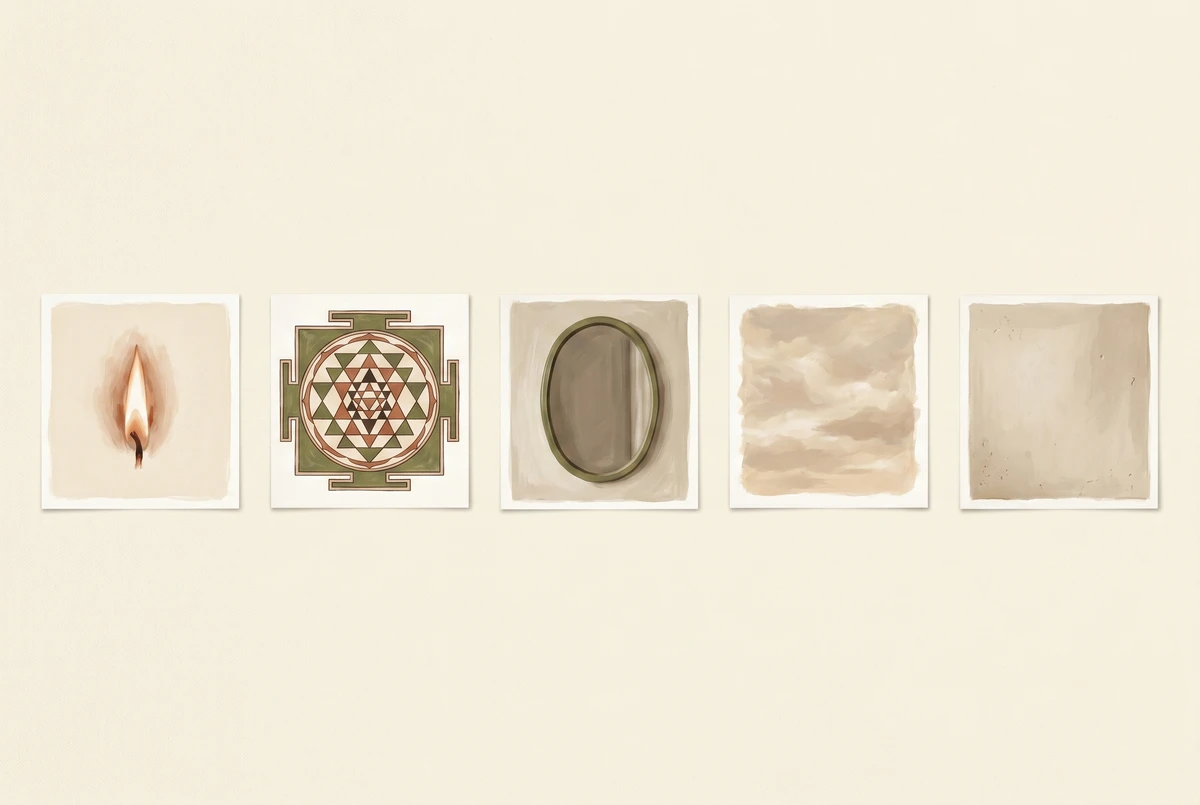
Gazing meditation in different traditions
Gazing meditation appears independently across cultures, suggesting it taps something structural about how human attention works rather than something any one culture invented.
In yoga, trataka is one of the six shatkarmas (purification practices) outlined in the Hatha Yoga Pradipika (c. 15th century). The text defines it plainly: “Being calm, one should gaze steadily at a small mark, till eyes are filled with tears. This is called Trataka by the teachers” (2:31). The next verse adds: “Trataka destroys the eye diseases and removes sloth. It should be kept secret very carefully, like a box of gold” (2:32). Trataka sits in the yoga system as a bridge: it follows physical purification practices and prepares the mind for dharana (concentration) and dhyana (meditation).
In Theravada Buddhism, kasina meditation involves gazing at one of ten prescribed objects (earth, water, fire, air, colors, space, light, consciousness) to build a mental image so vivid it can be held with eyes closed. The practice is described in detail in Buddhaghosa’s Visuddhimagga (5th century CE), where the ten kasinas form one category among the 40 classical meditation objects.
Zen took a different approach. Rather than concentrating on a bright object to build a mental image, Zen practitioners sit facing a blank wall with eyes half-open and gaze soft. The effect is similar (stabilized gaze, stabilized attention) but the intention differs: open presence rather than focused concentration.
Dzogchen (Tibetan Buddhism) uses sky gazing to disorient the conceptual mind. With nothing to fix on, the grasping quality of attention relaxes. The instruction is to rest in the vast blue without looking at anything.
In Taoism, flower gazing and moon gazing qigong emphasize receptivity over concentration. In Sufi traditions, later sources associate Rumi and Shams of Tabriz with prolonged gazing sessions, though primary evidence is sparse. Christian contemplative monasticism, particularly in the Orthodox tradition, uses icon gazing as a focal practice during extended retreats.
Benefits of gazing meditation
The research base is still small, but what exists is encouraging, especially for concentration and stress reduction.
Concentration and focus are the most reliably reported benefits and the best-studied. A randomized controlled trial by Talwadkar, Jagannathan, and Raghuram (2014) tested 60 subjects aged 60 to 80, half assigned to daily 30-minute trataka for one month. The trataka group showed significant improvements in working memory (Digit Span Test, P<0.01), sustained attention (Six Letter Cancellation Test, P<0.01), and executive function (Trail Making Test-B, P<0.01) compared to the control group. Training sustained visual attention, it seems, transfers to sustained mental attention.
Anxiety and stress reduction have support from multiple small studies. Raghavendra (2014) reported lower blood pressure, reduced cortisol, slower pulse rate, and increased heart rate variability after a single 30-minute session. Rajpoot and Vaishnav found that one month of trataka significantly reduced anxiety scores in a sample of 30 young adults. These are small studies, but the physiological direction is consistent: gazing meditation appears to shift the nervous system toward parasympathetic dominance.
Sleep improvement is commonly reported by practitioners, which aligns with the parasympathetic shift these studies describe. At least one study (PMID: 33036930) has investigated trataka for insomnia, though the evidence base remains thin.
Emotional processing is the less comfortable benefit. Longer sessions, especially mirror gazing, tend to surface suppressed emotions and memories. The Hatha Yoga tradition frames this as purification. The mechanism may involve the same eye-brain pathways targeted in EMDR, though this connection remains speculative.
Visualization ability improves through the afterimage stage. Holding and sharpening a mental image after the external object is removed is direct training for mental visualization, a capacity that supports virtually every other meditation technique.
The honest assessment: concentration and stress reduction have the strongest evidence. The other benefits are well-reported by practitioners and physiologically plausible, but not yet supported by rigorous large-scale studies.
How to practice gazing meditation
Candle gazing is the simplest entry point. 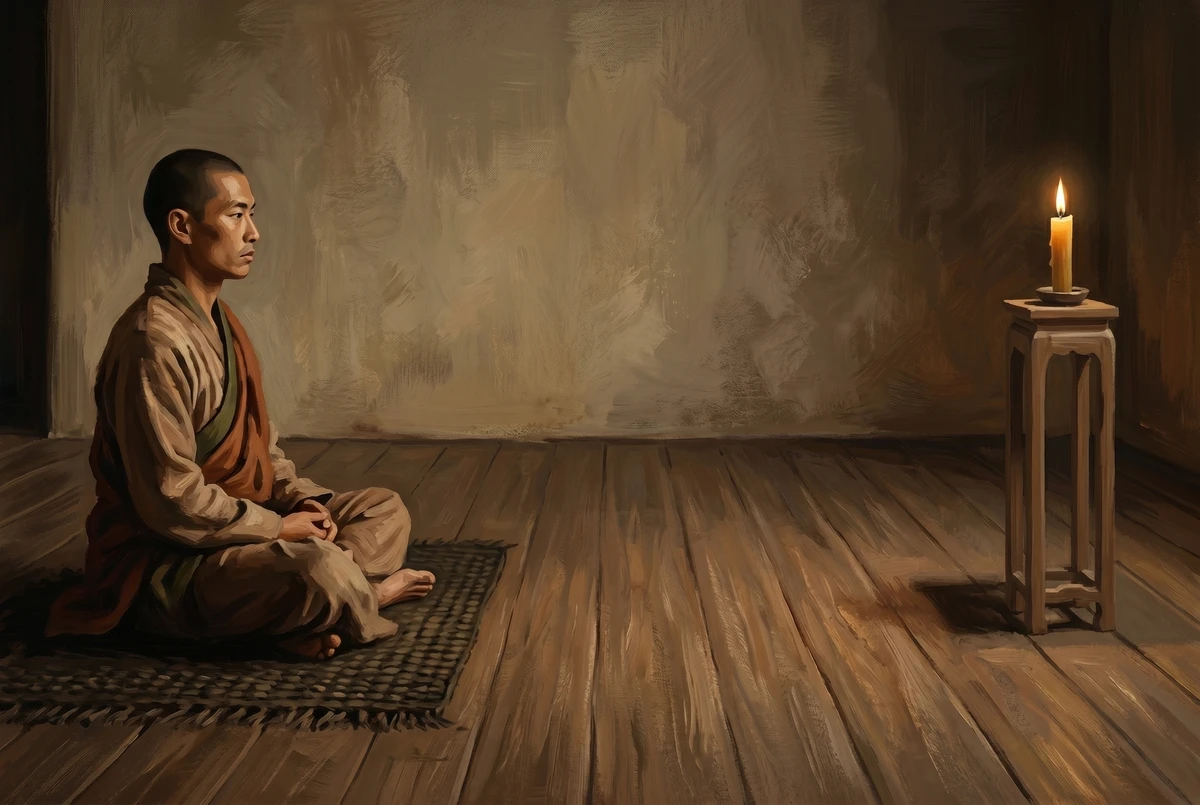
Setup. A dark or dimly lit room, free of drafts so the flame stays steady. Place a candle at eye level, roughly two to three feet in front of you. Sit comfortably with your spine upright and shoulders relaxed.
The gaze. Open your eyes and fix your gaze on the brightest part of the flame, or on its steady blue base. Let your gaze be purposeful but soft. This is not a staring contest. Relax your face, your jaw, the muscles around your eyes.
Blinking. Try to minimize blinking, but don’t strain against it. If you need to blink, blink gently and return your gaze. Over weeks of practice, the intervals between blinks lengthen naturally. Forcing it causes tension, which defeats the purpose.
Duration. Start with two to three minutes of continuous gazing. When tears come or your eyes feel tired, close them.
The afterimage. With your eyes closed, you’ll see an afterimage of the flame, usually a colored shape on a dark background. Hold it in the center of your awareness. Don’t try to construct it or chase it. Just watch. When it fades, open your eyes for another round.
Rounds. Two to three rounds is enough for beginners. Gradually work up to 10 to 15 minutes total. Don’t push past 10 minutes of external gazing per session without experienced guidance.
Finishing. After your final round, rub your palms together and cup them over your closed eyes (palming). Wash your eyes with cool water. 
No candle? Alternatives work fine: a small black dot drawn on white paper taped to the wall, a small object at eye level, a yantra image on a dimmed screen, or a point on a plain wall. The object matters far less than the quality of attention.
The progression path. Traditional trataka follows a clear arc: external gazing (with an object) leads to afterimage work (eyes closed, holding the image), which leads to internal gazing (visualizing without any external prompt), which eventually leads to space gazing (gazing at emptiness itself). Each stage builds the concentration capacity the next stage requires.
What to expect when you start
Most of what happens during gazing meditation is normal, even when it doesn’t feel that way.
Your eyes will water. This is the body’s natural response to reduced blinking, and the traditional texts treat it as a sign the practice is working. The Hatha Yoga Pradipika defines trataka as gazing “till eyes are filled with tears.”
You’ll want to blink constantly. In your first sessions, you may manage only 10 to 20 seconds before blinking. That’s fine. The reflex softens over days and weeks.
You’ll get bored. This might be the most useful thing to understand: boredom during gazing meditation is not a sign that you’re doing it wrong. It is the practice working. Your mind expects constant stimulation. When you remove that stimulation and give it a single, unmoving point of focus, it rebels. The restlessness you feel as boredom is the mental noise becoming visible. Sitting with it is the meditation.
Visual phenomena may occur. Colors shifting around the flame. The flame appearing to grow or shrink. Peripheral vision dimming or vanishing. A sense that the boundary between you and the object is softening. These are normal perceptual effects of sustained focus (Troxler’s fading and related phenomena), not mystical events, though various traditions have interpreted them that way.
Emotions may surface. Especially in longer sessions or during mirror gazing. If this happens, treat it as information, not as a problem.
The afterimage will be hard to hold. At first, it fades within seconds, and your mind will try to reconstruct it rather than observe what’s there. With practice, the afterimage becomes vivid and stable, and you’ll be able to hold it for minutes.
Progress isn’t linear. Some days, you’ll hold a steady, relaxed gaze for five minutes without effort. Other days, 30 seconds will feel impossible. This variation is normal and not a measure of how well the practice is working.
Is gazing meditation safe?
For most healthy adults, short sessions of 5 to 15 minutes are safe. But there are situations that call for caution.
Eye conditions. If you have cataracts, glaucoma, significant myopia, astigmatism, or have had recent eye surgery, avoid candle gazing and consult an ophthalmologist before starting any gazing practice.
Epilepsy. A flickering candle can trigger seizures in people with photosensitive epilepsy. Use a static object (a dot, a yantra, a point on the wall) instead.
Duration. Don’t practice external gazing for more than 10 minutes per session without experienced guidance, especially with candle flames. Some practitioners report that daily candle gazing beyond two months without breaks can create a persistent retinal impression. Rotating between different objects or taking periodic breaks is a common precaution.
Emotional intensity. Mirror gazing and darkness gazing can surface suppressed psychological material quickly. If you have unprocessed trauma, approach these forms cautiously and consider having a therapist or experienced teacher available.
Do not sun-gaze. Despite claims circulating online, staring at the sun damages your retina. There is no safe way to do it and no meditation benefit that justifies the risk.
Sources
- Talwadkar S, Jagannathan A, Raghuram N. (2014). “Effect of trataka on cognitive functions in the elderly.” International Journal of Yoga, 7(2), 96–103. PMCID: PMC4097909.
- Rajpoot PL, Vaishnav P. “Effect of Trataka on Anxiety among Adolescents.” World Academy of Science, Engineering and Technology. DOI: 10.5281/zenodo.1099920.
- Raghavendra. (2014). “Trataka and Heart Rate Variability.” Heart India, 2(1), 15–18.
- Sur M, Sheth BR, Sharma J, Rao SC. (1996). “Brain Processing of Visual Information.” Science. Reported in MIT News, December 19, 1996.
- Woo M. (2019). “Eyes hint at hidden mental-health conditions.” Nature, April 10, 2019. doi: 10.1038/d41586-019-01114-9.
- Costandi M. (2015). “How your eyes betray your thoughts.” The Guardian (Neurophilosophy), June 2, 2015.
- World Health Organization. “Post-traumatic stress disorder.” WHO Fact Sheet.
- Swami Swatmarama. Hatha Yoga Pradipika (c. 15th century CE). Translation: Pancham Sinh, 1914.
- Buddhaghosa. Visuddhimagga (Path of Purification) (c. 5th century CE).