Candle Gazing Meditation: How to Practice Trataka
Miha Cacic · April 11, 2026 · 8 min read
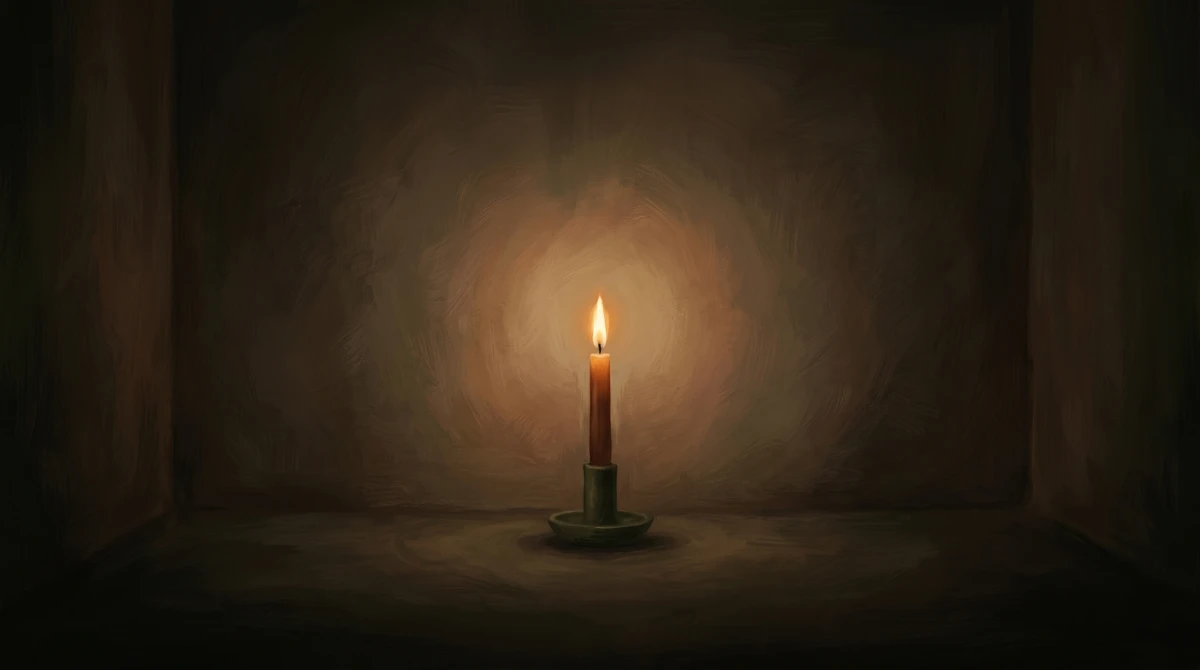
Candle gazing meditation is a concentration technique where you stare at a flame, then close your eyes and focus on the afterimage. In yoga, it’s called trataka, and it’s one of the six shatkarmas (purification practices) described in the Hatha Yoga Pradipika, a 15th-century text. Most guides tell you to light a candle, stare at it, and relax. What they skip is the part that actually makes it work: when your eyes are truly still, your mind follows. The flame isn’t decorative. It’s a tool for forcing visual stillness, and that stillness is what turns staring into meditation.
What is candle gazing meditation?
Trataka comes from the Sanskrit root meaning “to look” or “to gaze.” The Hatha Yoga Pradipika defines it simply: “Being calm, one should gaze steadily at a small mark, till eyes are filled with tears” (Chapter 2, verses 31-32). The Gheranda Samhita, written about two centuries later, echoes the same instruction: “Gaze steadily without winking at any small object, until tears begin to flow.”
What makes trataka different from casually watching a candle burn is its two-phase structure. The first phase, bahiranga trataka (external gazing), trains your ability to hold attention on a single point. The second phase, antaranga trataka (internal gazing), is where you close your eyes and focus on the afterimage the flame leaves behind. Most articles treat this afterimage as a pleasant side effect. It’s actually the whole point. External gazing builds concentration. Internal gazing applies that concentration without any external aid. That’s the transition from concentration to meditation. 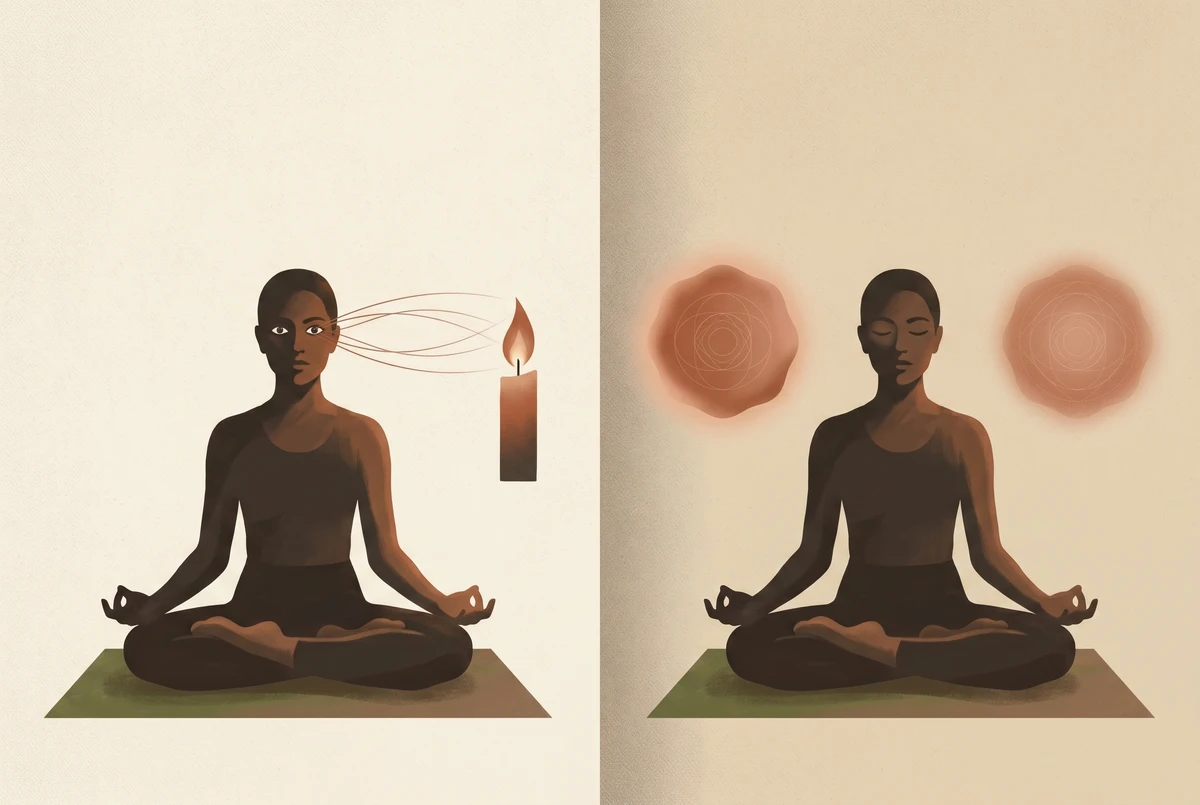
Candles are the most common focal object, but trataka can be practiced with any small, stable point: a black dot on a white wall, the tip of a flame, or even a star. In Theravada Buddhism, the same principle appears as Kasina meditation, where fire is one of ten recommended objects for concentrated gazing. That this technique developed independently across traditions suggests something reliable is happening when you fix your gaze.
Why it works: the eye-mind connection
Your eyes never stop moving. Even when you think you’re staring at a fixed point, your eyes make tiny involuntary jumps called microsaccades, several times per second. These movements serve a purpose: they prevent the visual image from fading (a phenomenon called Troxler’s fading), and they keep the brain in a constant state of low-level scanning and updating. Neurophysiology research shows that microsaccades strongly modulate neuron activity in the visual cortex, meaning each tiny eye movement sends a fresh wave of processing through the brain.
When you fix your gaze on a single point and hold it there, you interrupt this scanning loop. The visual cortex receives less novel input. The brain’s processing demand drops. This is the proposed mechanism behind the calming effect practitioners consistently describe, and it aligns with what the cognitive studies (discussed below) actually measure: improved attention and reduced mental noise after trataka sessions.
This isn’t mystical. The connection between eye movement and mental state has a well-established parallel in Western medicine: EMDR (Eye Movement Desensitization and Reprocessing), developed by Francine Shapiro in 1987 and recognized by the WHO as an effective treatment for PTSD. EMDR uses deliberate eye movements to alter emotional processing. Trataka takes the opposite approach: deliberate eye stillness to reduce mental activity. The mechanisms aren’t identical, but both demonstrate that what the eyes do shapes how the brain operates.
A candle flame is particularly well-suited to this because it has natural visual magnetism (we’re drawn to watch fire), it’s bright enough against a dark background to leave a clear afterimage, and its gentle movement holds attention without requiring the eyes to track across space. The eyes stay fixed; the mind stays put.
The retina is, embryologically, a direct outgrowth of the brain, formed from the same tissue as the forebrain during fetal development. Estimates suggest that roughly 80% of the brain’s sensory processing is dedicated to vision. When you still the most demanding input channel, the downstream effect is disproportionate.
How to practice candle gazing meditation
Setup
Choose a room that’s dim but not pitch black. Complete darkness makes the flame too intense on the eyes; a small amount of ambient light reduces strain. The room should be draft-free, because an unstable flame forces the eyes to track its movement, which defeats the entire purpose.
Place the candle at eye level when you’re seated. Use a stack of books, a shelf, or a small table. If you have to tilt your head up or down to see the flame, neck tension will build within minutes and become a distraction. Sit at arm’s length to about 1.5 meters away. 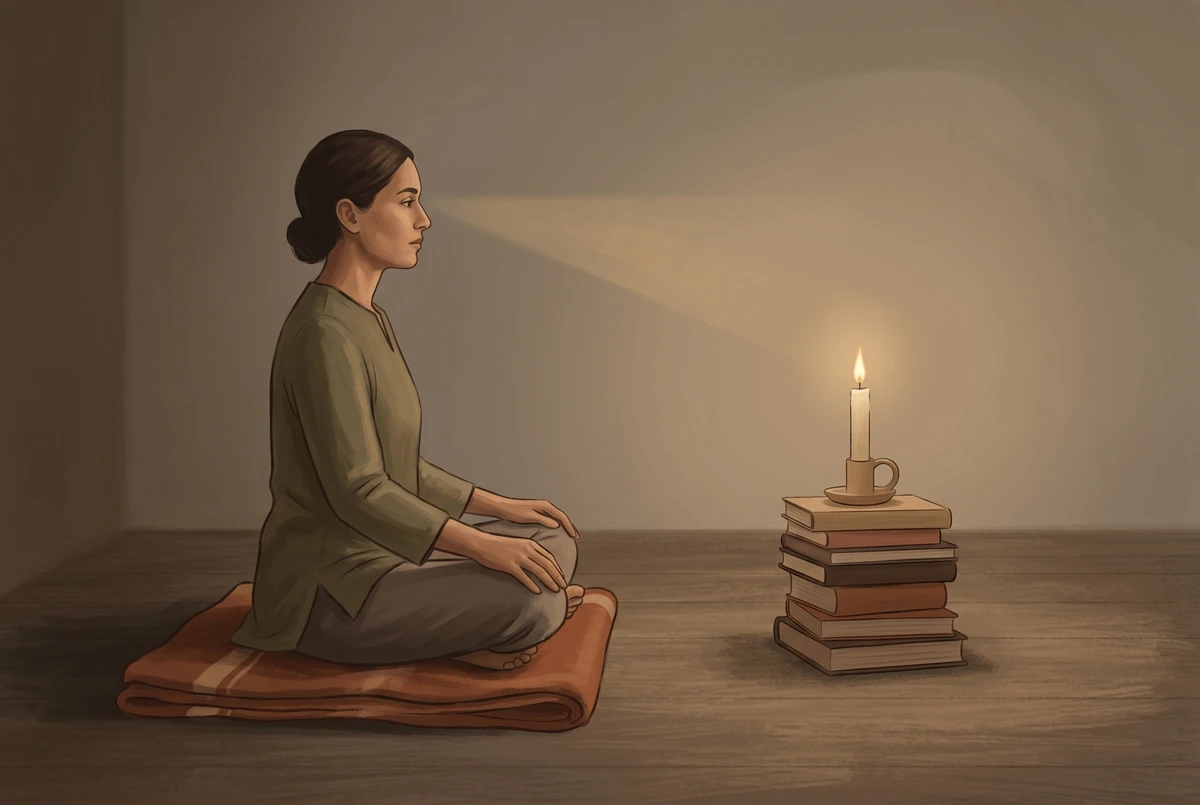
Your seat matters. Choose whatever lets you sit upright and comfortable for 10 or more minutes: a meditation cushion, a chair, the floor with a folded blanket. If your posture collapses, your gaze angle changes, and you spend the session fidgeting instead of focusing.
If you wear glasses, remove them as long as you can still see the flame clearly. The flame doesn’t need to be in sharp focus; a slightly soft image works fine and reduces the temptation to strain.
Phase 1: External gazing (bahiranga trataka)
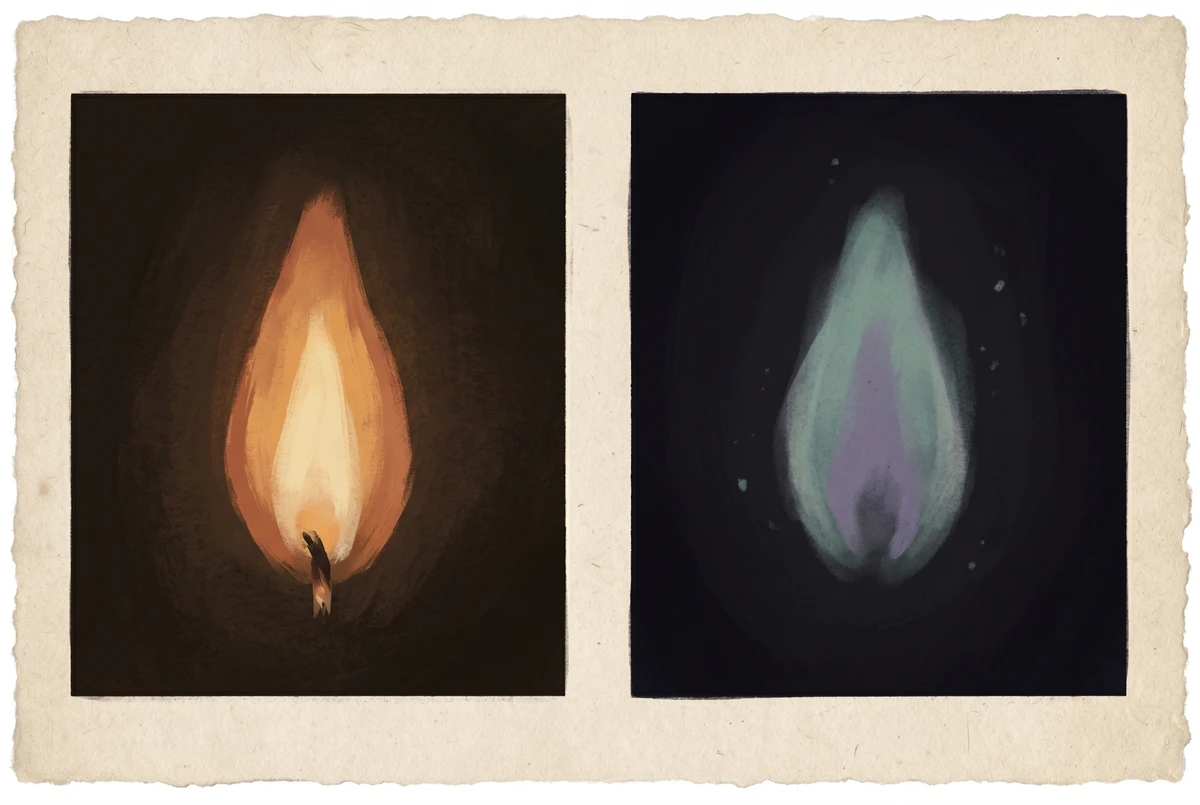
Gaze at the flame, specifically at the bright, steady point just above the wick tip. The blue-white center of the flame is the most stable region and easiest to hold your attention on.
Keep your eyes relaxed but steady. The goal is not to force your eyes open until they burn. Think of it as receiving light rather than staring at a target. Your eyelids can be slightly lowered, and you can blink when you need to, especially in the first few weeks. Trying to suppress blinking entirely leads to strain and quitting.
If your eyes water, let them. In the Hatha Yoga tradition, tears are not a side effect; they’re the explicit goal of the kriya (purification). Both the Hatha Yoga Pradipika and the Gheranda Samhita define trataka as gazing “until tears are shed.”
Start with 1 to 3 minutes of sustained gazing. With regular practice, this extends naturally to 5 minutes. What you should notice: thoughts slow down, peripheral vision may soften or narrow, and a sense of absorption develops, as though the flame fills more of your awareness than its physical size warrants.
Phase 2: Internal gazing (antaranga trataka)
Close your eyes. You’ll see the afterimage of the flame, usually in complementary colors: a blue-green or purple spot where the orange-yellow flame was. This is your new focus object.
Hold your inner gaze at the point between your eyebrows. The afterimage will drift, change color, shrink, and eventually fade. Your only job is to watch it without chasing it. Don’t move your closed eyes to follow it; hold your gaze steady at the center point and let the image come to you.
When the afterimage disappears completely, you have two options: open your eyes for another round of external gazing, or sit in the remaining stillness. This second option is where most practitioners report the deepest meditative states, because the external flame has already trained your concentration, and now you’re applying it to nothing but your own inner experience.
Finishing
Cup your palms gently over your closed eyes without pressing on them. This is called palming, and it lets the eyes rest in complete darkness for a minute or two. Open your eyes slowly when you’re ready. Splashing cool water on your eyes afterward is a traditional practice, and it does feel good after sustained focus. Avoid looking at screens for a few minutes.
What to expect as a beginner
The most common question practitioners ask is “am I doing this right?” Since there’s no visible output to check against, here’s a realistic progression based on what practitioners commonly report:
First sessions: You can’t hold the gaze for more than 10 to 20 seconds without blinking. The afterimage is faint or absent. Thoughts still race. All of this is normal. The gaze builds incrementally, like any other form of training.
After 1 to 2 weeks of daily practice: The gaze holds for 1 to 2 minutes. The afterimage becomes visible but moves around unpredictably. You notice a calming effect during and shortly after sessions.
After 1 to 2 months: Sustained gazing feels natural. The afterimage is vivid and holds its position longer. Entry into a meditative state is noticeably faster than with eyes-closed meditation alone.
Things that are normal and not cause for concern: eyes watering, seeing a halo of color around the flame, the afterimage appearing as a different color than the flame, and feeling unusually drowsy or unusually alert after a session.
How long to practice
Five to ten minutes total is the practical sweet spot for a daily session. Beginners should start with 3 to 5 minutes total.
A realistic session looks like this: 2 minutes of settling in and breathing normally, 3 to 5 minutes of external gazing, 2 to 3 minutes of internal afterimage focus, and 2 minutes of palming and rest. That’s roughly 10 minutes from sitting down to standing up.
The traditional guideline, echoed by experienced teachers like Giovanni Dienstmann and multiple yoga lineages, is to never exceed 10 minutes of continuous external gazing without guidance from an experienced teacher. The 2021 Frontiers in Psychology study that found significant improvements in working memory used 2-to-3-minute rounds of external gazing, totaling under 10 minutes per session.
Frequency matters more than duration. Daily 5-minute sessions produce better results than weekly 30-minute sessions, because concentration is a skill that builds through repetition, not endurance.
Choosing a candle for trataka
Flame stability is what matters most. A flickering flame forces the eyes to track, which is exactly what you’re trying to stop doing. This means: no drafts, a trimmed wick (about a quarter inch), and a candle that burns cleanly.
The traditional choice is a ghee lamp (diya). Its flame is remarkably steady, produces minimal soot, and has been used for trataka for centuries. If you can find one, it’s the ideal option. 
For modern convenience, an unscented beeswax or soy candle is the best alternative. Both burn cleanly with a stable flame and produce less soot than paraffin.
Avoid scented candles. The fragrance compounds release particulates that irritate eyes already working hard to maintain a steady, unblinking gaze. If you want aroma in the room, place a separate diffuser behind you, outside your line of sight.
Candle color doesn’t affect the practice. White and natural beeswax are most common. The chakra-color associations some websites promote are decorative, not functional.
Do not use LED or electric candles. The afterimage in phase 2 requires actual light emission from a point source. An LED does not produce the same retinal impression, and without a usable afterimage, you lose half the technique.
Common problems and how to fix them
Eyes sting or burn within seconds. You’re straining. Soften the gaze: lower your eyelids slightly and think of receiving light rather than boring into the flame.
Can’t stop blinking. Normal for beginners. Blink when you need to, then return your gaze immediately. With practice, the urge decreases on its own. Trying to fight it creates tension that makes everything worse.
No afterimage when you close your eyes. The room may be too bright (the afterimage needs contrast to be visible) or you didn’t sustain the gaze long enough. Try a darker room and hold the gaze for 30 more seconds before closing.
The afterimage drifts around. It will. Don’t chase it by moving your closed eyes. Hold your internal gaze at the point between your eyebrows and let the image come back to center on its own.
Headache or pressure between your eyebrows. You’re furrowing your brow without realizing it. Consciously relax your forehead, unclench your jaw, and drop your shoulders.
Feeling dizzy or spaced out. Reduce your session length. Also check whether you’re holding your breath, which people commonly do without noticing during concentration.
Tears streaming down your face. In the Hatha Yoga tradition, this is the intended effect: tears are the purification the practice is named for. It also means you’ve held the gaze long enough. Close your eyes and move to the internal phase. Don’t rub your eyes; dab gently.
Mind still races despite steady gaze. Notice something: even with racing thoughts, you’re returning your attention to the flame more quickly than you would in eyes-closed meditation. That faster return IS the practice working. The gaze stills the mind progressively, not like flipping a switch.
Is candle gazing meditation safe?
For most people, yes. A candle flame produces roughly 12 to 13 lumens of light, based on the original definition of the candela unit. A phone screen at full brightness emits several hundred lumens. If you can scroll through social media for an hour without eye damage, a few minutes of gazing at a candle flame is not going to hurt you.
No documented cases of retinal damage from candle trataka within standard practice durations (under 10 minutes of external gazing per session) appear in the medical literature. The practice has been done for centuries without producing a pattern of eye injuries. Common sense still applies: keep sessions within the traditional guideline of 10 minutes maximum for external gazing. Some traditional teachers recommend taking a two-week break from daily practice every couple of months as a precaution, though this is based on practitioner tradition rather than clinical evidence.
Who should skip this practice or consult a doctor first: people with glaucoma, detached retina, or recent eye surgery. People with severe myopia should consult their ophthalmologist. People prone to seizures, because flickering light is a known trigger. People with psychotic conditions, because sustained concentration practices can surface suppressed psychological material.
Eye watering is not damage. It’s a reflex response to prolonged gazing, and both the Hatha Yoga Pradipika and the Gheranda Samhita describe it as the intended outcome.
The most realistic negative outcome from candle gazing is mild eye strain or a tension headache from overdoing it or holding too rigid a gaze. Both resolve by ending the session and resting your eyes.
Benefits of candle gazing meditation
The strongest evidence for trataka is in cognitive performance. The studies are small, but they converge: multiple research groups using different cognitive tests consistently find improvements after trataka sessions.
Raghavendra and Singh (2016) tested 30 male volunteers using the Stroop Color-Word Test before and after trataka sessions. Performance improved significantly in selective attention, cognitive flexibility, and response inhibition compared to a control session.
Swathi, Raghavendra, and Saoji (2021) measured visuospatial working memory in 41 volunteers (mostly female, all with prior yoga experience) using the Corsi-Block Tapping Task. After trataka sessions, forward Corsi span improved with a medium effect size (Cohen’s d = 0.642, p < 0.001), and trataka significantly outperformed eye exercises alone. The researchers concluded that “trataka session improves working memory, spatial memory, and spatial attention.”
Talwadkar et al. (2014) ran a 26-day randomized controlled trial with 60 elderly participants and found significant improvements in digit span (memory), sustained attention, and processing speed. The fact that these results held in an older population and used an RCT design makes this one of the more rigorous studies available.
A 2021 narrative review of 37 studies on yogic purification practices (including trataka) summarized the evidence as showing “positive effects on various physiological and clinical domains,” while noting that the research base remains limited in size.
Beyond cognition, a preliminary study by Shathirapathiy et al. (2022) found that 29 people with insomnia who practiced trataka for 45 minutes daily over 10 days showed significant reductions in insomnia severity and improved sleep quality. The study had no control group and used longer sessions than typical home practice, so these results are promising but not conclusive.
Sherlee and David (2020) conducted a randomized controlled trial on trataka’s effects on anxiety and cognitive performance in adolescents, finding positive results on both measures. This is one of the few RCTs in the trataka literature.
There’s also a physiological mechanism worth noting. A study by Raghavendra and Ramamurthy (2014), cited in the narrative review, found that trataka increases parasympathetic nervous system activity in 30 participants: heart rate decreased, breathing rate decreased, and heart rate variability shifted toward the high-frequency range associated with vagal tone. This autonomic relaxation response likely explains both the calming effect practitioners describe and the sleep improvements found in preliminary research.
One claim that doesn’t hold up: the Hatha Yoga Pradipika states that trataka “destroys the eye diseases.” Two modern studies tested this directly. Tiwari et al. (2018) found no significant improvement in refractive errors or visual acuity after 8 weeks of trataka. Bansal (2014) found the same: no objective change in myopia. The ancient text overpromised on this one.
The practical advantage specific to candle gazing, compared to eyes-closed meditation, is that it gives people who struggle to focus with closed eyes a concrete, visible anchor. Many people find it significantly easier to maintain attention on a flame than on their breath. If you’ve tried meditation and felt like you were just sitting there thinking with your eyes closed, trataka offers a different entry point.
Sources
- Svātmārāma. (~15th century CE). Hatha Yoga Pradipika, Chapter 2, verses 31–32.
- Sage Gheranda. (~17th century CE). Gheranda Samhita, Chapter 1 (Shodana section).
- Raghavendra BR, Singh P. (2016). “Immediate effect of yogic visual concentration on cognitive performance.” Journal of Traditional and Complementary Medicine, 6(1):34–36. DOI: 10.1016/j.jtcme.2014.11.030. PMID: 26870685.
- Swathi PS, Raghavendra Bhat RB, Saoji AA. (2021). “Effect of Trataka (Yogic Visual Concentration) on the Performance in the Corsi-Block Tapping Task: A Repeated Measures Study.” Frontiers in Psychology, 12. DOI: 10.3389/fpsyg.2021.773049. PMID: 34975664.
- Swathi PS, Gowshik A, Saoji AA, Bhat RB. (2021). “Health and therapeutic benefits of Shatkarma: A narrative review of scientific studies.” International Journal of Yoga, 14(2):106–116. PMC8039332.
- Shathirapathiy G, Mooventhan A, et al. (2022). “Effect of trataka (yogic gazing) on insomnia severity and quality of sleep in people with insomnia.” Explore (NY), 18(1):100–103. DOI: 10.1016/j.explore.2020.09.009. PMID: 33036930.
- Sherlee JI, David A. (2020). “Effectiveness of yogic visual concentration (Trataka) on cognitive performance and anxiety among adolescents.” Journal of Complementary and Integrative Medicine, 17(3). DOI: 10.1515/jcim-2019-0055. PMID: 32415824.
- Talwadkar S, et al. (2014). 26-day RCT on trataka and cognitive performance in elderly participants (n=60). Cited in Swathi et al. 2021 narrative review.
- Raghavendra BR, Ramamurthy V. (2014). Autonomic effects of trataka: vagal tone, heart rate variability (n=30). Cited in Swathi et al. 2021 narrative review.
- Tiwari KK, Shaik R, Aparna B, Brundavanam R. (2018). “A Comparative Study on the Effects of Vintage Nonpharmacological Techniques in Reducing Myopia.” International Journal of Yoga, 11(1):72–76. PMC5769202. PMID: 29343934.
- Bansal C. (2014). “Comparative study on the effect of Saptamrita Lauha and Yoga therapy in myopia.” Ayu, 35(1):22–27. PMC4213962. PMID: 25364195.