Morning Meditation Routine for Beginners
Miha Cacic · April 11, 2026 · 6 min read

A morning meditation routine is a short, repeatable sequence you do in the first 20 minutes after waking: sit up, fix your attention on one thing, and hold that focus for 5 to 10 minutes before starting your day. The hard part isn’t the technique. It’s doing it when you’re groggy, your phone is glowing, and your brain hasn’t fully come online yet.
Most guides skip past this problem. They give you a generic meditation instruction and tell you to do it in the morning. This guide does the opposite: it starts with what makes morning different, then gives you a technique and a routine designed for that context.
Why morning meditation is harder than meditating at other times
Morning meditation is genuinely more difficult than meditating in the afternoon or evening, and the reasons are physiological, not motivational.
Your body is running a stress response. In the first 30 to 45 minutes after waking, cortisol surges 38 to 75 percent above baseline, averaging around 50 percent. This is the cortisol awakening response, or CAR, and it occurs in roughly 77 percent of healthy people (Wüst et al., 2000). The CAR is your body’s ignition sequence: it primes you for alertness. But it also means your nervous system is already running hot, which can make sitting still feel agitating rather than calming. 
Your brain is in a fog. For the first 15 to 30 minutes after waking, you’re experiencing sleep inertia: impaired cognitive performance, sluggish motor control, and reduced executive function (Tassi & Muzet, 2000). Complex mental tasks are hit hardest. This matters because meditation, particularly internally-directed practices like following the breath, requires exactly the kind of sustained, subtle attention that sleep inertia temporarily suppresses.
Your phone is in your hand. Most people use their phone as an alarm clock. The moment the alarm fires, you’re holding a device designed to capture attention. One glance at a notification and your focus is gone before you’ve decided where to put it. This is a design problem, not a discipline problem. The fix is environmental: charge your phone across the room, or use a standalone alarm.
Despite all this, morning works. The day hasn’t filled your head with problems yet, and fewer demands compete for your attention. That cortisol surge, while it makes stillness feel harder, also means your brain is primed for alertness once you give it something to focus on. The solution isn’t to avoid morning meditation. It’s to choose a technique that works with your morning physiology rather than against it.
The technique most guides recommend (and why it backfires in the morning)
Almost every beginner meditation guide gives the same instruction: close your eyes, focus on your breath, and when your mind wanders, gently return.
This works well in the afternoon or evening, when you’re fully awake. Closing your eyes removes visual distractions. The breath provides a subtle, always-available anchor. The internally-directed attention feels natural when your executive function is at full capacity.
At 6:30 in the morning, this same instruction creates two failure modes.
You fall asleep. Closing your eyes while sleep inertia is still clearing sends your brain a “go back to sleep” signal. You sit for ten minutes in a semi-conscious fog, neither meditating nor sleeping. The breath, which is supposed to be your anchor, is too subtle for a foggy brain to track. You open your eyes and wonder whether anything just happened.
You fight the drowsiness. Instead of drifting off, you spend the entire session tensing against sleepiness, clenching your way through each minute. The session becomes a struggle, and you associate morning meditation with misery.
Both paths lead to the same place: quitting. Not because meditation doesn’t work, but because the technique was wrong for the context.
A morning meditation technique that works with your sleepy brain
Instead of closing your eyes, try keeping them open.
Open-eye gazing meditation, known in the yoga tradition as trataka, works like this: you sit comfortably and fix a soft gaze on a single point. A candle flame is traditional. A small dot on the wall works too, or a geometric image placed at eye level about two to three feet away. You hold your gaze steady, blinking naturally, without straining. When your attention drifts, your eyes drift too, giving you instant physical feedback that it’s time to return.
Why this works in the morning. Keeping your eyes open sends visual input to the ascending reticular activating system (ARAS), a brain network involved in regulating wakefulness and sleep-wake transitions (Moruzzi & Magoun, 1949). Where closed-eye meditation can invite drowsiness, an open-eye practice keeps these arousal pathways engaged. The visual anchor is concrete and compelling: your brain doesn’t have to generate an internal focus point from scratch, which is exactly the kind of executive-function task that sleep inertia makes difficult. And the gaze-drift feedback loop means you notice immediately when your attention has wandered, without needing the metacognitive awareness that a foggy morning mind hasn’t yet built up. 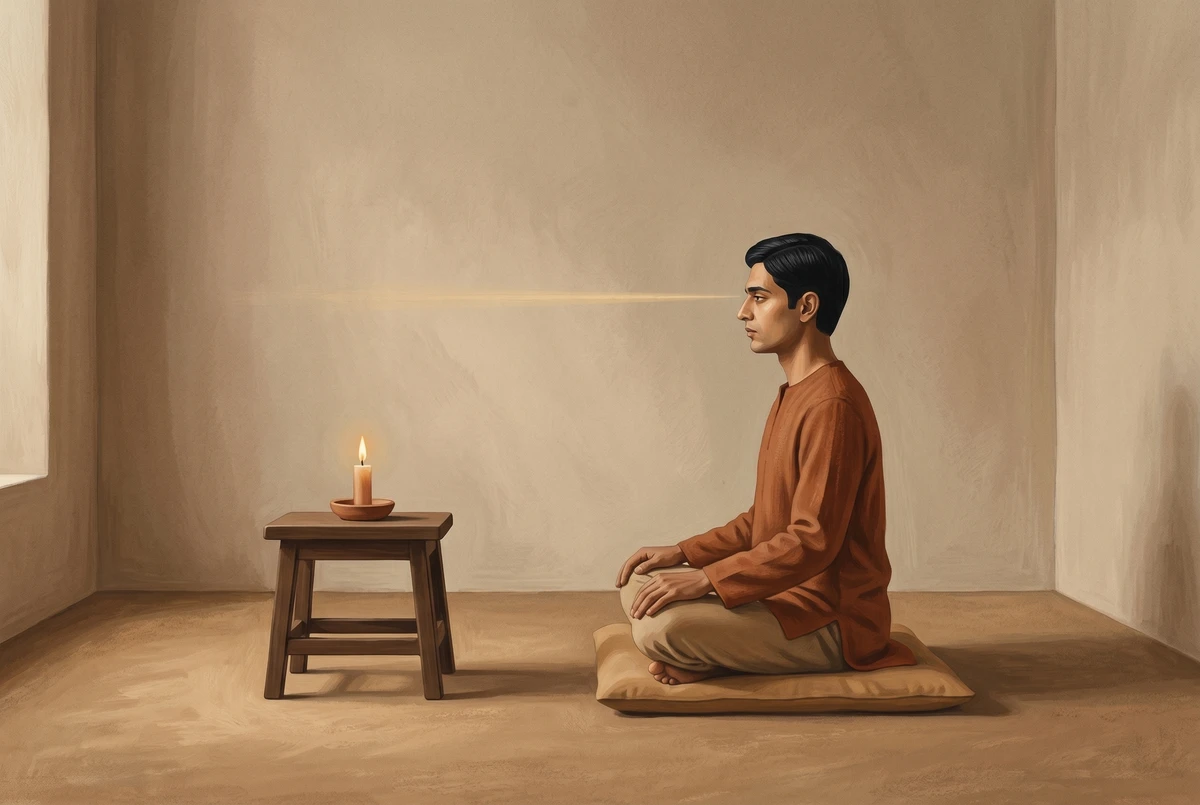
The clinical evidence is small but encouraging. A randomized crossover trial by Raghavendra and Singh (2016) found that trataka produced statistically significant improvements in selective attention on the Stroop test compared to a sham visual task (N=30, p < 0.001). A randomized controlled trial by Swathi et al. (2021) found significant improvements in spatial memory and prospective memory after trataka practice (N=41).
This isn’t a fringe technique. Trataka is one of the six purification practices (shatkarmas) described in the Hatha Yoga Pradipika, a 15th-century yoga text. Verse 2:31 defines it as “gazing steadily, without blinking, at a small object, until tears come to the eyes.” Verse 2:32 says it “removes sloth and lethargy.” The practice has been used for centuries as a concentration tool. It’s less common in modern Western meditation culture largely because the dominant apps and programs draw from Buddhist and secular mindfulness traditions, which favor breath-based practices.
Trataka doesn’t replace breath meditation. Many practitioners start with open-eye gazing to wake up the mind, then transition to breath or body scan work as alertness stabilizes. Others stick with trataka exclusively. Both approaches are valid. The point is that you have options, and the option that works best at 6:30 in the morning is probably not the same one that works best at 9:00 at night.
The 10-minute morning meditation routine (step by step)
This is a concrete daily sequence you can start tomorrow. No app required. No special equipment beyond a candle or a printed image if you choose to use trataka. 
Minute 0: Wake up, sit up, don’t touch your phone. If your phone is your alarm, turn it off and place it face-down or across the room. Sit on the edge of your bed or in a chair. Keep your eyes open.
Minutes 1 to 2: Arrive in your body. Take three slow, deep breaths through the nose. This isn’t a breathing exercise. It’s a gear shift. Then scan briefly: notice your feet on the floor, your weight on the seat, any tension in your shoulders or face. Spend about two minutes here.
Minutes 3 to 8: Focus on your anchor. Choose one:
- Trataka: Fix a soft gaze on a candle flame, a dot on the wall, or a printed image at eye level, about two to three feet away. Blink naturally. When your eyes wander or unfocus, gently bring them back.
- Breath counting: Close your eyes and count each exhale from 1 to 10. When you lose count (you will), start back at 1. The restart is not failure; it’s the practice.
- Body scan: Close your eyes and move your attention slowly from the top of your head to your toes, noticing whatever sensations are present without trying to change them.
If you’re drowsy and finding it hard to stay awake, trataka is likely your best option.
Minutes 9 to 10: Set a single intention. Close your eyes (or soften your gaze). Bring one word or short phrase to mind for how you want to move through the day: “patient,” “focused,” “present,” “kind.” Hold it for about 30 seconds. Then open your eyes. Done.
How to make it stick (a week-by-week plan)
Generic advice like “be consistent” doesn’t help when you’re staring at a candle at 6:30 in the morning wondering why you set an alarm for this. Here’s a specific four-week progression that addresses the predictable dropout points.
Week 1 (days 1 to 7): Just show up. Do 5 minutes, not 10. The only goal is to sit every morning. Don’t evaluate whether it was a “good” session. Success means you sat. Use habit stacking: place your meditation object (candle, image, cushion) next to your bed the night before so it’s the first thing you see. Attach the practice to something you already do, like sitting up after your alarm, rather than treating it as a separate decision.
Week 2 (days 8 to 14): Extend to 10 minutes. This is the week most people quit. The novelty has faded, and you haven’t felt dramatic results. That’s expected. The habit is forming even when you can’t perceive it. The fact that you sat yesterday makes sitting today slightly easier. That’s the habit loop building.
Week 3 (days 15 to 21): Notice what’s changing. Start paying attention to the rest of your morning after meditation. Practitioners commonly report small shifts at this stage: slightly less reactivity when opening their inbox, reaching for their phone a bit later than usual, more presence during breakfast. These shifts are subtle, which is why you need to look for them.
Week 4 (days 22 to 28): Make the routine yours. By now you know what fits and what doesn’t. Adjust the timing (before or after coffee), the technique (maybe you started with breath and want to try trataka, or vice versa), and the duration. This is when the routine stops being a script you follow and starts being something you own.
When you miss a day: Nothing happens. Sit the next morning. Research by Lally et al. (2010) found that missing a single day did not materially affect habit formation. Their study also found that habits take an average of 66 days to become automatic, with a range of 18 to 254 days. Two missed days in a row is worth troubleshooting (is your alarm too early? is the routine too long?). But one missed day is not evidence that you “can’t do this.” It’s a normal interruption in any new behavior.
Common questions beginners ask
Should I meditate before or after coffee?
Both work. If coffee helps you think clearly, meditate after your first cup. If you want to practice on an unaltered mind, meditate first. Many yoga traditions recommend practicing before consuming anything, but consistency matters more than purity. Do what you’ll actually do every day.
Can I meditate lying down?
You can, but you’ll likely fall asleep, especially in the morning. Sitting upright isn’t a spiritual rule. It’s a practical one: your brain associates lying down with sleep. If a chair feels too formal, sit on the edge of your bed.
Do I need an app?
Not to meditate. A meditation app can help as a timer and for guided sessions when you’re first learning. But the goal is learning to practice without one. If you use an app, keep your phone in airplane mode so notifications don’t pull you out.
What if I’m not a morning person?
“Morning meditation” means “shortly after you wake up,” whether that’s 5:30 a.m. or 10:30 a.m. The benefit is about catching the mind before the day’s noise fills it, not about a specific hour on the clock.
How long until I notice benefits?
Practitioners often report subtle shifts (less reactivity, slightly sharper focus, a calmer first hour) within the first few weeks of daily practice. On the structural side, Hölzel et al. (2011) found measurable increases in gray matter density in regions associated with learning, memory, and emotional regulation after an 8-week mindfulness program (N=16). A JAMA Internal Medicine meta-analysis by Goyal et al. (2014), reviewing multiple randomized controlled trials, found moderate evidence that meditation improves anxiety, depression, and pain. Individual timelines vary widely.
Sources
- Fries, E., Dettenborn, L., & Kirschbaum, C. (2009). “The cortisol awakening response (CAR): Facts and future directions.” International Journal of Psychophysiology, 72(1), 67–73. doi:10.1016/j.ijpsycho.2008.03.014
- Goyal, M., Singh, S., Sibinga, E. M., et al. (2014). “Meditation programs for psychological stress and well-being: A systematic review and meta-analysis.” JAMA Internal Medicine, 174(3), 357–368. PMID: 24395196.
- Hölzel, B. K., Carmody, J., Vangel, M., et al. (2011). “Mindfulness practice leads to increases in regional brain gray matter density.” Psychiatry Research: Neuroimaging, 191(1), 36–43. PMC3004979.
- Lally, P., van Jaarsveld, C. H. M., Potts, H. W. W., & Wardle, J. (2010). “How are habits formed: Modelling habit formation in the real world.” European Journal of Social Psychology, 40(6), 998–1009. doi:10.1002/ejsp.674
- Moruzzi, G., & Magoun, H. W. (1949). “Brain stem reticular formation and activation of the EEG.” Electroencephalography and Clinical Neurophysiology, 1(4), 455–473. doi:10.1016/0013-4694(49)90219-9
- Raghavendra, B. R., & Singh, P. (2016). “Immediate effect of yogic visual concentration on cognitive performance.” Journal of Traditional and Complementary Medicine, 6(1), 34–36. PMC4738033.
- Swathi, P. S., Saoji, A. A., & Kamarajan, N. V. (2021). “Trataka (yogic visual concentration) improves spatial memory and prospective memory in healthy adults.” Journal of Ayurveda and Integrative Medicine, 12(1), 52–56. PMC8718544.
- Swatmarama. (~15th century CE). Hatha Yoga Pradipika, 2:31–32.
- Tassi, P., & Muzet, A. (2000). “Sleep inertia.” Sleep Medicine Reviews, 4(4), 341–353. doi:10.1053/smrv.2000.0098
- Wüst, S., Wolf, J., Hellhammer, D. H., et al. (2000). “The cortisol awakening response — normal values and confounds.” Noise and Health, 2(7), 79–88.