The Sri Yantra in Hinduism and Tantra
Miha Cacic · April 9, 2026 · 8 min read
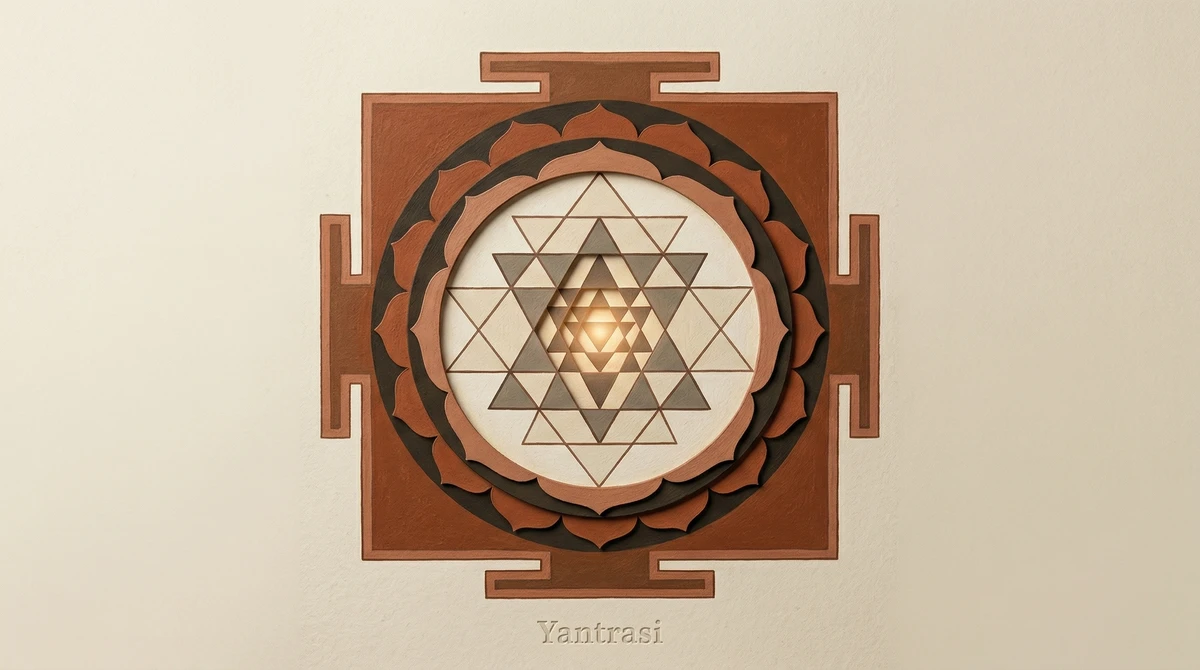
The Sri Yantra is not a symbol. In Hindu tantra, it is the geometric body of the goddess Tripura Sundari (also called Lalita), and the central ritual instrument of Shri Vidya, widely regarded as the most sophisticated worship tradition in Hinduism. Called the “king of yantras,” it holds that title not because it’s the most complex or the most ancient, but because it does something no other yantra does: it maps the entire cosmos onto a single diagram, and then maps that diagram onto the practitioner’s own body.
What is the Sri Yantra?
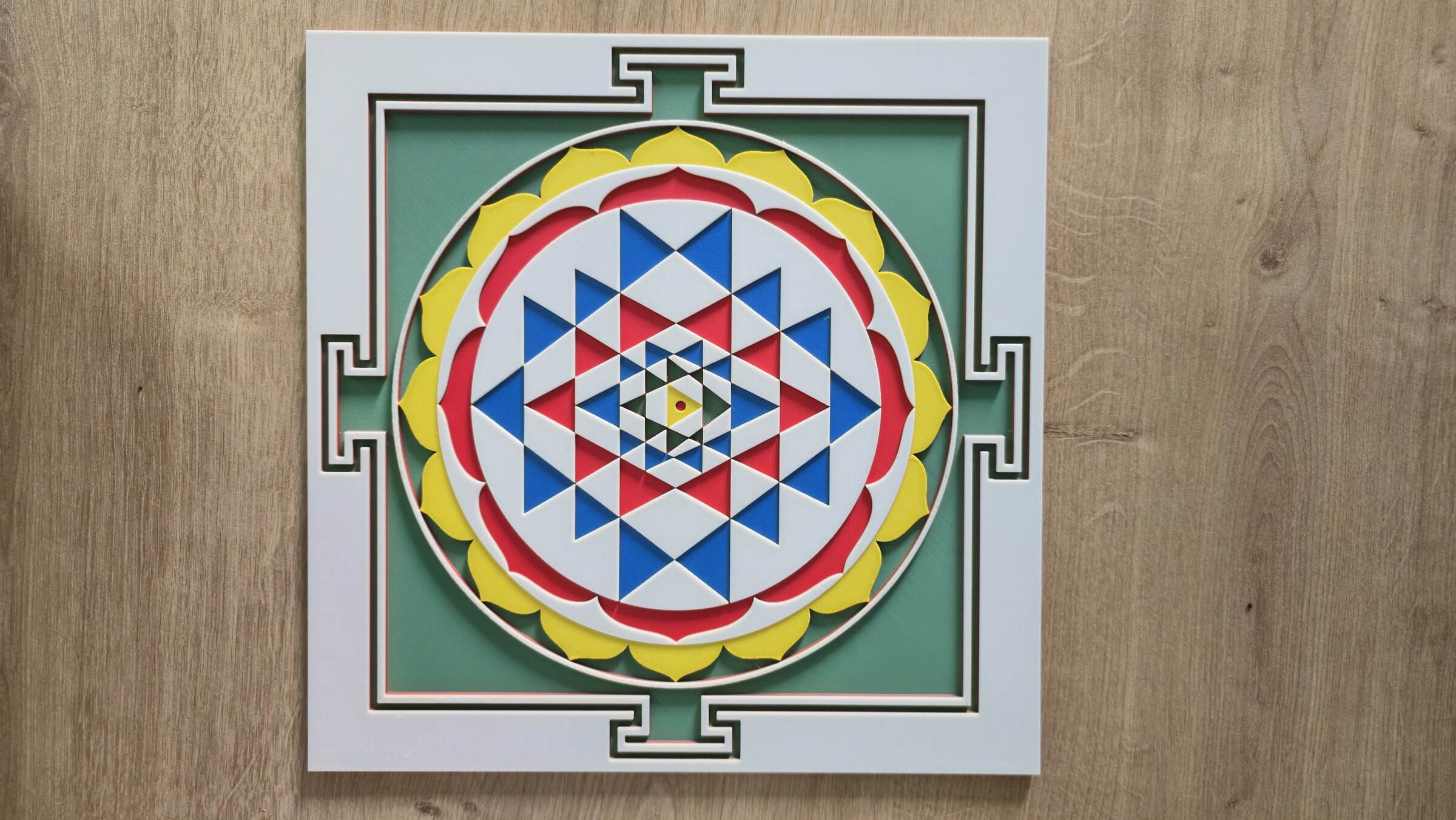
Nine interlocking triangles radiate from a central point called the bindu. Four triangles point upward (representing Shiva, consciousness), five point downward (representing Shakti, creative energy). Their intersections create 43 smaller triangles, each housing specific deities of the Shri Vidya tradition.
The full structure reads from outside to center: a bhupura (square boundary with four gates), two rings of lotus petals (16 and 8), then progressively smaller circuits of triangles, converging on the bindu at the center. Think of it as a map with the material world at the edges and pure consciousness at the center.
The same diagram also exists in three-dimensional form, called the Maha Meru. This is the version installed in temples and used for formal worship. When Ramana Maharshi oversaw the installation of a Sri Yantra at Ramanasramam’s Mathrubhuteswara Temple in 1949, he personally inscribed bija (seed syllable) mantras on the gold plate beneath a granite Meru, adding 43 sacred syllables to the 43 corners of the yantra.
The Sri Yantra’s place in Hindu tantra
The Western pop-culture version of tantra has almost nothing to do with the real thing. In Hinduism, tantra is a system of practice built on three integrated components: mantra (sacred sound), yantra (sacred diagram), and ritual technique. The traditional formula puts it plainly: “Mantra is the deity’s soul, yantra is the deity’s body, tantra is the method.” These are not three separate things. They are three aspects of one practice, and none works without the others.
The Lalita Sahasranama (the 1,000 names of the goddess, contained within the Brahmanda Purana) makes this explicit: Lalita Tripura Sundari is both the Sri Chakra (the yantra) and the Panchadashi (the 15-syllable mantra). Not metaphorically. In Shri Vidya theology, the sound, the form, and the goddess are the same reality expressed three ways.
Why did this particular yantra become supreme? Tradition holds that Shiva created 64 yantras with their corresponding mantras. The Sri Yantra stands above the rest because it is the only yantra that contains a complete cosmology within its structure. Its nine circuits house 182 deities. Its geometry encodes the entire creation-dissolution cycle. And it maps directly onto the human body, turning the practitioner into a living yantra.
The philosophical foundation comes from Shaktism and Kashmir Shaivism. The 9th-century Spandakarika framed Shakti as cosmic pulsation, the active creative energy of Shiva. Abhinavagupta’s Tantraloka later provided the theological framework for understanding yantras as instruments of pratyabhijna, divine self-recognition. Within this tradition, the Sri Yantra became the supreme instrument of that recognition.
The nine avaranas: a map of consciousness
The Sri Yantra’s nine enclosures (nava chakra) map the stages of spiritual progress. Each avarana is a stage, moving from the material world at the outer boundary toward pure consciousness at the center.
1. Trailokya Mohana Chakra (Enchanter of Three Worlds). The bhupura, or outermost square with its four gates. This represents material existence, the physical body, and the pull of the ordinary world. The starting point.
2. Sarva Aasha Paripuraka (Fulfiller of All Desires). The 16-petal lotus. Each petal corresponds to one of the 16 faculties: five sense organs, five action organs, five elements, and mind. This is the layer of perception and desire.
3. Sarva Sankshobhana (Agitator of All). The 8-petal lotus. Eight psychic channels. Here, habitual patterns begin to loosen.
4. Sarva Saubhagyadayaka (Bestower of All Fortune). Fourteen triangles, corresponding to 14 nadis (energy channels) in the subtle body. The Bhavanopanishad connects these to the breath distribution system: 21,600 daily breaths distributed among the body’s energy centers.
5. Sarvartha Sadhaka (Accomplisher of All Purposes). Ten outer triangles, corresponding to the 10 pranas (vital forces): prana, apana, vyana, udana, samana, and the five subsidiary pranas (naga, kurma, krikara, devadatta, dhananjaya).
6. Sarva Rakshakara (Protector of All). Ten inner triangles, corresponding to the 10 vital fires (agnis) that govern digestion and transformation in the body.
7. Sarva Rogahara (Destroyer of All Disease). Eight triangles. The eight Vag-Devis (speech goddesses) reside here. According to the Lalita Sahasranama, these are the deities who composed the 1,000 names of the goddess.
8. Sarva Siddhiprada (Granter of All Achievements). The primary triangle. Three stages: avyaktha (the unmanifest), mahad (cosmic intelligence), and ahankara (individuation). This is where the individual self recognizes its identity with the cosmic.
9. Sarva Anandamaya (Abode of All Bliss). The bindu. Pure consciousness. The union of Shiva and Shakti. Not a destination in a geographical sense, but the recognition that this unity was present all along.
The journey from outer square to central bindu is called samhara-krama (the method of absorption or dissolution). Each layer strips away a level of identification with the material, revealing what the tradition claims was always there underneath.
The internal Sri Yantra: mapping the diagram onto the body
The Bhavanopanishad, a Shakta Upanishad attached to the Atharvaveda (likely composed between the 12th and 15th century CE), teaches a radical idea: the human body is the Sri Chakra. Not “resembles” or “corresponds to.” Is.
The text’s central doctrine establishes identity between the yantra’s structure and the practitioner’s body. As the scholar Sreenivasarao writes: “The main purport of Bhavanopanishad is to establish a relation between structures of the human body and Sri Chakra. The Sri Chakra, in turn, is regarded as a projection of the essential characters of the universe. There is an attempt to harmonize the micro (pindanda) and the macro (brahmanda), with Sri Chakra being the median imbibing in itself the characteristics of both.”
The body mappings are specific and systematic:
- The 16 petals of the second avarana = the 16 faculties (sense organs, action organs, elements, and mind)
- The 14 triangles of the fourth avarana = 14 primary nadis (energy channels)
- The 10 outer triangles of the fifth avarana = 10 pranas (vital forces)
- The 10 inner triangles of the sixth avarana = 10 digestive and vital fires
- The primary triangle of the eighth avarana = three stages of manifestation (the unmanifest, cosmic intelligence, individuation)
- The bindu = pure consciousness (Brahman)
This body-mapping is what separates the Sri Yantra from sacred geometry in the decorative sense. During worship, the practitioner performs nyasa, literally “installing” the yantra’s deities onto their own body. The external diagram becomes a mirror for internal transformation. You don’t just look at the yantra. You become it.
The text’s namesake concept, bhavana (from the root bhu, “to be”), means contemplation so deep it transforms an idea into lived reality. The Bhavanopanishad describes three progressive levels of this practice: external worship with a physical yantra, internal worship using the yantra as a symbolic bridge, and finally internal worship without any external prop at all, performed entirely in the “space of one’s heart” (hrudayakasha madhye).
How the Sri Yantra is used in tantric practice
Practice with the Sri Yantra exists on a spectrum, from accessible to advanced:
Trataka (gazing meditation). The most accessible practice, and the one that requires no initiation. You fix your gaze on the bindu (or on the overall yantra) and hold steady attention. This is open to anyone.
Mantra combined with yantra. Gazing combined with the recitation of the Panchadashi (15-syllable) mantra or other mantras associated with Tripura Sundari. This is where the “inseparability” of mantra and yantra becomes a lived experience rather than a concept. In traditional practice, this step typically requires initiation (diksha) from a qualified guru.
Navavarana Puja. The full systematic worship, moving through each of the nine enclosures with specific mantras, mudras, and offerings. This is the heart of Shri Vidya practice. The Devi Khadgamala Mantra maps the 182 deities across the nine layers. Each deity receives invocation, each mudra unlocks a specific avarana. This requires formal initiation and extensive training.
Internal worship (Samayachara). The most advanced form. The practitioner performs the entire puja mentally, without any external yantra, using visualization and the body-mapping from the Bhavanopanishad. This is the method of the Dakshinamurti Sampradaya, the most internalized of the three main Shri Vidya lineages.
A direct answer to the initiation question, since this is what people actually want to know: basic trataka, contemplation of the geometry, and studying the symbolism do not require initiation. Recitation of the Panchadashi mantra, the Shodashi (16-syllable) mantra, full Navavarana Puja, and nyasa (deity installation on the body) traditionally do. The advanced internal worship practices of the Bhavanopanishad require deep initiation and years of practice.
Traditional sources distinguish between an “activated” and “non-activated” yantra. The ritual of prana-pratishtha (literally “establishment of life-breath”) installs the deity’s presence in the physical yantra. Without this, traditional practitioners consider the yantra to be simply metal or paper. This explains a common frustration in online communities: people buy a Sri Yantra, place it on a shelf, and wonder why nothing happens. Within the traditional framework, the answer is straightforward. An uninitiated yantra without associated practice is a diagram, not a tool.
Historical development: from Vedic roots to living tradition
The scholar Subhash Kak argues that the description in the Shri Sukta (a hymn from the Rigveda) matches the Sri Yantra’s structure, drawing further connections to the Shvetashvatara Upanishad. If he’s right, the conceptual seeds are Vedic, though the first unambiguous geometric descriptions appear much later, in tantric texts.
The Vamakeshvarimata Tantra and its companion text, the Yogini Hridaya, contain the earliest systematic descriptions of the Sri Yantra as a diagram. Ishwarashiva, a 9th-century head of a monastery established by Kashmir king Avantivarma, wrote the first known commentary on the Vamakeshvara Tantra (now lost), providing the earliest documented evidence of Sri Yantra construction methods.
Adi Shankara (8th century CE) brought Sri Vidya into the mainstream of Hindu practice. He composed the Soundarya Lahari, a 103-verse devotional poem whose verses 32 and 33 contain systematic exposition of kundalini and Sri Chakra concepts. According to temple tradition, Shankara consecrated a Sri Chakra Yantram at the Kamakshi Amman Temple in Kanchipuram, transforming the temple’s fierce deity into an all-providing Mother. The Chidambaram Nataraja Temple also has a Sri Yantra attributed to him. (The specific dating and scope of “temples across India” rest on hagiographic tradition rather than independent historical records, but the Kanchipuram installation is well-attested in temple history.)
Bhaskararaya Makhin (c. 1690-1785) was the definitive systematizer. Born in present-day Hyderabad, initiated into tantric worship by his father and later formally initiated by Shivadatta Shukla of Surat, he authored more than 40 books in Sanskrit over a 95-year life. His commentary on the Lalita Sahasranama (the Saubhagya Bhaskara) explained the precise placement of 108 deities within the Sri Yantra and the correspondence between yantra worship and consciousness transformation.
Three main lineages carry the tradition today, each with a distinct approach to practice:
- Dakshinamurti Sampradaya follows Samayachara (internal worship, mental visualization)
- Hayagriva Sampradaya follows Dakshinachara (orthodox external ritual and systematic worship)
- Ananda Bhairava Sampradaya follows Kaulachara (esoteric tantric practices)
Many mantras and procedures are shared among them. A fourth lineage (Dattatreya Sampradaya) is sometimes mentioned as a blend of the three, though it’s not recognized as a primary tradition by the Tantras themselves.
The tradition remains alive. Temples with installed Sri Yantras continue active worship. The Tripura Rahasya, a medieval text taught by Dattatreya to Parashurama, explores the advaitic dimensions of Sri Vidya and bridges the gap between the yantra as external form and the goddess as formless consciousness. Its central teaching (that Tripura refers to the “three cities” of waking, dreaming, and deep sleep) continues to inform contemporary practitioners who approach the Sri Yantra as a tool for self-inquiry rather than devotional ritual.
The Sri Yantra and trataka meditation
Practitioners traditionally consider the Sri Yantra the most powerful object for trataka (yogic gazing meditation).
The yantra’s geometric complexity sustains visual engagement. Unlike a candle flame or a single point, the concentric structure of nine interlocking circuits provides the eye with depth. The symmetry of the form tends to settle the mind, while the asymmetry within the triangles prevents the gaze from going slack. The natural movement of attention is inward, toward the bindu, which serves as a focal anchor that draws concentration progressively deeper.
Practitioners consistently report specific visual phenomena during Sri Yantra trataka. On the IndiaDivine forum, a meditation instructor described how even absolute beginners in their class saw “the Yantra morph into a variety of geometrical figures.” On Dharma Overground, a practitioner noted that “the outer edges appeared wobbly, like shimmering air on a hot day” after a few minutes of gazing. These reports are consistent with known effects of sustained visual fixation: the brain’s visual processing adapts to static stimuli, producing optical effects that traditional practice interprets as signs of deepening concentration (dharana).
Several small studies support cognitive benefits of the practice. A 2021 study in Frontiers in Psychology (Swathi, Bhat & Saoji) found that trataka sessions significantly improved working memory, spatial memory, and spatial attention compared to both eye exercises and baseline in 41 healthy volunteers, after two weeks of training (20 minutes per day, 6 days per week). The researchers proposed activation of the prefrontal cortex during sustained focused attention as a possible mechanism. A 2016 study (Raghavendra & Singh) found a 26% improvement in Stroop test performance following trataka, suggesting better selective attention, cognitive flexibility, and response inhibition. Talwadkar et al. (2014) found that 26 days of trataka practice significantly improved cognitive function in 30 elderly participants compared to a waitlist control.
For practical application: start with 5 to 10 minutes of steady gazing at the bindu. Blink naturally when needed (the “don’t blink” instruction in some traditions is for advanced practitioners). The visual effects (shimmering, movement, color shifts, afterimages) are normal and expected. In the tantric framework, they mark the transition from simple looking to dharana (concentration). If you’re practicing without initiation, trataka on the Sri Yantra is the one practice that’s fully traditional, fully accessible, and (according to the research) measurably beneficial.
Common misconceptions about the Sri Yantra
“The Sri Yantra is sacred geometry.” Partly. It is geometric, and it is sacred. But calling it “sacred geometry” places it in the same category as the Flower of Life or Metatron’s Cube, stripped of its living ritual context. In Shri Vidya, the Sri Yantra is a ritual instrument that requires activation (prana-pratishtha) and specific practices to function. Without these, it’s a diagram. With them, practitioners in the tradition consider it the body of the goddess.
“It attracts wealth.” The Sri Yantra does have an association with Lakshmi and abundance. But the primary purpose in Shri Vidya is spiritual realization, not material gain. The “wealth magnet” angle is a commercialized simplification. Traditional practice aims for something the texts call saubhagya (total auspiciousness), which includes material well-being but isn’t limited to it, and certainly can’t be achieved by placing an uninitiated yantra in your living room.
“Tantra is about sex.” In the context of the Sri Yantra, the union of Shiva and Shakti (represented by the interlocking upward and downward triangles) refers to the integration of consciousness and energy. The four upward triangles are Shiva (pure awareness), the five downward triangles are Shakti (creative power). Their intersection represents the non-dual reality that is both at once. This is a philosophical and experiential teaching about the nature of consciousness, not a reference to physical sexuality.
“You need gold or copper for it to work.” Traditional texts do prefer certain materials (copper, gold, crystal) for Sri Yantras used in formal puja. But as Ramana Maharshi put it when discussing his Sri Chakra installation: “Its worship is a method for concentration of mind… idols, mantras and yantras are all meant to give food to the mind in its introvert state so that it may later become capable of concentration.” The practice matters more than the material. For trataka meditation, a printed image works.
“The Sri Yantra contains the golden ratio.” Multiple modern sources claim that the golden ratio (approximately 1.618) appears in the Sri Yantra’s proportional relationships. However, traditional construction methods described in texts like the Yogini Hridaya use different mathematical frameworks. The golden ratio connection appears to be a modern observation rather than an intended design principle. Interesting if true, but not part of the original teaching.
Sources
- Swathi PS, Bhat R, Saoji AA. (2021). “Effect of Trataka (Yogic Visual Concentration) on the Performance in the Corsi-Block Tapping Task: A Repeated Measures Study.” Frontiers in Psychology, 12:773049. PMID: 34975664.
- Raghavendra BR, Singh P. (2016). “Immediate effect of yogic visual concentration on cognitive performance.” Journal of Traditional and Complementary Medicine, 6(1):34-36. PMCID: PMC4738033.
- Talwadkar S, Jagannathan A, Raghuram N. (2014). “Effect of trataka on cognitive functions in the elderly.” International Journal of Yoga, 7(2):96-103. PMCID: PMC4097909.
- Kak, Subhash. (2008-2009). “The Great Goddess Lalita and the Shri Cakra.” Brahmavidya: The Adyar Library Bulletin, vol. 72-73, pp. 155-172.
- Bhaskararaya Makhin. (c. 18th century). Saubhagya Bhaskara (commentary on Lalita Sahasranama).
- Bhavanopanishad. Shakta Upanishad, attached to Atharvaveda. English rendering by Prof. S.K. Ramachandra Rao, Kalpatharu Research Academy, Bangalore.
- Adi Shankara. (c. 8th century). Soundarya Lahari.
- Lalita Sahasranama. Contained within the Brahmanda Purana, Chapters 41-44.
- Tripura Rahasya. Medieval period (11th-17th century CE).
- Vamakeshvarimata Tantra / Yogini Hridaya. Early tantric text with first systematic Sri Yantra descriptions.